Institute of Cognitive Neuroscience, Faculty of Education, Huaibei Normal University, Huaibei 235000, China.
Department of Psychological Medicine, National University Health System, Kent Ridge 119228, Singapore.
Int J Environ Res Public Health. 2020 Mar 6;17(5):1729. doi: 10.3390/ijerph17051729.
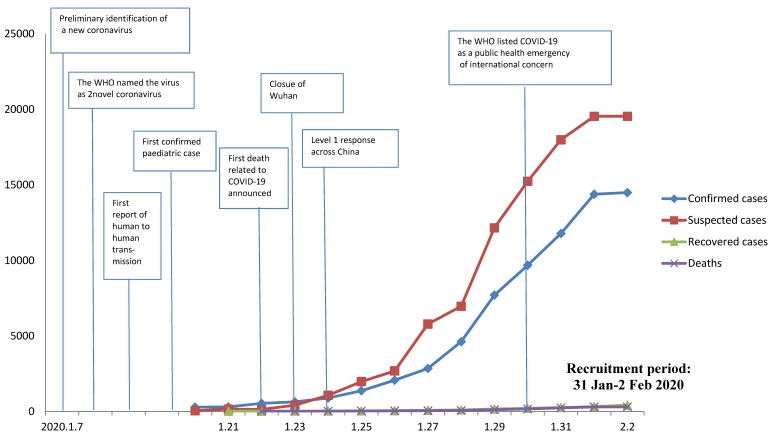
The 2019 coronavirus disease (COVID-19) epidemic is a public health emergency of international concern and poses a challenge to psychological resilience. Research data are needed to develop evidence-driven strategies to reduce adverse psychological impacts and psychiatric symptoms during the epidemic. The aim of this study was to survey the general public in China to better understand their levels of psychological impact, anxiety, depression, and stress during the initial stage of the COVID-19 outbreak. The data will be used for future reference. From 31 January to 2 February 2020, we conducted an online survey using snowball sampling techniques. The online survey collected information on demographic data, physical symptoms in the past 14 days, contact history with COVID-19, knowledge and concerns about COVID-19, precautionary measures against COVID-19, and additional information required with respect to COVID-19. Psychological impact was assessed by the Impact of Event Scale-Revised (IES-R), and mental health status was assessed by the Depression, Anxiety and Stress Scale (DASS-21). This study included 1210 respondents from 194 cities in China. In total, 53.8% of respondents rated the psychological impact of the outbreak as moderate or severe; 16.5% reported moderate to severe depressive symptoms; 28.8% reported moderate to severe anxiety symptoms; and 8.1% reported moderate to severe stress levels. Most respondents spent 20-24 h per day at home (84.7%); were worried about their family members contracting COVID-19 (75.2%); and were satisfied with the amount of health information available (75.1%). Female gender, student status, specific physical symptoms (e.g., myalgia, dizziness, coryza), and poor self-rated health status were significantly associated with a greater psychological impact of the outbreak and higher levels of stress, anxiety, and depression ( < 0.05). Specific up-to-date and accurate health information (e.g., treatment, local outbreak situation) and particular precautionary measures (e.g., hand hygiene, wearing a mask) were associated with a lower psychological impact of the outbreak and lower levels of stress, anxiety, and depression ( < 0.05). During the initial phase of the COVID-19 outbreak in China, more than half of the respondents rated the psychological impact as moderate-to-severe, and about one-third reported moderate-to-severe anxiety. Our findings identify factors associated with a lower level of psychological impact and better mental health status that can be used to formulate psychological interventions to improve the mental health of vulnerable groups during the COVID-19 epidemic.
2019 冠状病毒病(COVID-19)疫情是国际关注的公共卫生突发事件,对心理弹性构成挑战。需要研究数据来制定循证策略,以减少疫情期间的不良心理影响和精神症状。本研究旨在调查中国公众,以更好地了解他们在 COVID-19 爆发初期的心理影响、焦虑、抑郁和压力水平。该数据将供未来参考。
2020 年 1 月 31 日至 2 月 2 日,我们采用滚雪球抽样技术进行了在线调查。在线调查收集了人口统计学数据、过去 14 天的身体症状、与 COVID-19 的接触史、对 COVID-19 的认知和担忧、针对 COVID-19 的预防措施以及与 COVID-19 相关的其他信息。心理影响采用修订后的事件影响量表(IES-R)评估,心理健康状况采用抑郁、焦虑和压力量表(DASS-21)评估。
本研究共纳入中国 194 个城市的 1210 名受访者。总体而言,53.8%的受访者认为疫情对他们产生了中度或重度心理影响;16.5%报告有中度至重度抑郁症状;28.8%报告有中度至重度焦虑症状;8.1%报告有中度至重度压力水平。大多数受访者每天在家花费 20-24 小时(84.7%);担心家人感染 COVID-19(75.2%);对现有的健康信息量感到满意(75.1%)。女性、学生身份、特定身体症状(如肌痛、头晕、流涕)和自评健康状况较差与更大的疫情心理影响以及更高的压力、焦虑和抑郁水平显著相关(<0.05)。特定的最新和准确的健康信息(例如,治疗方法、当地疫情情况)和特定的预防措施(例如,手部卫生、戴口罩)与较小的疫情心理影响和较低的压力、焦虑和抑郁水平相关(<0.05)。
在中国 COVID-19 疫情的初始阶段,超过一半的受访者认为心理影响为中度至重度,约三分之一的受访者报告有中度至重度焦虑。我们的研究结果确定了与较低心理影响水平和更好心理健康状态相关的因素,可用于制定心理干预措施,以改善 COVID-19 疫情期间弱势群体的心理健康。