Rodrigue Simonet Poueme Namegni, Alexandre Michel Njan-Nloga, Abel Wade, Albert Eisenbarth, Martin Hermann Groschup, Franziska Stoek
National Veterinary Laboratory Cameroon (LANAVET), Garoua BP 503, Cameroon.
Department of Biological Sciences, The University of Ngaoundere, Ngaoundere BP 454, Cameroon.
Insects. 2020 Nov 19;11(11):814. doi: 10.3390/insects11110814.
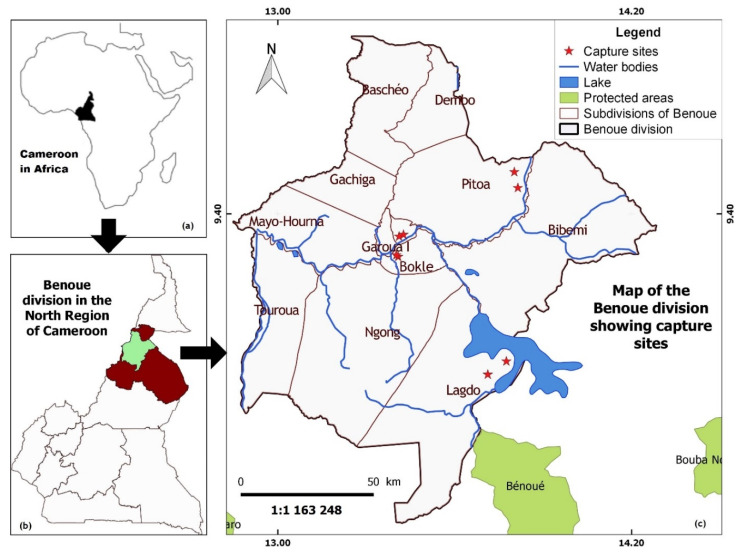
Rift Valley fever (RVF) is a major viral zoonosis transmitted by mosquitoes. The virus is endemic in most parts of sub-Saharan Africa and can affect humans, livestock, and wild ungulates. Knowledge of the biology of vectors of Rift Valley fever virus (RVFV) is essential for the establishment of effective control measures of the disease. The objective of this study was to determine the species diversity and relative abundance of potential RVFV vectors in the North Region of Cameroon. Adult mosquitoes were trapped during the wet and dry seasons from December 2017 to January 2019 with "EVS Light" traps with CO baits placed at selected sites. The captured mosquitoes were identified using dichotomous keys according to standard procedures. The abundance was calculated with regard to site, zone, and collection season. A total of 27,851 mosquitoes belonging to four genera (, and ) and comprising 31 species were caught (including 22 secondary vectors (98.05%) and nine primary vectors (1.94%). The total number of mosquitoes varied significantly depending on the locality (-value < 0.001). The average number of mosquitoes collected per trap night was significantly higher in irrigated areas (-value < 0.001), compared to urban and non-irrigated areas. The study revealed the presence of potential primary and secondary vectors of RVFV with varying abundance and diversity according to locality and ecological site in the North Region of Cameroon. The results showed that the genus with the species and formed the dominant taxon (52.33%), followed by the genera (45.04%) and (2.61%). The need for molecular analysis (PCR) tests for RVFV RNA research and viral isolation methods on these vectors to determine their role in the epidemiology and control of RVF cannot be overemphasized.
裂谷热(RVF)是一种由蚊子传播的主要病毒性人畜共患病。该病毒在撒哈拉以南非洲的大部分地区流行,可感染人类、家畜和野生有蹄类动物。了解裂谷热病毒(RVFV)传播媒介的生物学特性对于制定有效的疾病控制措施至关重要。本研究的目的是确定喀麦隆北部地区潜在RVFV传播媒介的物种多样性和相对丰度。在2017年12月至2019年1月的雨季和旱季,使用放置在选定地点的带有CO诱饵的“EVS Light”诱捕器捕获成年蚊子。根据标准程序,使用二分检索表对捕获的蚊子进行鉴定。根据地点、区域和采集季节计算丰度。共捕获了27851只蚊子,分属于四个属(、和),包括31个物种(其中包括22种次要传播媒介(98.05%)和9种主要传播媒介(1.94%))。蚊子的总数因地点不同而有显著差异(-值<0.001)。与城市和非灌溉地区相比,灌溉地区每个诱捕器每晚收集的蚊子平均数量显著更高(-值<0.001)。该研究揭示了喀麦隆北部地区存在潜在的RVFV主要和次要传播媒介,其丰度和多样性因地点和生态环境而异。结果表明,属中的物种和构成了优势分类群(52.33%),其次是属(45.04%)和属(2.61%)。对于这些传播媒介进行RVFV RNA研究的分子分析(PCR)测试以及病毒分离方法,以确定它们在裂谷热的流行病学和控制中的作用,其必要性再怎么强调也不为过。