Department of Clinical Sciences Lund, Orthopaedics, Lund University, Lund.
Department of Research and Development, Region Kronoberg, Växjö;
Acta Orthop. 2021 Apr;92(2):222-227. doi: 10.1080/17453674.2020.1848154. Epub 2020 Nov 24.
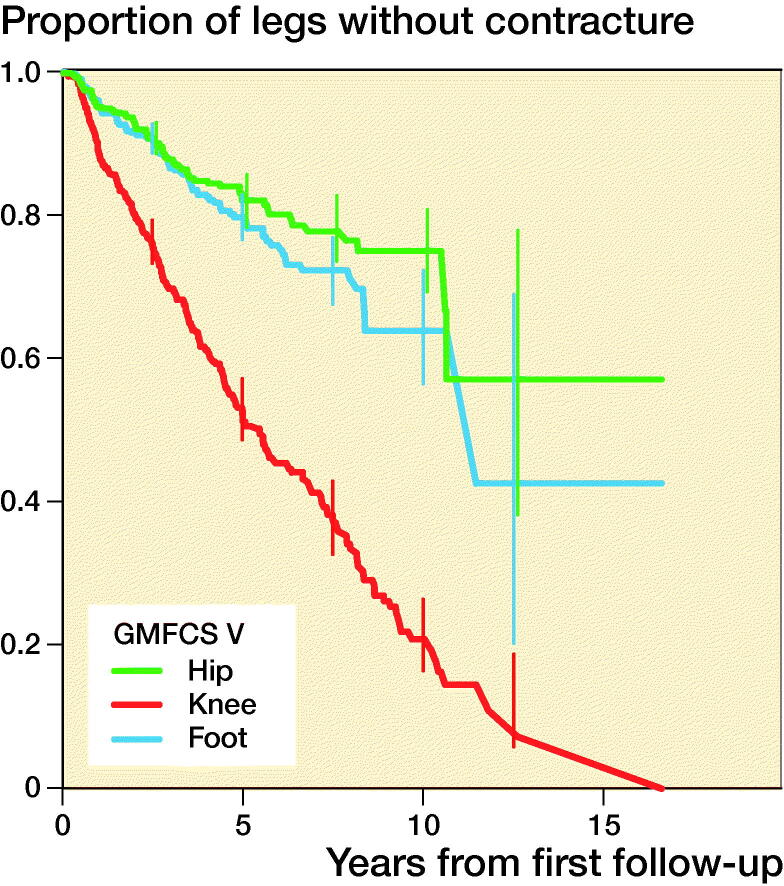
Background and purpose - Joint contracture is a common problem among children with cerebral palsy (CP). To prevent severe contracture and its effects on adjacent joints, it is crucial to identify children with a reduced range of motion (ROM) early. We examined whether significant hip, knee, or foot contracture occurs earliest in children with CP.Patients and methods - This was a longitudinal study involving 27,230 measurements obtained for 2,693 children (59% boys, 41% girls) with CP born 1990 to 2018 and registered before 5 years of age in the Swedish surveillance program for CP. The analysis was based on 4,751 legs followed up for an average of 5.0 years. Separate Kaplan-Meier (KM) curves were drawn for each ROM to illustrate the proportions of contracture-free legs at a given time during the follow-up. Using a clustered bootstrap method and considering the child as the unit of clustering, 95% pointwise confidence intervals were generated for equally spaced time points every 2.5 years for each KM curve.Results - Contracture developed in 34% of all legs, and the median time to the first contracture was 10 years from the first examination. Contracture was most common in children with a higher Gross Motor Function Classification System (GMFCS) level. The first contracture was a flexion contracture preventing dorsiflexion in children with GMFCS level I or II and preventing knee extension in children with GMFCS level III to V.Interpretation - Early interventions to prevent knee and foot contractures in children with CP should be considered.
背景与目的 - 联合挛缩是脑瘫(CP)儿童常见的问题。为了防止严重挛缩及其对相邻关节的影响,及早发现运动范围(ROM)减小的儿童至关重要。我们研究了 CP 儿童中最早出现髋关节、膝关节或足部挛缩的情况。
患者与方法 - 这是一项纵向研究,共涉及 27230 次测量,对象为 1990 年至 2018 年间出生且在 5 岁前在瑞典 CP 监测计划中登记的 2693 名 CP 儿童(59%为男孩,41%为女孩)。分析基于 4751 条随访平均时间为 5.0 年的腿部。为了说明在随访过程中特定时间点无挛缩腿部的比例,分别绘制了每个 ROM 的 Kaplan-Meier(KM)曲线。使用聚类 bootstrap 方法,并将儿童作为聚类的单位,为每条 KM 曲线的每个等间隔时间点(每 2.5 年)生成 95%的点估计置信区间。
结果 - 所有腿部中有 34%发生挛缩,第一次挛缩的中位时间是首次检查后 10 年。GMFCS 分级较高的儿童中挛缩更为常见。第一次挛缩是屈曲挛缩,会导致 GMFCS 分级 I 或 II 的儿童无法背屈,GMFCS 分级 III 至 V 的儿童无法伸直膝关节。
结论 - 应考虑对 CP 儿童进行早期干预以预防膝部和足部挛缩。