Institute of Epidemiology and Preventive Medicine, College of Public Health, National Taiwan University, Taipei, Taiwan.
Department of Psychiatry, College of Medicine and National Taiwan University Hospital, National Taiwan University, Taipei, Taiwan.
BMC Psychiatry. 2020 Nov 23;20(1):552. doi: 10.1186/s12888-020-02957-7.
Switching to aripiprazole from other antipsychotics can avoid antipsychotic-induced hyperprolactinemia but may result in an abnormally low prolactin level. This study aimed to assess whether the aripiprazole-induced abnormally low prolactin level was a biomarker for subsequent rebound of positive symptoms in schizophrenia patients.
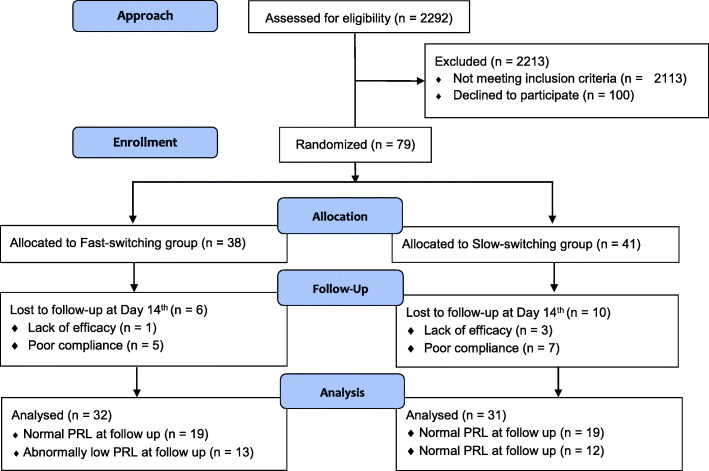
Participants were 63 patients in an 8-week trial of switching to aripiprazole, in which preswitching antipsychotics were maintained for the first 2 weeks and aripiprazole was fixed at 15 mg orally throughout the trial. A prolactin level of < 3.7 ng/ml was defined as abnormally low, and an increase of two or more points in the positive subscore of the Positive and Negative Syndrome Scale at two adjacent ratings was defined as a psychotic rebound.
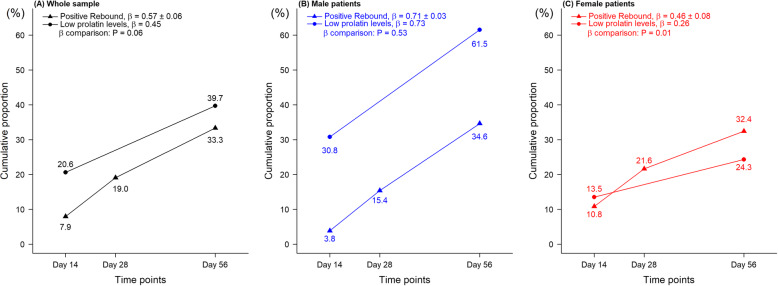
Among 63 patients, 25 (39.7%) had an abnormally low prolactin level and 21 (33.3%) had a psychotic rebound after switching to aripiprazole. In patients with abnormally low prolactin levels, 48.0% of them had a rebound in psychotic symptoms, whereas in those without abnormally low prolactin levels 23.7% did so. Multivariable logistic regression analysis with adjustment for sex, early age at onset, and preswitching medications revealed that abnormally low prolactin levels were associated with psychotic rebound (adjusted odds ratio = 3.55, 95% confidence interval = 1.02, 12.5). Furthermore, there was concurrency between the trend of the cumulative proportion of patients having an abnormally low prolactin level and that of the cumulative proportion of patients having a rebound in psychotic symptoms.
An abnormally low prolactin level after switching to aripiprazole in schizophrenia patients was a potential warning sign of a psychotic rebound. Hence, monitoring of prolactin levels after switching to aripiprazole may help avoid such rebound in schizophrenia.
NCT00545467 ; Date of registration: 17/10/2007.
从其他抗精神病药转换为阿立哌唑可以避免抗精神病药引起的高催乳素血症,但可能导致催乳素水平异常降低。本研究旨在评估阿立哌唑引起的催乳素水平异常降低是否是精神分裂症患者随后出现阳性症状反弹的生物标志物。
63 名患者参加了一项为期 8 周的转换为阿立哌唑的试验,在该试验中,在最初的 2 周内维持使用原抗精神病药物,整个试验期间阿立哌唑固定剂量为 15mg 口服。催乳素水平<3.7ng/ml 定义为异常低,阳性和阴性综合征量表的阳性亚量表在两次相邻评定中增加两个或更多点定义为精神病性反弹。
在 63 名患者中,25 名(39.7%)催乳素水平异常降低,21 名(33.3%)转换为阿立哌唑后精神病性反弹。在催乳素水平异常降低的患者中,48.0%的患者出现精神病症状反弹,而催乳素水平正常的患者中,23.7%的患者出现精神病症状反弹。多变量逻辑回归分析调整性别、发病年龄较早和转换前药物后显示,催乳素水平异常降低与精神病性反弹相关(调整优势比=3.55,95%置信区间=1.02,12.5)。此外,患者出现催乳素水平异常降低的累积比例趋势与出现精神病性症状反弹的累积比例趋势之间存在一致性。
精神分裂症患者转换为阿立哌唑后催乳素水平异常降低是精神病性反弹的潜在警告信号。因此,监测转换为阿立哌唑后的催乳素水平可能有助于避免精神分裂症的反弹。
NCT00545467;注册日期:2007 年 10 月 17 日。