State Key Laboratory of Veterinary Etiological Biology/National Professional Laboratory for Animal Echinococcosis/Key Laboratory of Veterinary Parasitology of Gansu Province/Key Laboratory of Zoonoses of Agriculture Ministry, Lanzhou Veterinary Research Institute (CAAS), Lanzhou, 730046, Gansu, People's Republic of China.
Jiangsu Co-innovation Center for Prevention and Control of Important Animal Infectious Disease, Yangzhou, 225009, Jiangsu, People's Republic of China.
Parasit Vectors. 2020 Nov 23;13(1):590. doi: 10.1186/s13071-020-04456-w.
Cystic or alveolar echinococcosis caused by the larval stages of Echinococcus spp. is a very severe zoonotic helminth infection. Echinococcus shiquicus is a newly discovered species that has only been reported in the Qinghai and Sichuan provinces of the Qinghai-Tibet plateau, China where, to date, it has only been confirmed in Tibetan foxes and wild small mammal populations of the Tibetan plateau. Information on its genetic and evolutionary diversity is scanty. The aim of this study was to investigate the prevalence of E. shiquicus in plateau pikas (Ochotona curzoniae), a known intermediate host, and to determine the genetic variation and phylogenetic relationship of the E. shiquicus population in the Tibet region of China based on mitochondrial DNA.
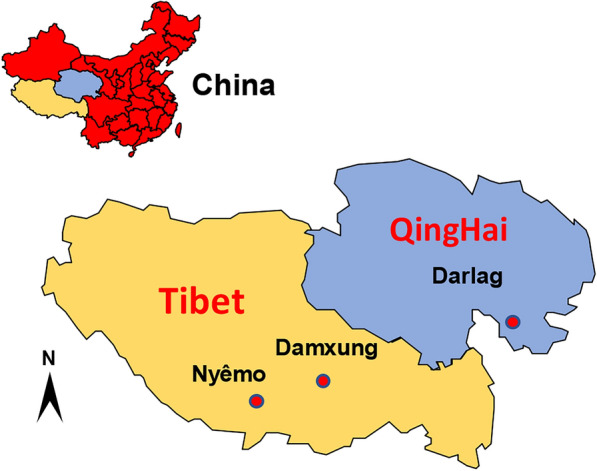
Echinococcus shiquicus samples were collected from Damxung and Nyêmo counties (located in Tibet Autonomous Region, China). The mitochondrial cox1 and nad1 gene sequences were analyzed, and the genetic diversity and epidemiology of E. shiquicus in the region were discussed based on the results.
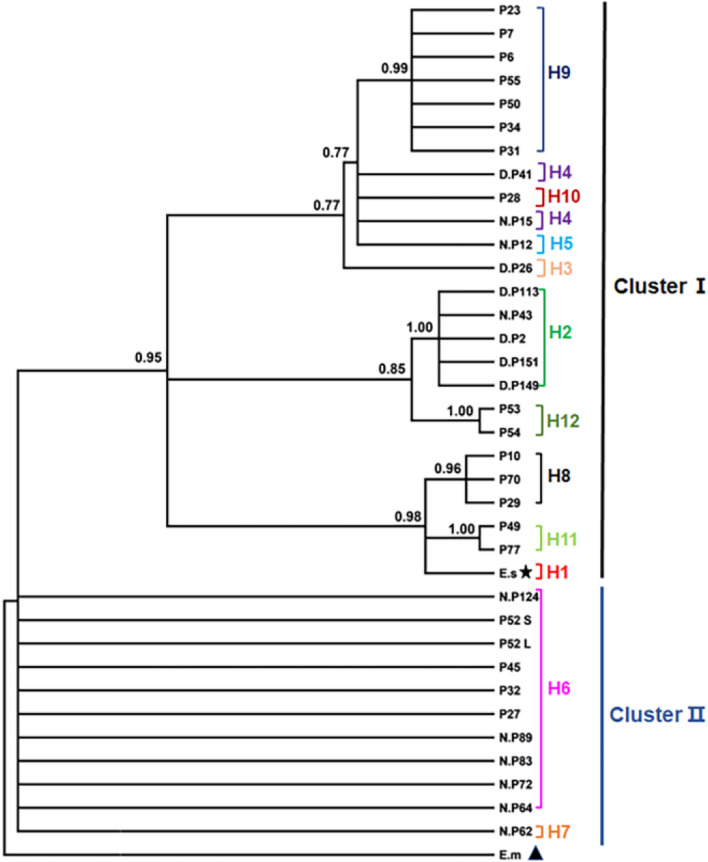
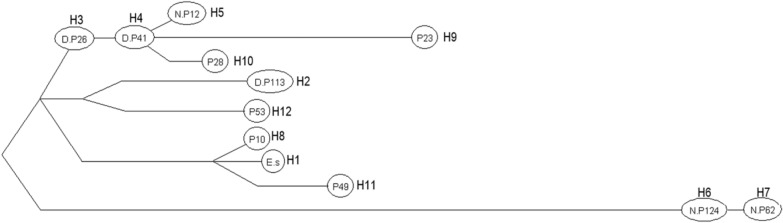
The prevalence of E. shiquicus in pikas in Damxung and Nyêmo counties was 3.95% (6/152) and 6.98% (9/129), respectively. In combination with previous public sequence data, the haplotype analysis revealed 12 haplotypes (H) characterized by two distinct clusters (I and II), and a sequence distance of 99.1-99.9% from the reference haplotype (H1). The diversity and neutrality indices for the entire E. shiquicus populations were: haplotype diversity (Hd) ± standard deviation (SD) 0.862 ± 0.035; nucleotide diversity (Hd ± SD) 0.0056 ± 0.0003; Tajima's D 0.876 (P > 0.05); and Fu's F 6.000 (P > 0.05).
This was the first analysis of the newly discovered E. shiquicus in plateau pikas in the Tibet Autonomous Region of China. The neutrality indices suggest a deficiency of alleles, indicative of a recent population bottleneck.
由细粒棘球蚴属幼虫引起的囊性或肺泡包虫病是一种非常严重的人畜共患寄生虫感染。青海包虫是一种新发现的物种,仅在中国青藏高原的青海和四川省报告过,迄今为止,仅在藏狐和青藏高原野生小哺乳动物种群中得到确认。关于其遗传和进化多样性的信息很少。本研究旨在调查高原鼠兔(Ochotona curzoniae)作为中间宿主的青海包虫感染流行情况,并基于线粒体 DNA 确定中国西藏地区青海包虫种群的遗传变异和系统发育关系。
从当雄县和尼玛县(位于中国西藏自治区)采集青海包虫样本。分析线粒体 cox1 和 nad1 基因序列,并根据结果讨论该地区青海包虫的遗传多样性和流行病学。
当雄县和尼玛县高原鼠兔的青海包虫感染率分别为 3.95%(6/152)和 6.98%(9/129)。结合以前的公共序列数据,单倍型分析显示有 12 种单倍型(H),分为两个明显的聚类(I 和 II),与参考单倍型(H1)的序列距离为 99.1-99.9%。整个青海包虫种群的多样性和中性指数为:单倍型多样性(Hd)±标准偏差(SD)0.862±0.035;核苷酸多样性(Hd±SD)0.0056±0.0003;Tajima's D 0.876(P>0.05);Fu's F 6.000(P>0.05)。
这是首次对中国西藏自治区高原鼠兔中的新发现的青海包虫进行分析。中性指数表明等位基因缺乏,表明最近存在种群瓶颈。