Xu Xi, Xu Dong-Sheng
Department of Rehabilitation Medicine, Affiliated Hospital of Nantong University, Nantong, Jiangsu Province, China.
Department of Rehabilitation Medicine, Yueyang Hospital of Integrated Traditional Chinese and Western Medicine; School of Rehabilitation Science, Shanghai University of Traditional Chinese Medicine, Shanghai, China.
Neural Regen Res. 2021 May;16(5):955-962. doi: 10.4103/1673-5374.297062.
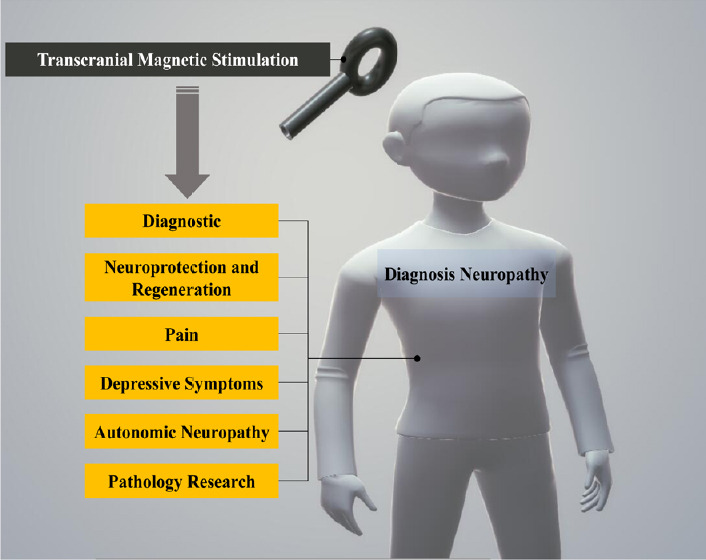
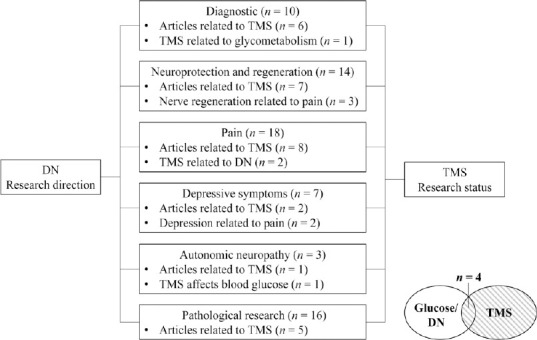
Encouraging results have been reported for the use of transcranial magnetic stimulation-based nerve stimulation in studies of the mechanisms of neurological regulation, nerve injury repair, and nerve localization. However, to date, there are only a few reviews on the use of transcranial magnetic stimulation for diabetic neuropathy. Patients with diabetic neuropathy vary in disease progression and show neuropathy in the early stage of the disease with mild symptoms, making it difficult to screen and identify. In the later stage of the disease, irreversible neurological damage occurs, resulting in treatment difficulties. In this review, we summarize the current state of diabetic neuropathy research and the prospects for the application of transcranial magnetic stimulation in diabetic neuropathy. We review significant studies on the beneficial effects of transcranial magnetic stimulation in diabetic neuropathy treatment, based on the outcomes of its use to treat neurodegeneration, pain, blood flow change, autonomic nervous disorders, vascular endothelial injury, and depression. Collectively, the studies suggest that transcranial magnetic stimulation can produce excitatory/inhibitory stimulation of the cerebral cortex or local areas, promote the remodeling of the nervous system, and that it has good application prospects for the localization of the injury, neuroprotection, and the promotion of nerve regeneration. Therefore, transcranial magnetic stimulation is useful for the screening and early treatment of diabetic neuropathy. Transcranial magnetic stimulation can also alleviate pain symptoms by changing the cortical threshold and inhibiting the conduction of sensory information in the thalamo-spinal pathway, and therefore it has therapeutic potential for the treatment of pain and pain-related depressive symptoms in patients with diabetic neuropathy. Additionally, based on the effect of transcranial magnetic stimulation on local blood flow and its ability to change heart rate and urine protein content, transcranial magnetic stimulation has potential in the treatment of autonomic nerve dysfunction and vascular injury in diabetic neuropathy. Furthermore, oxidative stress and the inflammatory response are involved in the process of diabetic neuropathy, and transcranial magnetic stimulation can reduce oxidative damage. The pathological mechanisms of diabetic neuropathy should be further studied in combination with transcranial magnetic stimulation technology.
在神经调节机制、神经损伤修复和神经定位研究中,基于经颅磁刺激的神经刺激应用已报告了令人鼓舞的结果。然而,迄今为止,关于经颅磁刺激用于糖尿病性神经病变的综述较少。糖尿病性神经病变患者的疾病进展各不相同,且在疾病早期表现为神经病变,症状较轻,难以筛查和识别。在疾病后期,会发生不可逆的神经损伤,导致治疗困难。在本综述中,我们总结了糖尿病性神经病变的研究现状以及经颅磁刺激在糖尿病性神经病变中的应用前景。我们基于经颅磁刺激用于治疗神经退行性变、疼痛、血流变化、自主神经功能障碍、血管内皮损伤和抑郁的结果,回顾了其在糖尿病性神经病变治疗中有益作用的重要研究。总体而言,这些研究表明经颅磁刺激可对大脑皮层或局部区域产生兴奋性/抑制性刺激,促进神经系统重塑,并且在损伤定位、神经保护和促进神经再生方面具有良好的应用前景。因此,经颅磁刺激对糖尿病性神经病变的筛查和早期治疗有用。经颅磁刺激还可通过改变皮层阈值和抑制丘脑 - 脊髓通路中的感觉信息传导来缓解疼痛症状,因此在治疗糖尿病性神经病变患者的疼痛及与疼痛相关的抑郁症状方面具有治疗潜力。此外,基于经颅磁刺激对局部血流的影响及其改变心率和尿蛋白含量的能力,经颅磁刺激在治疗糖尿病性神经病变中的自主神经功能障碍和血管损伤方面具有潜力。此外,氧化应激和炎症反应参与了糖尿病性神经病变的过程,经颅磁刺激可减少氧化损伤。应结合经颅磁刺激技术进一步研究糖尿病性神经病变的病理机制。