Yang Ya-Wen, Pan Wen-Xiu, Xie Qing
Department of Rehabilitation Medicine, Ruijin Hospital, School of Medicine, Shanghai Jiao Tong University, Shanghai, China.
Department of Rehabilitation Medicine, Ruijin Hospital, School of Medicine, Shanghai Jiao Tong University; Department of Rehabilitation Medicine, Shanghai Ruijin Rehabilitation Hospital, Shanghai, China.
Neural Regen Res. 2020 Nov;15(11):1986-1994. doi: 10.4103/1673-5374.282239.
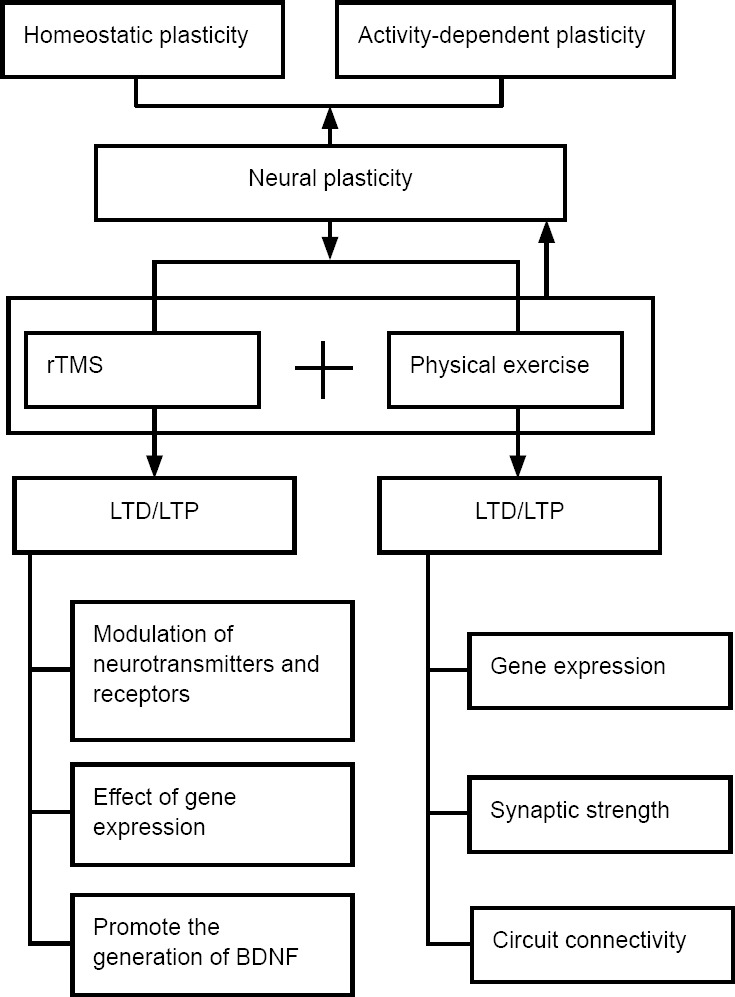
Physical exercise can minimize dysfunction and optimize functional motor recovery after stroke by modulating cortical plasticity. However, the limitation of physical exercise is that large amounts of time and effort are necessary to significantly improve motor function, and even then, substantial exercise may not be sufficient to normalize the observed improvements. Thus, interventions that could be used to strengthen physical exercise-induced neuroplasticity may be valuable in treating hemiplegia after stroke. Repetitive transcranial magnetic stimulation seems to be a viable strategy for enhancing such plasticity. As a non-invasive cortical stimulation technique, repetitive transcranial magnetic stimulation is able to induce long-term plastic changes in the motor system. Recently, repetitive transcranial magnetic stimulation was found to optimize the plastic changes caused by motor training, thereby enhancing the long-term effects of physical exercise in stroke patients. Therefore, it is believed that the combination of repetitive transcranial magnetic stimulation and physical exercise may represent a superior method for restoring motor function after stroke.
体育锻炼可通过调节皮质可塑性,将中风后的功能障碍降至最低,并优化运动功能恢复。然而,体育锻炼的局限性在于,要显著改善运动功能需要大量的时间和精力,即便如此,大量锻炼可能仍不足以使观察到的改善恢复正常。因此,可用于增强体育锻炼诱导的神经可塑性的干预措施,可能对治疗中风后的偏瘫有价值。重复经颅磁刺激似乎是增强这种可塑性的可行策略。作为一种非侵入性皮质刺激技术,重复经颅磁刺激能够在运动系统中诱导长期的可塑性变化。最近发现,重复经颅磁刺激可优化由运动训练引起的可塑性变化,从而增强体育锻炼对中风患者的长期效果。因此,人们认为重复经颅磁刺激与体育锻炼相结合可能是中风后恢复运动功能的一种更优方法。