Section for Cell Biology and Physiology, Department of Biology, University of Copenhagen, 2100 Copenhagen Ø, Denmark.
Int J Mol Sci. 2020 Nov 20;21(22):8781. doi: 10.3390/ijms21228781.
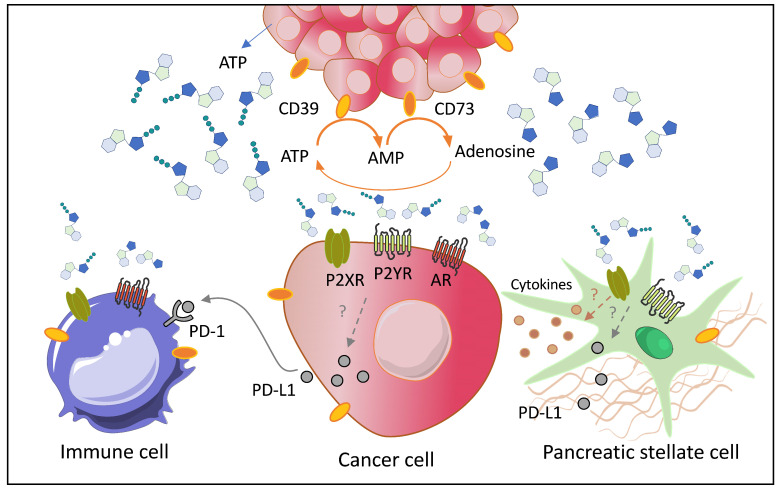
The purinergic signaling has an important role in regulating pancreatic exocrine secretion. The exocrine pancreas is also a site of one of the most serious cancer forms, the pancreatic ductal adenocarcinoma (PDAC). Here, we explore how the network of purinergic and adenosine receptors, as well as ecto-nucleotidases regulate normal pancreatic cells and various cells within the pancreatic tumor microenvironment. In particular, we focus on the P2X7 receptor, P2Y and P2Y receptors, as well as A receptors and ecto-nucleotidases CD39 and CD73. Recent studies indicate that targeting one or more of these candidates could present new therapeutic approaches to treat pancreatic cancer. In pancreatic cancer, as much as possible of normal pancreatic function should be preserved, and therefore physiology of purinergic signaling in pancreas needs to be considered.
嘌呤能信号在调节胰腺外分泌分泌中具有重要作用。外分泌胰腺也是最严重的癌症形式之一,即胰腺导管腺癌(PDAC)的部位。在这里,我们探讨嘌呤能和腺苷受体以及核苷酸酶的网络如何调节正常胰腺细胞和胰腺肿瘤微环境中的各种细胞。特别地,我们专注于 P2X7 受体、P2Y 和 P2Y 受体以及 A 受体和核苷酸酶 CD39 和 CD73。最近的研究表明,针对这些候选物中的一个或多个可能为治疗胰腺癌提供新的治疗方法。在胰腺癌中,应尽可能保留正常胰腺功能,因此需要考虑胰腺中嘌呤能信号的生理学。