Faraoni Erika Y, Ju Cynthia, Robson Simon C, Eltzschig Holger K, Bailey-Lundberg Jennifer M
Department of Anesthesiology, Center for Perioperative Medicine, McGovern Medical School, The University of Texas Health Science Center at Houston, Houston, TX, United States.
Departments of Internal Medicine and Anesthesiology, Center for Inflammation Research, Beth Israel Deaconess Medical Center and Harvard Medical School, Boston, MA, United States.
Front Physiol. 2022 Mar 14;13:849258. doi: 10.3389/fphys.2022.849258. eCollection 2022.
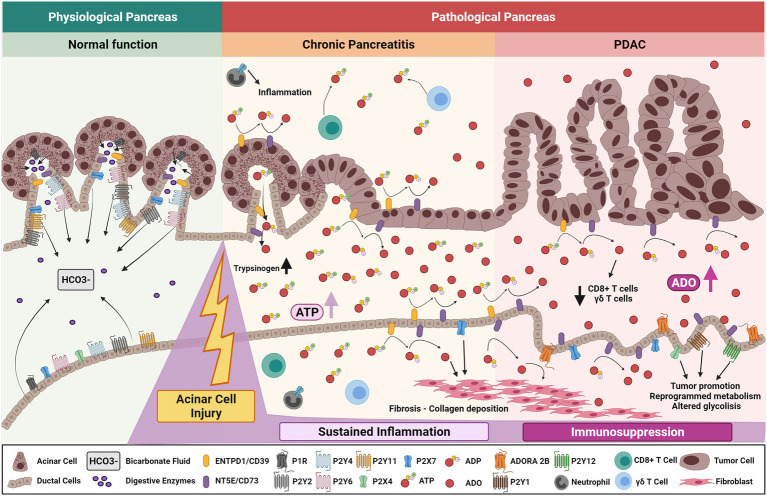
Adenosine 5'-triphosphate (ATP), other nucleotides, and the nucleoside analogue, adenosine, all have the capacity to modulate cellular signaling pathways. The cellular processes linked to extracellular purinergic signaling are crucial in the initiation, evolution, and resolution of inflammation. Injured or dying cells in the pancreatobiliary tract secrete or release ATP, which results in sustained purinergic signaling mediated through ATP type-2 purinergic receptors (P2R). This process can result in chronic inflammation, fibrosis, and tumor development. In contrast, signaling the extracellular nucleoside derivative adenosine type-1 purinergic receptors (P1R) is largely anti-inflammatory, promoting healing. Failure to resolve inflammation, as in the context of primary sclerosing cholangitis or chronic pancreatitis, is a risk factor for parenchymal and end-organ scarring with the associated risk of pancreatobiliary malignancies. Emerging immunotherapeutic strategies suggest that targeting purinergic and adenosinergic signaling can impact the growth and invasive properties of cancer cells, potentiate anti-tumor immunity, and also block angiogenesis. In this review, we dissect out implications of disordered purinergic responses in scar formation, end-organ injury, and in tumor development. We conclude by addressing promising opportunities for modulation of purinergic/adenosinergic signaling in the prevention and treatment of pancreatobiliary diseases, inclusive of cancer.
5'-三磷酸腺苷(ATP)、其他核苷酸以及核苷类似物腺苷都具有调节细胞信号通路的能力。与细胞外嘌呤能信号传导相关的细胞过程在炎症的发生、发展和消退中起着关键作用。胰胆管中受损或濒死的细胞分泌或释放ATP,这会导致通过2型嘌呤能受体(P2R)介导的持续嘌呤能信号传导。这个过程可能导致慢性炎症、纤维化和肿瘤发展。相比之下,细胞外核苷衍生物腺苷通过1型嘌呤能受体(P1R)进行信号传导在很大程度上具有抗炎作用,促进愈合。如在原发性硬化性胆管炎或慢性胰腺炎的情况下,炎症无法消退是实质和终末器官瘢痕形成的危险因素,并伴有胰胆管恶性肿瘤的相关风险。新兴的免疫治疗策略表明,靶向嘌呤能和腺苷能信号传导可以影响癌细胞的生长和侵袭特性,增强抗肿瘤免疫力,还能阻断血管生成。在本综述中,我们剖析了嘌呤能反应紊乱在瘢痕形成、终末器官损伤和肿瘤发展中的影响。我们通过探讨在预防和治疗包括癌症在内的胰胆管疾病中调节嘌呤能/腺苷能信号传导的潜在机会来得出结论。