Aging Research Center, Department of Neurobiology, Care Sciences and Society, Karolinska Institutet-Stockholm University, 17165 Stockholm, Sweden.
National School of Public Health, Carlos III Institute of Health, 28029 Madrid, Spain.
Int J Environ Res Public Health. 2020 Nov 20;17(22):8637. doi: 10.3390/ijerph17228637.
Loneliness and social isolation have detrimental effects on health in old age; however, the prospective associations with quality of life (QoL) remain unclear. Furthermore, despite the existence of a European north-south gradient in the distribution of loneliness and social isolation, little is known whether the associations are context-specific. We investigated the relationships between loneliness, social isolation and QoL of older adults residing in the North (Sweden) and South (Spain) of Europe.
Study sample consisted of 2995 Swedish and 4154 Spanish older adults who participated in waves six and seven of the Study on Health, Aging and Retirement in Europe (SHARE). Loneliness and social isolation were measured at the baseline, and QoL was measured at the baseline and follow-up using CASP-12. Prospective associations were assessed via multivariate linear regression.
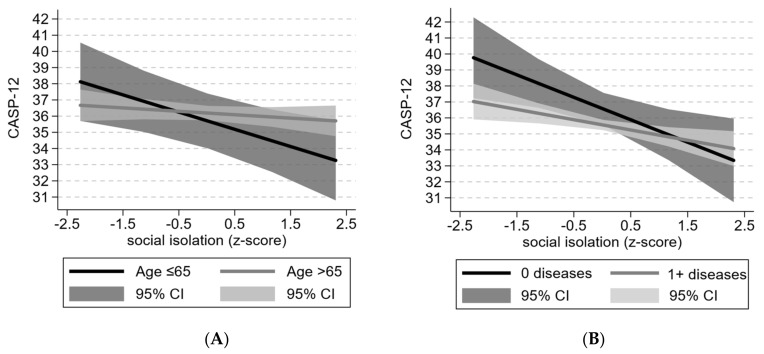
In Sweden, subjects with higher vs. lower loneliness had 1.01 (95% CI: -1.55, -0.40) units lower QoL, while every standard deviation increase in social isolation was associated with a 0.27 (95% CI: -0.42, -0.09)-unit decrease in QoL. In Spain, every standard deviation increase in social isolation was associated with a 0.66 (95% CI: -1.11, -0.22)-unit decrease in QoL. The association was stronger in subjects aged ≤65 years old and those with no chronic diseases. The association with loneliness was not statistically significant in Spain.
Loneliness and social isolation are prospectively associated with decreased QoL among older adults, yet the associations are contextually bound. Future interventions should target both exposures, among others, in order to increase QoL in this group.
孤独和社会隔离对老年人的健康有不利影响;然而,其与生活质量(QoL)的前瞻性关联尚不清楚。此外,尽管孤独和社会隔离在欧洲存在南北分布梯度,但对于这些关联是否具有特定背景知之甚少。我们调查了居住在欧洲北部(瑞典)和南部(西班牙)的老年人中孤独、社会隔离与 QoL 之间的关系。
研究样本由参加欧洲健康、老龄化和退休研究(SHARE)第六和第七波的 2995 名瑞典人和 4154 名西班牙老年人组成。孤独和社会隔离在基线时进行测量,而 QoL 在基线和随访时使用能力状态问卷(CASP-12)进行测量。通过多变量线性回归评估前瞻性关联。
在瑞典,与孤独程度较高的人相比,孤独程度较低的人 QoL 低 1.01(95% CI:-1.55,-0.40)单位,而社会隔离每增加一个标准差与 QoL 降低 0.27(95% CI:-0.42,-0.09)单位相关。在西班牙,社会隔离每增加一个标准差与 QoL 降低 0.66(95% CI:-1.11,-0.22)单位相关。在年龄≤65 岁和无慢性病的人群中,这种关联更强。在西班牙,孤独与 QoL 之间的关联不具有统计学意义。
孤独和社会隔离与老年人 QoL 下降具有前瞻性关联,但这种关联具有特定背景。未来的干预措施应针对这两种暴露因素,以提高该人群的 QoL。