McCoy Rozalina G, Lipska Kasia J, Van Houten Holly K, Shah Nilay D
Division of Community Internal Medicine, Department of Medicine, Mayo Clinic, Rochester, Minnesota, USA
Division of Health Care Policy & Research, Department of Health Sciences Research, Mayo Clinic, Rochester, Minnesota, USA.
BMJ Open Diabetes Res Care. 2020 Nov;8(2). doi: 10.1136/bmjdrc-2020-001878.
Current diabetes quality measures are agnostic to patient clinical complexity and type of treatment required to achieve it. Our objective was to introduce a patient-centered indicator of appropriate diabetes therapy indicator (ADTI), designed for patients with type 2 diabetes, which is based on hemoglobin A1c (HbA1c) but is also contextualized by patient complexity and treatment intensity.
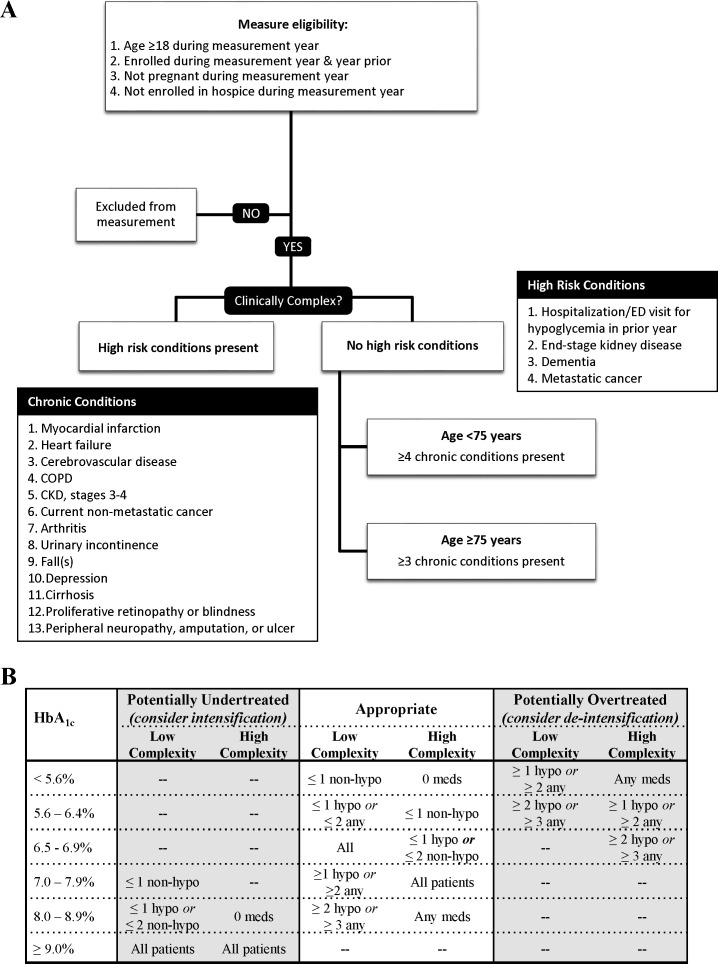
A draft indicator was iteratively refined by a multidisciplinary Delphi panel using existing quality measures, guidelines, and published literature. ADTI performance was then assessed using OptumLabs Data Warehouse data for 2015. Included adults (n=206 279) with type 2 diabetes were categorized as clinically complex based on comorbidities, then categorized as treated appropriately, overtreated, or undertreated based on a matrix of clinical complexity, HbA1c level, and medications used. Associations between ADTI and emergency department/hospital visits for hypoglycemia and hyperglycemia were assessed by calculating event rates for each treatment intensity subset.
Overall, 7.4% of patients with type 2 diabetes were overtreated and 21.1% were undertreated. Patients with high complexity were more likely to be overtreated (OR 5.60, 95% CI 5.37 to 5.83) and less likely to be undertreated (OR 0.65, 95% CI 0.62 to 0.68) than patients with low complexity. Overtreated patients had higher rates of hypoglycemia than appropriately treated patients (22.0 vs 6.2 per 1000 people/year), whereas undertreated patients had higher rates of hyperglycemia (8.4 vs 1.9 per 1000 people/year).
The ADTI may facilitate timely, patient-centered treatment intensification/deintensification with the goal of achieving safer evidence-based care.
当前的糖尿病质量衡量标准未考虑患者的临床复杂性以及实现治疗目标所需的治疗类型。我们的目标是引入一种以患者为中心的2型糖尿病患者适当糖尿病治疗指标(ADTI),该指标基于糖化血红蛋白(HbA1c),但也会根据患者的复杂性和治疗强度进行调整。
一个多学科德尔菲小组利用现有的质量衡量标准、指南和已发表的文献,对指标草案进行了反复完善。然后使用2015年OptumLabs数据仓库的数据评估ADTI的表现。纳入的2型糖尿病成年患者(n = 206279)根据合并症被分类为临床复杂患者,然后根据临床复杂性、HbA1c水平和所用药物的矩阵被分类为治疗适当、治疗过度或治疗不足。通过计算每个治疗强度亚组的事件发生率,评估ADTI与低血糖和高血糖的急诊科/医院就诊之间的关联。
总体而言,7.4%的2型糖尿病患者治疗过度,21.1%的患者治疗不足。与低复杂性患者相比,高复杂性患者更有可能治疗过度(比值比5.60,95%置信区间5.37至5.83),而治疗不足的可能性较小(比值比0.65,95%置信区间0.62至0.68)。治疗过度的患者低血糖发生率高于治疗适当的患者(每1000人/年分别为22.0和6.2),而治疗不足的患者高血糖发生率更高(每1000人/年分别为8.4和1.9)。
ADTI可能有助于及时进行以患者为中心的治疗强化/弱化,目标是实现更安全的循证护理。