• 文献检索
  • 文档翻译
  • 深度研究
  • 学术资讯
  • Suppr Zotero 插件Zotero 插件
  • 邀请有礼
  • 套餐&价格
  • 历史记录
应用&插件
Suppr Zotero 插件Zotero 插件浏览器插件Mac 客户端Windows 客户端微信小程序
定价
高级版会员购买积分包购买API积分包
服务
文献检索文档翻译深度研究API 文档MCP 服务
关于我们
关于 Suppr公司介绍联系我们用户协议隐私条款
关注我们

Suppr 超能文献

核心技术专利:CN118964589B侵权必究
粤ICP备2023148730 号-1Suppr @ 2026

文献检索

告别复杂PubMed语法,用中文像聊天一样搜索,搜遍4000万医学文献。AI智能推荐,让科研检索更轻松。

立即免费搜索

文件翻译

保留排版,准确专业,支持PDF/Word/PPT等文件格式,支持 12+语言互译。

免费翻译文档

深度研究

AI帮你快速写综述,25分钟生成高质量综述,智能提取关键信息,辅助科研写作。

立即免费体验

雾化与侵入性给予表面活性剂治疗新生儿呼吸窘迫综合征:一项系统评价与荟萃分析。

Nebulized versus invasively delivered surfactant therapy for neonatal respiratory distress syndrome: A systematic review and meta-analysis.

作者信息

Rong Hui, Bao Ying, Wen Zunjia, Chen Xiuli, Chen Cen, Li Fang

机构信息

NICU.

Nursing department, Children's Hospital of Nanjing Medical University, China.

出版信息

Medicine (Baltimore). 2020 Nov 25;99(48):e23113. doi: 10.1097/MD.0000000000023113.

DOI:10.1097/MD.0000000000023113
PMID:33235071
原文链接:https://pmc.ncbi.nlm.nih.gov/articles/PMC7710245/
Abstract

BACKGROUND

Pulmonary surfactant (PS) is commonly used for the treatment of neonatal respiratory distress syndrome (NRDS), several randomized controlled trials (RCTs) have evaluated the role of nebulized versus invasively delivered PS, yet the results remained inconsistent. Therefore, we aimed to conduct this meta-analysis to evaluate the effects and safety of nebulized versus invasively delivered PS in the treatment of NRDS.

METHODS

We searched PubMed et al databases from inception date to May 15, 2020 for RCTs that compared nebulized vs invasively delivered PS. Two authors independently screened the studies and extracted data from the published articles. Summary odd ratios (OR) or mean differences (MDs) with 95% confidence intervals (CIs) were calculated for each outcome by means of fixed- or random-effects model.

RESULTS

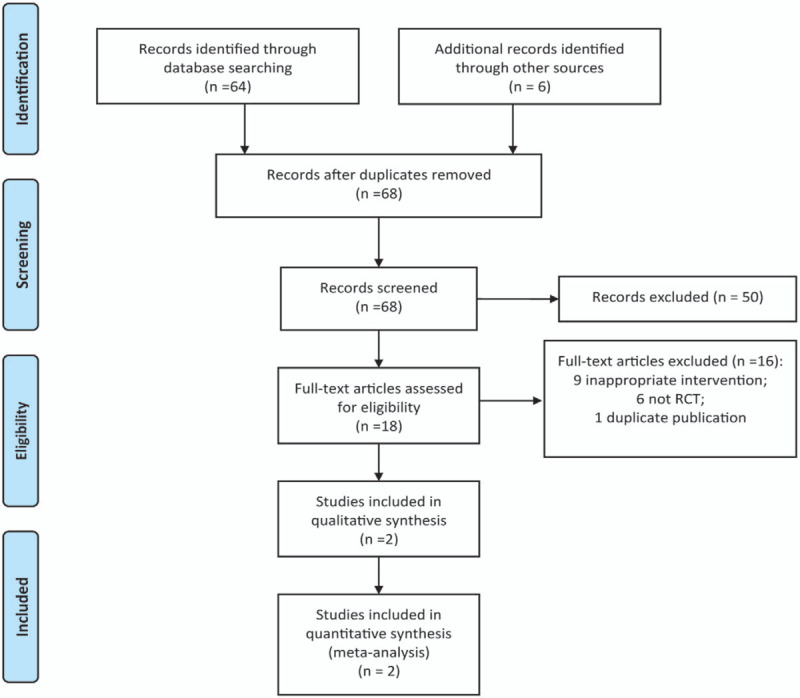
Two RCTs with a total of 95 preterm neonates were identified, with 48 neonates received PS nebulization and 47 neonates undergone invasive PS administration. There was no significant difference in the SpO2 level (MD = -0.44, 95% CI -6.01 to 5.12) and the A/APaO2 level (MD = 0.01, 95% CI -0.02 to 0.05) 1 hour after treatment among 2 groups. But the duration of mechanical ventilation in the nebulization groups was significantly less than that of invasive group (MD = -30.70, 95% CI -41.45 to 19.95).

CONCLUSIONS

Given the limited evidences, the effects and safety of nebulized versus invasively delivered PS still need further verification.

摘要

背景

肺表面活性物质(PS)常用于治疗新生儿呼吸窘迫综合征(NRDS),多项随机对照试验(RCT)评估了雾化吸入与侵入性给予PS的作用,但结果仍不一致。因此,我们旨在进行这项荟萃分析,以评估雾化吸入与侵入性给予PS治疗NRDS的效果和安全性。

方法

我们检索了从起始日期至2020年5月15日的PubMed等数据库,以查找比较雾化吸入与侵入性给予PS的RCT。两位作者独立筛选研究并从已发表的文章中提取数据。通过固定效应或随机效应模型为每个结局计算汇总比值比(OR)或平均差(MD)及其95%置信区间(CI)。

结果

共纳入两项RCT,总计95例早产儿,其中48例接受PS雾化吸入,47例接受侵入性PS给药。两组治疗1小时后的SpO2水平(MD = -0.44,95%CI -6.01至5.12)和A/APaO2水平(MD = 0.01,95%CI -0.02至0.05)无显著差异。但雾化吸入组的机械通气时间显著短于侵入性给药组(MD = -30.70,95%CI -41.45至19.95)。

结论

鉴于证据有限,雾化吸入与侵入性给予PS的效果和安全性仍需进一步验证。
https://cdn.ncbi.nlm.nih.gov/pmc/blobs/acad/7710245/28b6b929f451/medi-99-e23113-g006.jpg
https://cdn.ncbi.nlm.nih.gov/pmc/blobs/acad/7710245/1768254adce1/medi-99-e23113-g001.jpg
https://cdn.ncbi.nlm.nih.gov/pmc/blobs/acad/7710245/fe805ff003e9/medi-99-e23113-g002.jpg
https://cdn.ncbi.nlm.nih.gov/pmc/blobs/acad/7710245/4360ad3803a0/medi-99-e23113-g003.jpg
https://cdn.ncbi.nlm.nih.gov/pmc/blobs/acad/7710245/c5ce80c83313/medi-99-e23113-g004.jpg
https://cdn.ncbi.nlm.nih.gov/pmc/blobs/acad/7710245/a2360d71cc15/medi-99-e23113-g005.jpg
https://cdn.ncbi.nlm.nih.gov/pmc/blobs/acad/7710245/28b6b929f451/medi-99-e23113-g006.jpg
https://cdn.ncbi.nlm.nih.gov/pmc/blobs/acad/7710245/1768254adce1/medi-99-e23113-g001.jpg
https://cdn.ncbi.nlm.nih.gov/pmc/blobs/acad/7710245/fe805ff003e9/medi-99-e23113-g002.jpg
https://cdn.ncbi.nlm.nih.gov/pmc/blobs/acad/7710245/4360ad3803a0/medi-99-e23113-g003.jpg
https://cdn.ncbi.nlm.nih.gov/pmc/blobs/acad/7710245/c5ce80c83313/medi-99-e23113-g004.jpg
https://cdn.ncbi.nlm.nih.gov/pmc/blobs/acad/7710245/a2360d71cc15/medi-99-e23113-g005.jpg
https://cdn.ncbi.nlm.nih.gov/pmc/blobs/acad/7710245/28b6b929f451/medi-99-e23113-g006.jpg

相似文献

1
Nebulized versus invasively delivered surfactant therapy for neonatal respiratory distress syndrome: A systematic review and meta-analysis.雾化与侵入性给予表面活性剂治疗新生儿呼吸窘迫综合征:一项系统评价与荟萃分析。
Medicine (Baltimore). 2020 Nov 25;99(48):e23113. doi: 10.1097/MD.0000000000023113.
2
Early Intratracheal Administration of Corticosteroid and Pulmonary Surfactant for Preventing Bronchopulmonary Dysplasia in Preterm Infants with Neonatal Respiratory Distress Syndrome: A Meta-analysis.早期经气管内给予皮质类固醇和肺表面活性物质预防新生儿呼吸窘迫综合征早产儿支气管肺发育不良的 Meta 分析。
Curr Med Sci. 2019 Jun;39(3):493-499. doi: 10.1007/s11596-019-2064-9. Epub 2019 Jun 17.
3
Minimally invasive surfactant administration in preterm infants: a meta-narrative review.早产儿微创表面活性剂给药:荟萃叙述性综述。
JAMA Pediatr. 2014 Oct;168(10):901-8. doi: 10.1001/jamapediatrics.2014.1148.
4
Prophylaxis of neonatal respiratory distress syndrome by intra-amniotic administration of pulmonary surfactant.通过羊膜腔内注入肺表面活性物质预防新生儿呼吸窘迫综合征
Chin Med J (Engl). 2004 Jan;117(1):120-4.
5
Effect of exogenous pulmonary surfactants on mortality rate in neonatal respiratory distress syndrome: A network meta-analysis of randomized controlled trials.外源性肺表面活性物质对新生儿呼吸窘迫综合征死亡率的影响:随机对照试验的网状Meta分析
Pulm Pharmacol Ther. 2015 Oct;34:46-54. doi: 10.1016/j.pupt.2015.08.005. Epub 2015 Aug 18.
6
[Efficacy of different preparations of budesonide combined with pulmonary surfactant in the treatment of neonatal respiratory distress syndrome: a comparative analysis].布地奈德不同制剂联合肺表面活性物质治疗新生儿呼吸窘迫综合征的疗效:对比分析
Zhongguo Dang Dai Er Ke Za Zhi. 2016 May;18(5):400-4. doi: 10.7499/j.issn.1008-8830.2016.05.005.
7
Exogenous surfactant: intubated present, nebulized future?外源性表面活性剂:气管内给药还是雾化吸入?
World J Pediatr. 2011 Feb;7(1):11-5. doi: 10.1007/s12519-010-0201-4. Epub 2010 Jun 12.
8
Ultrasonic nebulized in comparison with instilled surfactant treatment of preterm lambs.超声雾化与滴注表面活性剂治疗早产羔羊的比较。
Am J Respir Crit Care Med. 1996 Aug;154(2 Pt 1):366-75. doi: 10.1164/ajrccm.154.2.8756808.
9
Nebulised surfactant in preterm infants with or at risk of respiratory distress syndrome.用于患有或有呼吸窘迫综合征风险的早产儿的雾化表面活性剂
Cochrane Database Syst Rev. 2012 Oct 17;10(10):CD008310. doi: 10.1002/14651858.CD008310.pub2.
10
Effect of pulmonary surfactant combined with mechanical ventilation on oxygenation functions and expressions of serum transforming growth factor-beta1 (TGF-β1) and bone morphogenetic protein 7 (BMP-7) of neonatal respiratory distress syndrome.肺表面活性物质联合机械通气对新生儿呼吸窘迫综合征氧合功能及血清转化生长因子-β1(TGF-β1)和骨形态发生蛋白 7(BMP-7)表达的影响。
Eur Rev Med Pharmacol Sci. 2017 Oct;21(19):4357-4361.

引用本文的文献

1
Effect of leisure-time physical activity on depression and depressive symptoms in menopausal women: a systematic review and meta-analysis of randomized controlled trials.闲暇时间体育活动对更年期女性抑郁及抑郁症状的影响:一项随机对照试验的系统评价和荟萃分析
Front Psychiatry. 2025 Jan 30;15:1480623. doi: 10.3389/fpsyt.2024.1480623. eCollection 2024.
2
Laryngeal Mask for Minimally-invasive Surfactant Administration: A Narrative Review.用于微创表面活性剂给药的喉罩:一篇叙述性综述
Curr Pediatr Rev. 2025;21(2):111-117. doi: 10.2174/0115733963328784240820062714.
3
Respiratory distress syndrome management in resource limited settings-Current evidence and opportunities in 2022.

本文引用的文献

1
Porcine versus bovine surfactant therapy for RDS in preterm neonates: pragmatic meta-analysis and review of physiopathological plausibility of the effects on extra-pulmonary outcomes.猪肺表面活性剂与牛肺表面活性剂治疗早产儿呼吸窘迫综合征的比较:实用荟萃分析及对肺外结局影响的病理生理学合理性的评价。
Respir Res. 2020 Jan 7;21(1):8. doi: 10.1186/s12931-019-1267-8.
2
Characteristics of prescription in 29 Level 3 Neonatal Wards over a 2-year period (2017-2018). An inventory for future research.29 个三级新生儿病房两年(2017-2018 年)处方特征。未来研究的清单。
PLoS One. 2019 Sep 19;14(9):e0222667. doi: 10.1371/journal.pone.0222667. eCollection 2019.
3
资源有限环境下呼吸窘迫综合征的管理——2022年的当前证据与机遇
Front Pediatr. 2022 Jul 29;10:961509. doi: 10.3389/fped.2022.961509. eCollection 2022.
4
A survey of minimally invasive surfactant therapy in Canada.加拿大微创表面活性剂疗法调查。
Can J Respir Ther. 2022 Jul 28;58:122-126. doi: 10.29390/cjrt-2022-011. eCollection 2022.
Minimally Invasive Surfactant Therapy Using a 2.0 mm Uncuffed Endotracheal Tube as the Conduit: An Easily Adaptable Technique.
使用2.0毫米无套囊气管内导管作为通道的微创表面活性剂治疗:一种易于应用的技术。
Cureus. 2019 Aug 19;11(8):e5428. doi: 10.7759/cureus.5428.
4
Early Predictors for INtubation-SURfactant-Extubation Failure in Preterm Infants with Neonatal Respiratory Distress Syndrome: A Systematic Review.早产儿呼吸窘迫综合征行气管内插管-表面活性剂-拔管失败的早期预测指标:系统评价。
Neonatology. 2020;117(1):33-45. doi: 10.1159/000501654. Epub 2019 Aug 22.
5
From bench to bedside: in vitro and in vivo evaluation of a neonate-focused nebulized surfactant delivery strategy.从实验室到病床:新生儿聚焦型雾化表面活性剂递送策略的体外与体内评价。
Respir Res. 2019 Jul 2;20(1):134. doi: 10.1186/s12931-019-1096-9.
6
Early Intratracheal Administration of Corticosteroid and Pulmonary Surfactant for Preventing Bronchopulmonary Dysplasia in Preterm Infants with Neonatal Respiratory Distress Syndrome: A Meta-analysis.早期经气管内给予皮质类固醇和肺表面活性物质预防新生儿呼吸窘迫综合征早产儿支气管肺发育不良的 Meta 分析。
Curr Med Sci. 2019 Jun;39(3):493-499. doi: 10.1007/s11596-019-2064-9. Epub 2019 Jun 17.
7
Aerosolized surfactant in neonatal respiratory distress syndrome: Phase I study.雾化表面活性剂治疗新生儿呼吸窘迫综合征:I 期研究。
Early Hum Dev. 2019 Jul;134:19-25. doi: 10.1016/j.earlhumdev.2019.05.005. Epub 2019 May 20.
8
European Consensus Guidelines on the Management of Respiratory Distress Syndrome - 2019 Update.欧洲呼吸窘迫综合征管理共识指南-2019 更新版。
Neonatology. 2019;115(4):432-450. doi: 10.1159/000499361. Epub 2019 Apr 11.
9
Pulmonary surfactant and drug delivery: Focusing on the role of surfactant proteins.肺表面活性剂与药物递送:聚焦于表面活性剂蛋白的作用。
J Control Release. 2018 Dec 10;291:116-126. doi: 10.1016/j.jconrel.2018.10.012. Epub 2018 Oct 12.
10
Sedation during minimal invasive surfactant therapy: a randomised controlled trial.微创表面活性剂治疗期间的镇静:一项随机对照试验。
Arch Dis Child Fetal Neonatal Ed. 2019 Jul;104(4):F378-F383. doi: 10.1136/archdischild-2018-315015. Epub 2018 Aug 1.