Department of Dermatology, Zibo First Hospital, Zibo, Shandong 255200, P.R. China.
Department of Oncology, Zibo First Hospital, Zibo, Shandong 255200, P.R. China.
Mol Med Rep. 2021 Jan;23(1). doi: 10.3892/mmr.2020.11714. Epub 2020 Nov 25.
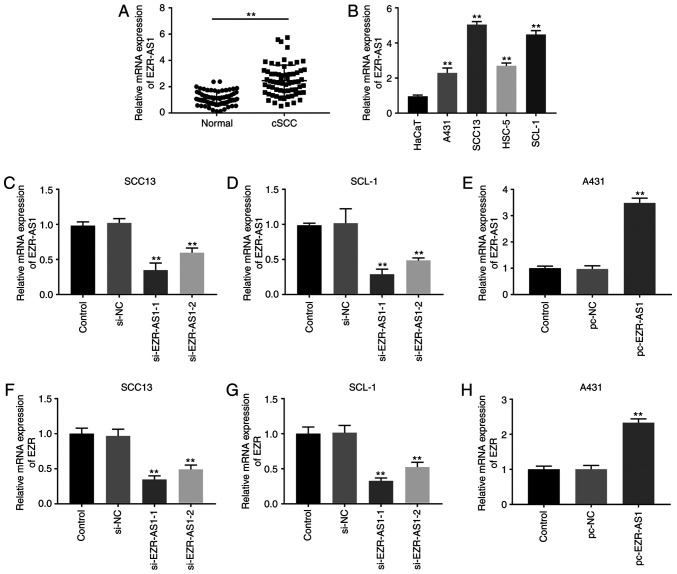
Although long non‑coding RNAs (lncRNAs) have been implicated in various human cancer types, the role of lncRNA ezrin antisense RNA 1 (EZR‑AS1) in cutaneous squamous cell carcinoma (cSCC) remains unclear. The present study aimed to investigate the effect of lncRNAEZR‑AS1 on cSCC and identify the underlying molecular mechanisms. EZR‑AS1 expression was measured in cSCC tissue and cells detected using reverse transcription‑quantitative PCR. Gain‑of‑function assays were performed in A431 cells, which have a relatively low expression of EZR‑AS1, while loss‑of‑function assays were performed in SCC13 and SCL‑1 colon cancer cells, which have a relatively high expression of EZR‑AS1. Cell viability, proliferation, migration, invasion and apoptosis were assessed using MTT, plate cloning, wound healing, Transwell and flow cytometry assays, respectively. EZR‑AS1 mRNA expression levels were significantly upregulated in cSCC tissues and cells compared with adjacent healthy tissues and HaCaT cells, respectively. Compared with the small interfering RNA (si)‑negative control (NC) group, si‑EZR‑AS1 significantly inhibited SCC13 and SCL‑1 cell proliferation, migration and invasion, but promoted cell apoptosis. By contrast, compared with the pc‑NC group, EZR‑AS1 overexpression significantly enhanced A431 cell proliferation, migration and invasion, but inhibited cell apoptosis. Moreover, focal adhesion kinase (FAK) was identified as a target of EZR‑AS1, and EZR‑AS1 knockdown significantly decreased FAK expression compared with the si‑NC group. Moreover, EZR‑AS1 knockdown significantly downregulated the protein expression levels of phosphorylated (p)‑PI3K/PI3K and p‑AKT/AKT in cSCC cells compared with the si‑NC group. The PI3K agonist 740Y‑P significantly reversed si‑EZR‑AS1‑mediated effects on SCC13 and SCL‑1 cell proliferation, migration, invasion and apoptosis. In conclusion, the present study demonstrated that si‑EZR‑AS1 inhibited cSCC cell proliferation, migration and invasion, and promoted cell apoptosis, potentially via regulating the PI3K/AKT signaling pathway. Therefore, the present study provided novel insights into the diagnosis and treatment of cSCC.
尽管长链非编码 RNA(lncRNA)已被认为与多种人类癌症类型有关,但 lncRNA ezrin 反义 RNA 1(EZR-AS1)在皮肤鳞状细胞癌(cSCC)中的作用仍不清楚。本研究旨在探讨 lncRNA EZR-AS1 对 cSCC 的影响,并确定潜在的分子机制。通过逆转录-定量 PCR 检测 cSCC 组织和细胞中的 EZR-AS1 表达。在 A431 细胞中进行了过表达实验,A431 细胞中 EZR-AS1 的表达相对较低,而在 SCC13 和 SCL-1 结肠癌细胞中进行了敲低实验,SCC13 和 SCL-1 结肠癌细胞中 EZR-AS1 的表达相对较高。通过 MTT、平板克隆、划痕愈合、Transwell 和流式细胞术检测细胞活力、增殖、迁移、侵袭和凋亡。与相邻健康组织和 HaCaT 细胞相比,cSCC 组织和细胞中的 EZR-AS1 mRNA 表达水平明显上调。与 si-NC 组相比,si-EZR-AS1 显著抑制 SCC13 和 SCL-1 细胞的增殖、迁移和侵袭,但促进细胞凋亡。相反,与 pc-NC 组相比,EZR-AS1 的过表达显著增强 A431 细胞的增殖、迁移和侵袭,但抑制细胞凋亡。此外,发现粘着斑激酶(FAK)是 EZR-AS1 的靶标,与 si-NC 组相比,EZR-AS1 敲低显著降低 FAK 的表达。此外,与 si-NC 组相比,EZR-AS1 敲低显著下调 cSCC 细胞中磷酸化(p)-PI3K/PI3K 和 p-AKT/AKT 的蛋白表达水平。PI3K 激动剂 740Y-P 显著逆转了 si-EZR-AS1 对 SCC13 和 SCL-1 细胞增殖、迁移、侵袭和凋亡的影响。综上所述,本研究表明,si-EZR-AS1 抑制 cSCC 细胞的增殖、迁移和侵袭,并促进细胞凋亡,可能是通过调节 PI3K/AKT 信号通路。因此,本研究为 cSCC 的诊断和治疗提供了新的见解。