Department of International Medical Center, Xiangya Hospital, Central South University, Changsha, Hunan 410008, P.R. China.
Department of Integrated Traditional Chinese and Western Medicine, Xiangya Hospital, Central South University, Changsha, Hunan 410008, P.R. China.
Mol Med Rep. 2021 Jan;23(1). doi: 10.3892/mmr.2020.11726. Epub 2020 Nov 25.
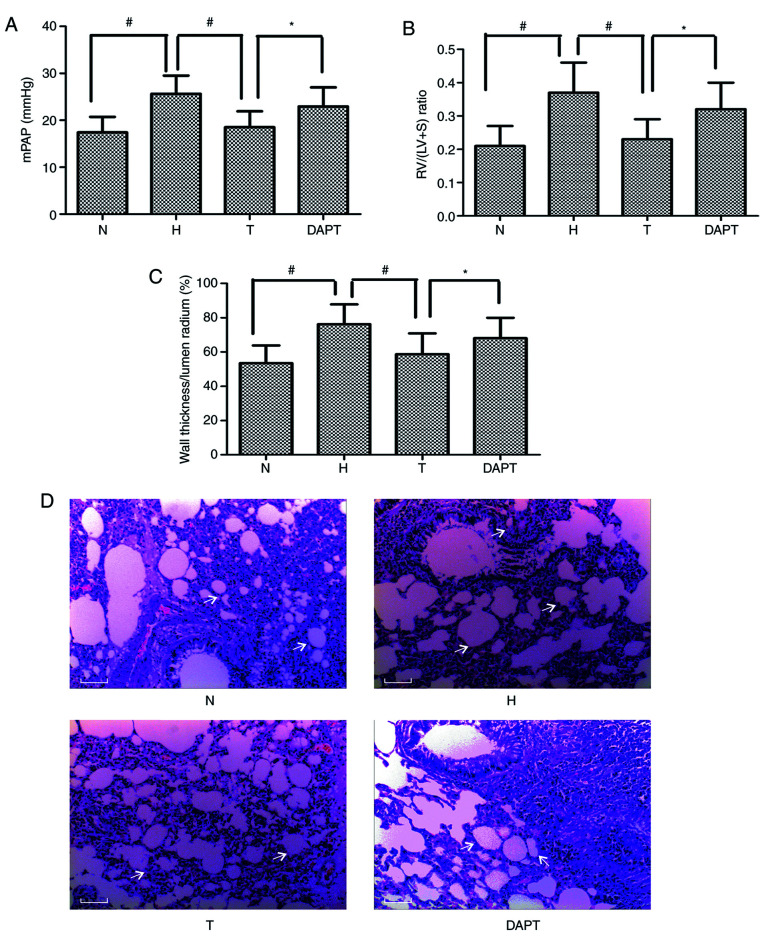
The Notch signaling pathway participates in pulmonary artery smooth muscle cell (PASMC) proliferation and apoptosis. Astragaloside IV (AS‑IV) is an effective antiproliferative treatment for vascular diseases. The present study aimed to investigate the protective effects and mechanisms underlying AS‑IV on hypoxia‑induced PASMC proliferation and pulmonary vascular remodeling in pulmonary arterial hypertension (PAH) model rats. Rats were divided into the following four groups: i) normoxia; ii) hypoxia (10% O); iii) treatment, hypoxia + intragastrical administration of AS‑IV (2 mg/kg) daily for 28 days; and iv) DAPT, hypoxia + AS‑IV treatment + subcutaneous administration of DAPT (10 mg/kg) three times daily. The effects of AS‑IV treatment on the development of hypoxia‑induced PAH, right ventricle (RV) hypertrophy and pulmonary vascular remodeling were examined. Furthermore, PASMCs were treated with 20 µmol/l AS‑IV under hypoxic conditions for 48 h. To determine the effect of Notch signaling in vascular remodeling and the potential mechanisms underlying AS‑IV treatment, 5 mmol/l γ‑secretase inhibitor [N‑[N‑(3,5‑difluorophenacetyl)‑L‑alanyl]‑S‑phenylglycine t‑butyl ester (DAPT)] was used. Cell viability and apoptosis were determined by performing the MTT assay and flow cytometry, respectively. Immunohistochemistry was conducted to detect the expression of proliferating cell nuclear antigen (PCNA). Moreover, the mRNA and protein expression levels of Notch‑3, Jagged‑1, hes family bHLH transcription factor 5 (Hes‑5) and PCNA were measured via reverse transcription‑quantitative PCR and western blotting, respectively. Compared with the normoxic group, hypoxia‑induced PAH model rats displayed characteristics of PAH and RV hypertrophy, whereas AS‑IV treatment alleviated PAH and prevented RV hypertrophy. AS‑IV also inhibited hypoxia‑induced pulmonary vascular remodeling, as indicated by reduced wall thickness and increased lumen diameter of pulmonary arterioles, and decreased muscularization of distal pulmonary vasculature in hypoxia‑induced PAH model rats. Compared with normoxia, hypoxia promoted PASMC proliferation , whereas AS‑IV treatment inhibited hypoxia‑induced PASMC proliferation by downregulating PCNA expression and . In hypoxia‑treated PAH model rats and cultured PASMCs, AS‑IV treatment reduced the expression levels of Jagged‑1, Notch‑3 and Hes‑5. Furthermore, Notch signaling inhibition via DAPT significantly inhibited the pulmonary vascular remodeling effect of AS‑IV and . Collectively, the results indicated that AS‑IV effectively reversed hypoxia‑induced pulmonary vascular remodeling and PASMC proliferation via the Notch signaling pathway. Therefore, the present study provided novel insights into the mechanism underlying the use of AS‑IV for treatment of vascular diseases, such as PAH.
Notch 信号通路参与肺动脉平滑肌细胞(PASMC)的增殖和凋亡。黄芪甲苷(AS- IV)是血管疾病的有效抗增殖治疗药物。本研究旨在探讨 AS-IV 对缺氧诱导的肺动脉高压(PAH)模型大鼠 PASMC 增殖和肺血管重构的保护作用及其机制。大鼠分为以下四组:i)常氧;ii)缺氧(10%O);iii)治疗,缺氧+每日灌胃 AS-IV(2mg/kg),共 28 天;iv)DAPT,缺氧+AS-IV 治疗+每日皮下注射 DAPT(10mg/kg),共 3 次。检测 AS-IV 治疗对缺氧诱导的 PAH、右心室(RV)肥大和肺血管重构发展的影响。此外,在缺氧条件下用 20μmol/L AS-IV 处理 PASMC 48h。为了确定 Notch 信号在血管重构中的作用以及 AS-IV 治疗的潜在机制,使用 5mmol/L γ-分泌酶抑制剂[N-[[N-(3,5-二氟苯乙酰基)-L-丙氨酰]-S-苯甘氨酸叔丁酯(DAPT)]。通过 MTT 测定法和流式细胞术分别测定细胞活力和细胞凋亡。免疫组织化学法检测增殖细胞核抗原(PCNA)的表达。此外,通过逆转录定量 PCR 和蛋白质印迹法分别测量 Notch-3、Jagged-1、Hes 家族 bHLH 转录因子 5(Hes-5)和 PCNA 的 mRNA 和蛋白质表达水平。与常氧组相比,缺氧诱导的 PAH 模型大鼠表现出 PAH 和 RV 肥大的特征,而 AS-IV 治疗减轻了 PAH 并预防了 RV 肥大。AS-IV 还抑制了缺氧诱导的肺血管重构,表现为缺氧诱导的 PAH 模型大鼠肺小动脉壁厚度降低和管腔直径增加,以及远端肺血管的肌化减少。与常氧相比,缺氧促进 PASMC 增殖,而 AS-IV 治疗通过下调 PCNA 表达抑制缺氧诱导的 PASMC 增殖。在缺氧处理的 PAH 模型大鼠和培养的 PASMC 中,AS-IV 治疗降低了 Jagged-1、Notch-3 和 Hes-5 的表达水平。此外,通过 DAPT 抑制 Notch 信号显著抑制了 AS-IV 的肺血管重构作用。综上所述,该研究结果表明,AS-IV 通过 Notch 信号通路有效逆转了缺氧诱导的肺血管重构和 PASMC 增殖。因此,本研究为 AS-IV 治疗血管疾病(如 PAH)的机制提供了新的见解。