Department of Vector Biology, Liverpool School of Tropical Medicine, Liverpool, United Kingdom.
Department of Tropical Disease Biology, Liverpool School of Tropical Medicine, Liverpool, United Kingdom.
PLoS Negl Trop Dis. 2020 Nov 25;14(11):e0008308. doi: 10.1371/journal.pntd.0008308. eCollection 2020 Nov.
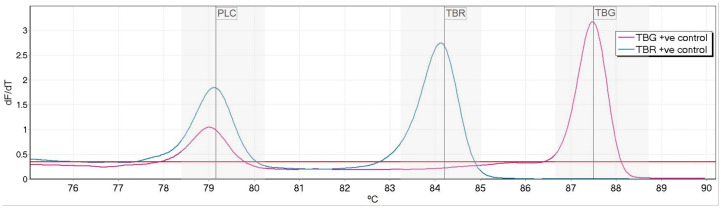
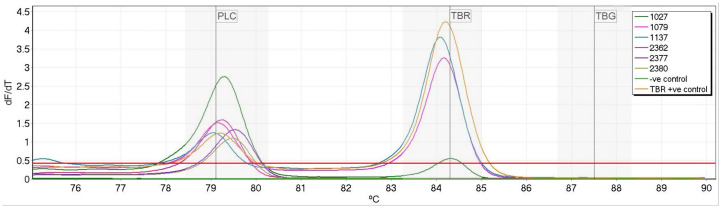
Human African Trypanosomiasis (HAT) is a potentially fatal parasitic infection caused by the trypanosome sub-species Trypanosoma brucei gambiense and T. b. rhodesiense transmitted by tsetse flies. Currently, global HAT case numbers are reaching less than 1 case per 10,000 people in many disease foci. As such, there is a need for simple screening tools and strategies to replace active screening of the human population which can be maintained post-elimination for Gambian HAT and long-term for Rhodesian HAT. Here, we describe the proof of principle application of a novel high-resolution melt assay for the xenomonitoring of Trypanosoma brucei gambiense and T. b. rhodesiense in tsetse. Both novel and previously described primers which target species-specific single copy genes were used as part of a multiplex qPCR. An additional primer set was included in the multiplex to determine if samples had sufficient genomic material for detecting genes present in low copy number. The assay was evaluated on 96 wild-caught tsetse previously identified to be positive for T. brucei s. l. of which two were known to be positive for T. b. rhodesiense. The assay was found to be highly specific with no cross-reactivity with non-target trypanosome species and the assay limit of detection was 104 tryps/mL. The qPCR successfully identified three T. b. rhodesiense positive flies, in agreement with the reference species-specific PCRs. This assay provides an alternative to running multiple PCRs when screening for pathogenic sub-species of T. brucei s. l. and produces results in less than 2 hours, avoiding gel electrophoresis and subjective analysis. This method could provide a component of a simple and efficient method of screening large numbers of tsetse flies in known HAT foci or in areas at risk of recrudescence or threatened by the changing distribution of both forms of HAT.
人体感染非洲锥虫病(HAT)是一种潜在致命的寄生虫感染,由布氏锥虫亚种冈比亚锥虫和罗得西亚锥虫通过采采蝇传播引起。目前,在许多疾病流行地区,全球 HAT 病例数已降至每 10000 人不到 1 例。因此,需要简单的筛查工具和策略来替代对人群的主动筛查,这种筛查在冈比亚型 HAT 消除后和罗得西亚型 HAT 长期存在的情况下可以进行。在这里,我们描述了一种新型高分辨率熔解分析(HRM)在采采蝇中对冈比亚锥虫和罗得西亚锥虫进行 xenomonitoring 的原理验证应用。用于多重 qPCR 的新型和以前描述的针对种特异性单拷贝基因的引物都被用作一部分。在多重 PCR 中还包括一组额外的引物,以确定样品是否具有足够的基因组材料来检测低拷贝数存在的基因。该检测方法在 96 只先前鉴定为携带布鲁斯锥虫 s.l.的野生捕获采采蝇上进行了评估,其中 2 只为罗得西亚锥虫阳性。该检测方法具有高度特异性,与非靶标锥虫物种无交叉反应,检测限为 104 个 tryp/mL。qPCR 成功鉴定了 3 只罗得西亚锥虫阳性的苍蝇,与参考种特异性 PCR 一致。该检测方法为筛选布鲁斯锥虫 s.l.的致病性亚种提供了一种替代多种 PCR 的方法,并在不到 2 小时内产生结果,避免了凝胶电泳和主观分析。这种方法可以为在已知 HAT 流行地区或在复发风险或两种 HAT 形式的分布变化受到威胁的地区筛选大量采采蝇提供一种简单有效的方法的组成部分。