
乌干达北部两个地区无人体布氏锥虫病的证据:对牛、猪和采采蝇中是否存在布氏冈比亚锥虫的分析。
Evidence of the absence of human African trypanosomiasis in two northern districts of Uganda: Analyses of cattle, pigs and tsetse flies for the presence of Trypanosoma brucei gambiense.
机构信息
Department of Vector Biology, Liverpool School of Tropical Medicine, Liverpool, United Kingdom.
Institute for Global Health, University of Barcelona, Barcelona, Spain.
出版信息
PLoS Negl Trop Dis. 2020 Apr 7;14(4):e0007737. doi: 10.1371/journal.pntd.0007737. eCollection 2020 Apr.
BACKGROUND
Large-scale control of sleeping sickness has led to a decline in the number of cases of Gambian human African trypanosomiasis (g-HAT) to <2000/year. However, achieving complete and lasting interruption of transmission may be difficult because animals may act as reservoir hosts for T. b. gambiense. Our study aims to update our understanding of T. b. gambiense in local vectors and domestic animals of N.W. Uganda.
METHODS
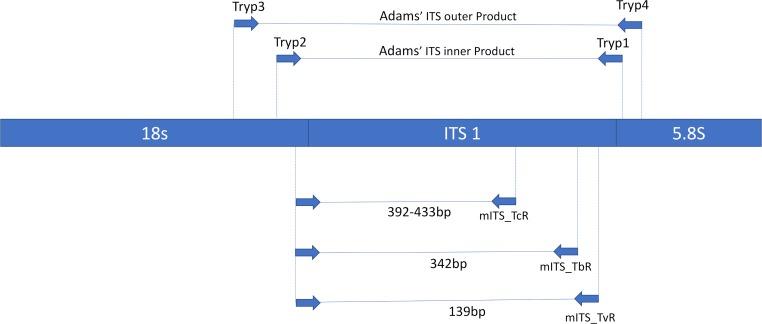
We collected blood from 2896 cattle and 400 pigs and In addition, 6664 tsetse underwent microscopical examination for the presence of trypanosomes. Trypanosoma species were identified in tsetse from a subsample of 2184 using PCR. Primers specific for T. brucei s.l. and for T. brucei sub-species were used to screen cattle, pig and tsetse samples.
RESULTS
In total, 39/2,088 (1.9%; 95% CI = 1.9-2.5) cattle, 25/400 (6.3%; 95% CI = 4.1-9.1) pigs and 40/2,184 (1.8%; 95% CI = 1.3-2.5) tsetse, were positive for T. brucei s.l.. Of these samples 24 cattle (61.5%), 15 pig (60%) and 25 tsetse (62.5%) samples had sufficient DNA to be screened using the T. brucei sub-species PCR. Further analysis found no cattle or pigs positive for T. b. gambiense, however, 17/40 of the tsetse samples produced a band suggestive of T. b. gambiense. When three of these 17 PCR products were sequenced the sequences were markedly different to T. b. gambiense, indicating that these flies were not infected with T. b. gambiense.
CONCLUSION
The lack of T. b. gambiense positives in cattle, pigs and tsetse accords with the low prevalence of g-HAT in the human population. We found no evidence that livestock are acting as reservoir hosts. However, this study highlights the limitations of current methods of detecting and identifying T. b. gambiense which relies on a single copy-gene to discriminate between the different sub-species of T. brucei s.l.
背景
大规模控制昏睡病导致冈比亚人体非洲锥虫病(g-HAT)的病例数下降到每年<2000 例。然而,实现传播的完全和持久中断可能很困难,因为动物可能是冈比亚锥虫(T. b. gambiense)的储存宿主。我们的研究旨在更新对 NW 乌干达当地媒介和家畜中 T. b. gambiense 的了解。
方法
我们从 2896 头牛和 400 头猪以及 6664 只采采蝇中采集血液,用于检测锥虫。从 2184 只采采蝇中抽取的一个亚样本中使用 PCR 鉴定采采蝇中的锥虫种类。针对 T. brucei s.l. 和 T. brucei 亚种的特异性引物用于筛选牛、猪和采采蝇样本。
结果
总共有 39/2088(1.9%;95%CI=1.9-2.5)头牛、25/400(6.3%;95%CI=4.1-9.1)头猪和 40/2184(1.8%;95%CI=1.3-2.5)只采采蝇对 T. brucei s.l.呈阳性。在这些样本中,24 头牛(61.5%)、15 头猪(60%)和 25 只采采蝇(62.5%)的 DNA 足够进行 T. brucei 亚种 PCR 筛查。进一步分析发现牛或猪没有 T. b. gambiense 阳性,但 40 只采采蝇样本中有 17 只产生了 T. b. gambiense 阳性的条带。当对这 17 个 PCR 产物中的 3 个进行测序时,序列与 T. b. gambiense 明显不同,表明这些苍蝇没有感染 T. b. gambiense。
结论
牛、猪和采采蝇中没有 T. b. gambiense 阳性与人类 g-HAT 的低流行率一致。我们没有发现家畜作为储存宿主的证据。然而,这项研究强调了当前检测和识别 T. b. gambiense 的方法存在局限性,该方法依赖于单个拷贝基因来区分 T. brucei s.l.的不同亚种。




 Zotero 插件