Martínez-González Nahara Anani, Di Gangi Stefania, Pichierri Giuseppe, Neuner-Jehle Stefan, Senn Oliver, Plate Andreas
Institute of Primary Care, University of Zurich and University Hospital of Zurich, Pestalozzistrasse 24, CH-8091 Zurich, Switzerland.
Department of Health Sciences and Medicine, University of Lucerne, Frohburgstrasse 3, PO Box 4466, CH-6002 Lucerne, Switzerland.
Antibiotics (Basel). 2020 Nov 23;9(11):837. doi: 10.3390/antibiotics9110837.
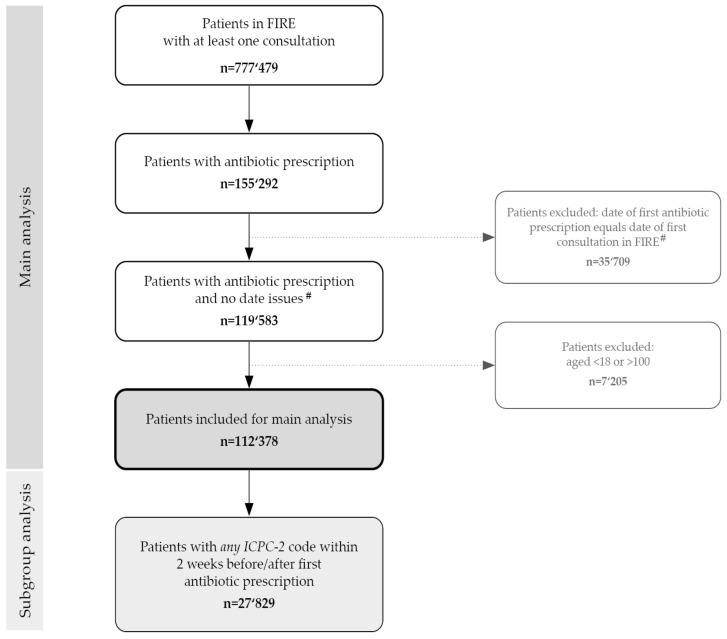
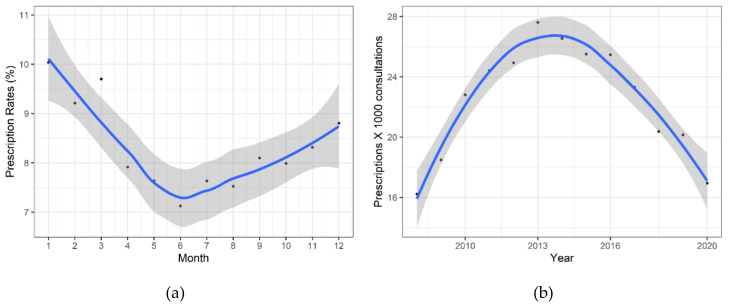
Antibiotic resistance (ABR) is a major threat to public health, and the majority of antibiotics are prescribed in the outpatient setting, especially in primary care. Monitoring antibiotic consumption is one key measure in containing ABR, but Swiss national surveillance data are limited. We conducted a retrospective cross-sectional study to characterise the patterns of antibiotic prescriptions, assess the time trends, and identify the factors associated with antibiotic prescribing in Swiss primary care. Using electronic medical records data, we analysed 206,599 antibiotic prescriptions from 112,378 patients. Based on 27,829 patient records, respiratory (52.1%), urinary (27.9%), and skin (4.8%) infections were the commonest clinical indications for antibiotic prescribing. The most frequently prescribed antibiotics were broad-spectrum penicillins (BSP) (36.5%), fluoroquinolones (16.4%), and macrolides/lincosamides (13.8%). Based on the WHO AWaRe classification, antibiotics were 57.9% Core-Access and 41.7% Watch, 69% of which were quinolones and macrolides. Between 2008 and 2020, fluoroquinolones and macrolides/lincosamides prescriptions significantly declined by 53% and 51%; BSP prescriptions significantly increased by 54%. Increasing patients' age, volume, and employment level were significantly associated with antibiotic prescribing. Our results may inform future antibiotic stewardship interventions to improve antibiotic prescribing.
抗生素耐药性(ABR)是对公众健康的重大威胁,大多数抗生素是在门诊环境中开具的,尤其是在初级医疗保健中。监测抗生素消费是控制ABR的一项关键措施,但瑞士的国家监测数据有限。我们进行了一项回顾性横断面研究,以描述抗生素处方模式、评估时间趋势,并确定瑞士初级医疗保健中与抗生素处方相关的因素。利用电子病历数据,我们分析了来自112378名患者的206599份抗生素处方。根据27829份患者记录,呼吸道感染(52.1%)、泌尿系统感染(27.9%)和皮肤感染(4.8%)是抗生素处方最常见的临床指征。最常开具的抗生素是广谱青霉素(BSP)(36.5%)、氟喹诺酮类(16.4%)和大环内酯类/林可酰胺类(13.8%)。根据世界卫生组织的AWaRe分类,抗生素中有57.9%属于核心使用类,41.7%属于谨慎使用类,其中69%是喹诺酮类和大环内酯类。在2008年至2020年期间,氟喹诺酮类和大环内酯类/林可酰胺类处方显著下降了53%和51%;BSP处方显著增加了54%。患者年龄的增加、就诊量和就业水平与抗生素处方显著相关。我们的结果可为未来改善抗生素处方的抗生素管理干预措施提供参考。