Department of Family Medicine, General Practice and Community Health, Faculty of Medicine, University of Tsukuba, 1-1-1 Tennodai, Tsukuba, Ibaraki, 305-8575, Japan.
Department of Primary Care and Medical Education, Faculty of Medicine, University of Tsukuba, 1-1-1 Tennodai, Tsukuba, Ibaraki, 305-8575, Japan.
BMC Med Educ. 2020 Nov 25;20(1):470. doi: 10.1186/s12909-020-02391-z.
A community-based medical education (CBME) curriculum may provide opportunities to learn about the social determinants of health (SDH) by encouraging reflection on context, but the categories that students can learn about and their level of reflection are unclear. We aimed to analyze medical students' understanding and level of reflection about SDH in a CBME curriculum.
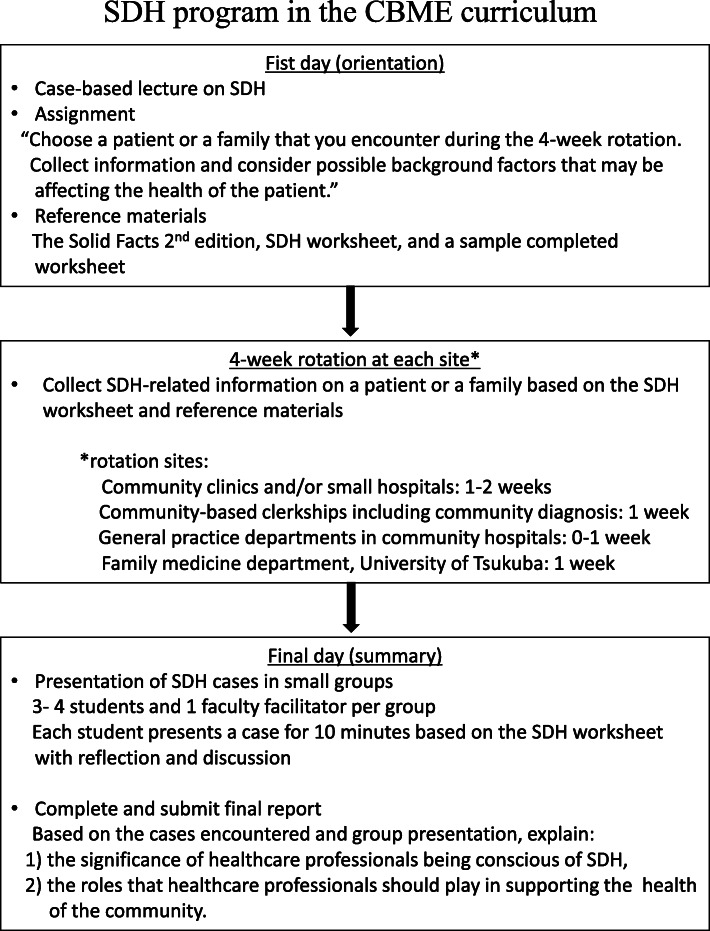
Study design: General inductive approach for qualitative data analysis. Education Program: All 5th-year and 6th-year medical students at the University of Tsukuba School of Medicine in Japan who completed a mandatory 4-week clinical clerkship in general medicine and primary care during October 2018 and May 2019 were included. The curriculum included 3 weeks of rotations in community clinics and hospitals in suburban and rural areas of Ibaraki Prefecture. On the first day, students learned about SDH through a lecture and a group activity. As an SDH assignment, they were instructed to prepare a structural case description using the Solid Facts framework based on encounters during the curriculum. On the final day, they submitted the structural reflection report.
Content analysis was based on the Solid Facts framework. Levels of reflection were categorized as reflective, analytical, or descriptive.
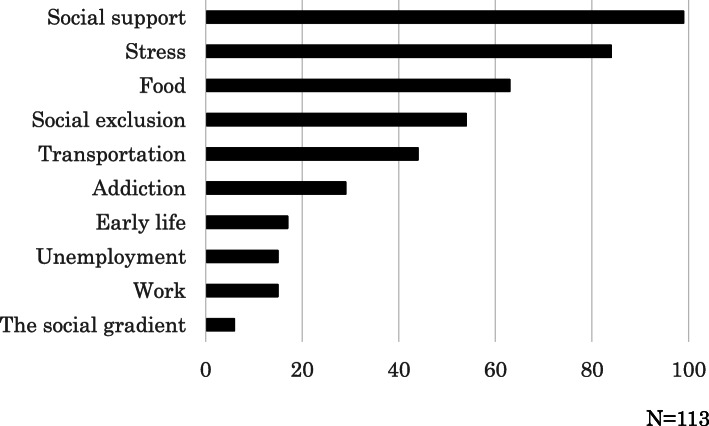
We analyzed 113 SDH case descriptions and 118 reports. On the SDH assignments, the students frequently reported on social support (85%), stress (75%), and food (58%), but less frequently on early life (15%), unemployment (14%), and social gradient (6%). Of the 118 reports, 2 were reflective, 9 were analytical, and 36 were descriptive. The others were not evaluable.
The CBME curriculum enabled medical students to understand the factors of SDH to some extent. Further work is needed to deepen their levels of reflection.
基于社区的医学教育(CBME)课程可以通过鼓励对背景的反思来提供学习健康的社会决定因素(SDH)的机会,但学生可以学习的类别及其反思水平尚不清楚。我们旨在分析医学生在 CBME 课程中对 SDH 的理解和反思水平。
研究设计:定性数据分析的一般归纳方法。教育计划:日本筑波大学医学院所有五年级和六年级的医学生都参加了这项研究,他们在 2018 年 10 月和 2019 年 5 月期间完成了为期 4 周的普通医学和初级保健临床实习。该课程包括在茨城县郊区和农村地区的社区诊所和医院进行 3 周的轮转。在第一天,学生通过讲座和小组活动了解 SDH。作为 SDH 作业,他们被指示根据课程期间的遭遇使用 Solid Facts 框架准备结构案例描述。在最后一天,他们提交了结构反思报告。
内容分析基于 Solid Facts 框架。反思水平分为反思性、分析性和描述性。
我们分析了 113 份 SDH 案例描述和 118 份报告。在 SDH 作业中,学生经常报告社会支持(85%)、压力(75%)和食物(58%),但较少报告早期生活(15%)、失业(14%)和社会梯度(6%)。在 118 份报告中,有 2 份是反思性的,9 份是分析性的,36 份是描述性的。其他的则无法评估。
CBME 课程使医学生在一定程度上能够理解 SDH 的因素。需要进一步努力深化他们的反思水平。