Department of Orthopaedic Surgery, Shanghai Jiao Tong University Affiliated Sixth People's Hospital, No. 600 Yishan Road, Shanghai, China.
Youth Science and Technology Innovation Studio of Shanghai Jiao Tong University School of Medicine, Shanghai, 200025, China.
Stem Cell Res Ther. 2020 Nov 25;11(1):500. doi: 10.1186/s13287-020-02016-8.
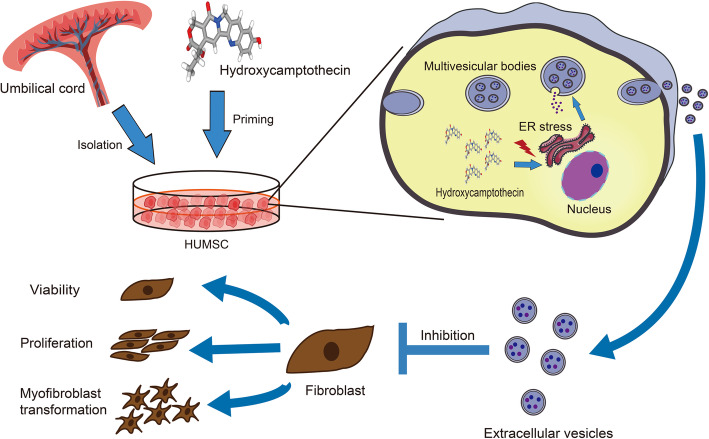
Peritendinous fibrosis represents a fibrotic healing process that usually occurs after tendon injury or surgery. This worldwide challenge hampers the functional rehabilitation and the mobility of extremities. However, effective treatment is still lacking at present. The aim of our study was to explore the effect of extracellular vesicles derived from hydroxycamptothecin primed human umbilical cord stem cells (HCPT-EVs) on post-traumatic tendon adhesion.
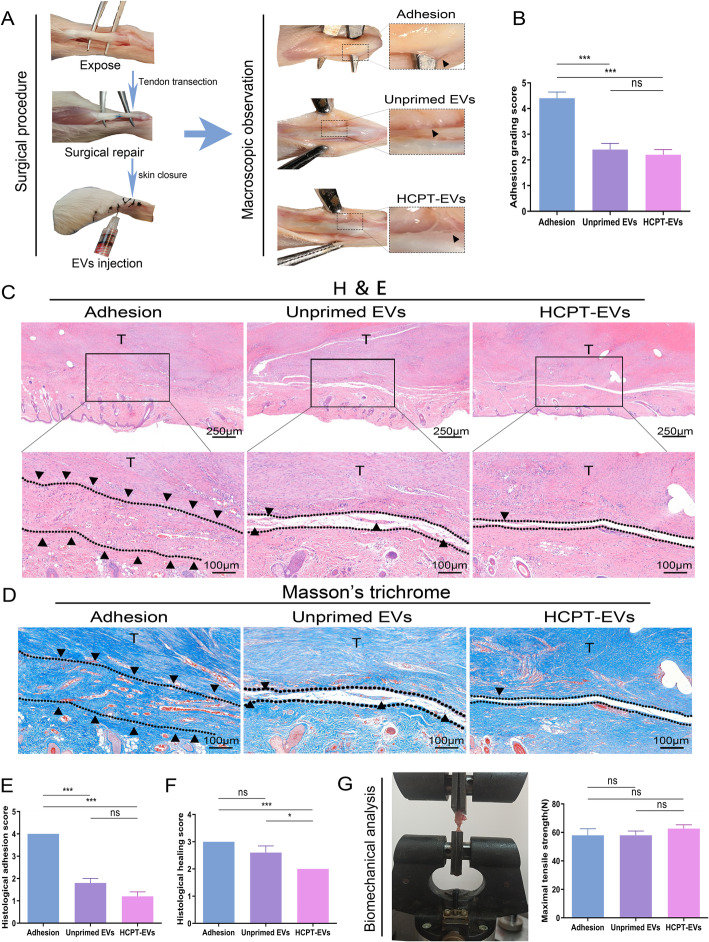
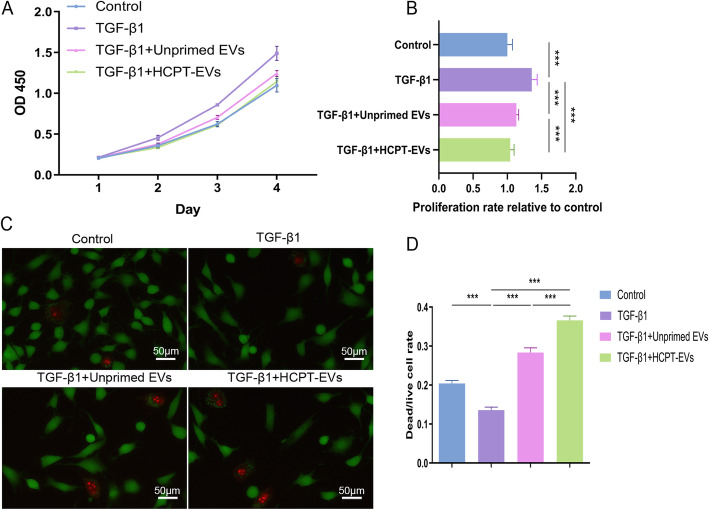
Extracellular vesicles derived from unprimed human umbilical cord mesenchymal stem cells (Unprimed EVs) or HCPT-EVs were isolated and characterized. A rat model of Achilles tendon injury was used to confirm the anti-adhesion effect of HCPT-EVs and compared with that of Unprimed EVs in vivo. In vitro, the inhibitory effects of HCPT-EVs on fibroblast proliferation, viability, and myofibroblast differentiation upon TGF-β1 stimulation were compared with the effects of Unprimed EVs. For mechanistic analysis, the expression of endoplasmic reticulum stress (ERS)-associated proteins was examined among the effector cargos of HCPT-EVs and Unprimed EVs. The ERS antagonist salubrinal was used to determine the ERS dependence of the anti-adhesion effects of HCPT-EVs.
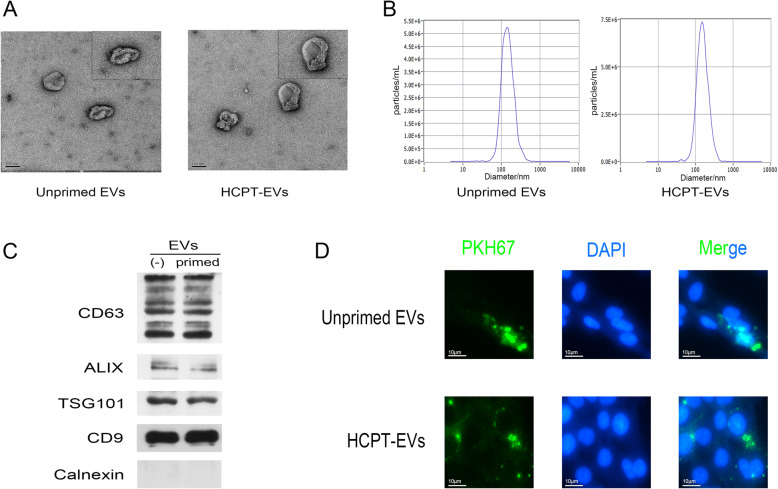
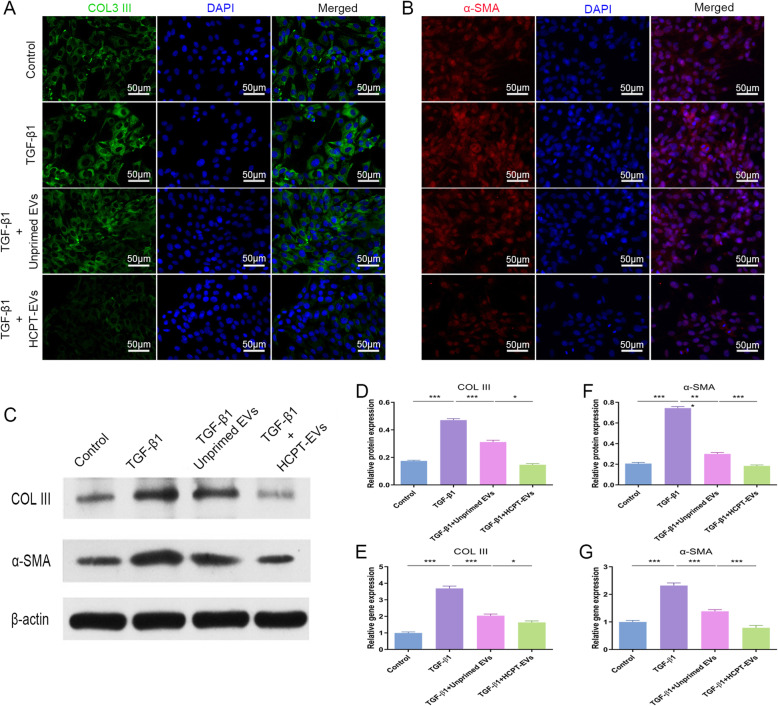
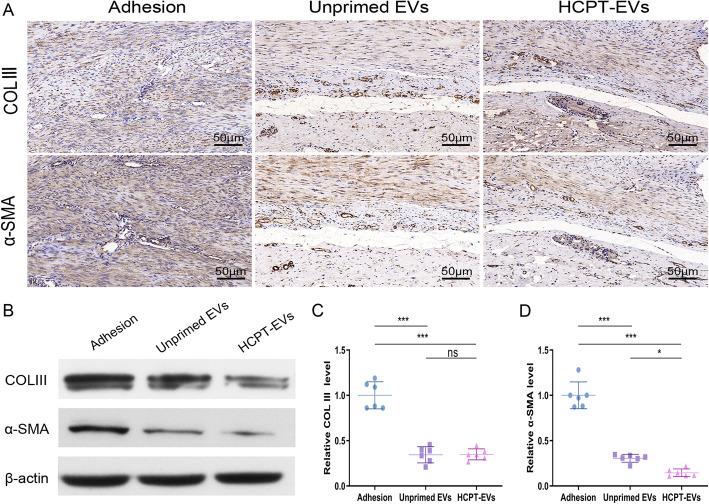
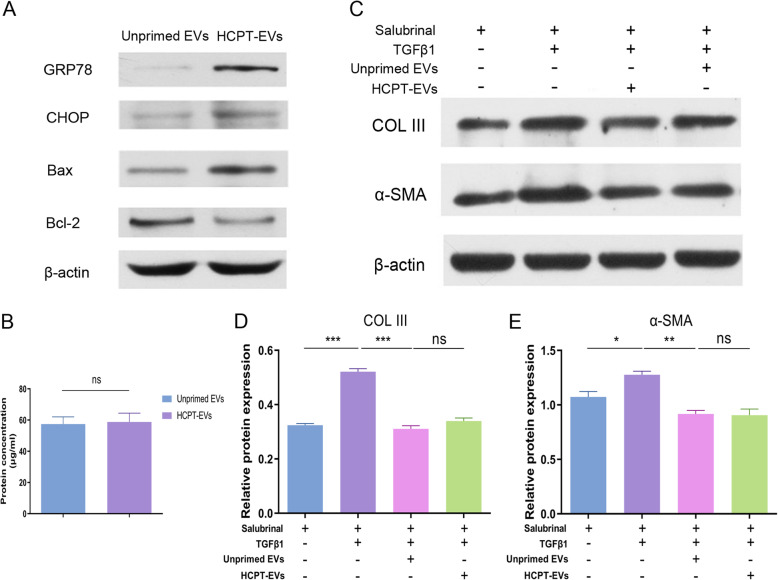
There were no obvious differences between Unprimed EVs and HCPT-EVs in terms of morphology, particle size, characteristic protein expression, and cellular uptake. HCPT-EVs exhibited a fortified anti-adhesion effect after Achilles tendon injury compared with Unprimed EVs. Fibroblast proliferation and viability and myofibroblast differentiation were all inhibited by HCPT-EVs. These properties were superior for HCPT-EVs relative to Unprimed EVs. Mechanistically, HCPT-EVs contained more ERS-associated protein than Unprimed EVs and activated the ERS pathway in fibroblast to counteract myofibroblast differentiation.
This study demonstrates that HCPT-EVs show high anti-adhesion potential for the treatment of tendon injury by provoking ERS in fibroblasts. HCPT-EVs represent a promising strategy for clinical use in treating adhesion-related diseases.
腱周纤维化代表一种纤维愈合过程,通常发生在肌腱损伤或手术后。这个全球性的挑战阻碍了四肢的功能康复和活动能力。然而,目前仍然缺乏有效的治疗方法。我们的研究目的是探讨羟基喜树碱预处理的人脐带间充质干细胞来源的细胞外囊泡(HCPT-EVs)对创伤后肌腱粘连的影响。
分离并鉴定未预处理的人脐带间充质干细胞来源的细胞外囊泡(Unprimed EVs)或 HCPT-EVs。使用大鼠跟腱损伤模型体内验证 HCPT-EVs 的抗粘连作用,并与 Unprimed EVs 进行比较。在体外,比较 HCPT-EVs 与 Unprimed EVs 对 TGF-β1 刺激下成纤维细胞增殖、活力和肌成纤维细胞分化的抑制作用。为了进行机制分析,在 HCPT-EVs 和 Unprimed EVs 的效应器 cargos 中检测内质网应激(ERS)相关蛋白的表达。使用 ERS 拮抗剂 salubrinal 来确定 HCPT-EVs 抗粘连作用的 ERS 依赖性。
Unprimed EVs 和 HCPT-EVs 在形态、粒径、特征蛋白表达和细胞摄取方面没有明显差异。与 Unprimed EVs 相比,HCPT-EVs 在跟腱损伤后表现出更强的抗粘连作用。HCPT-EVs 抑制成纤维细胞增殖、活力和肌成纤维细胞分化。这些特性均优于 Unprimed EVs。在机制上,HCPT-EVs 比 Unprimed EVs 含有更多的 ERS 相关蛋白,并在成纤维细胞中激活 ERS 途径以拮抗肌成纤维细胞分化。
本研究表明,HCPT-EVs 通过在成纤维细胞中引发 ERS 显示出治疗肌腱损伤的高抗粘连潜力。HCPT-EVs 为治疗与粘连相关的疾病提供了一种有前途的临床应用策略。