Department of Biological Sciences, Binghamton University, Binghamton, New York, USA.
Binghamton Biofilm Research Center, Binghamton University, Binghamton, New York, USA.
mSphere. 2020 Nov 25;5(6):e01109-20. doi: 10.1128/mSphere.01109-20.
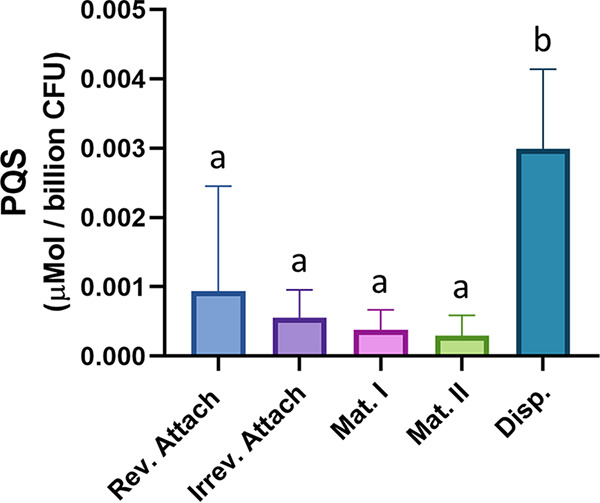
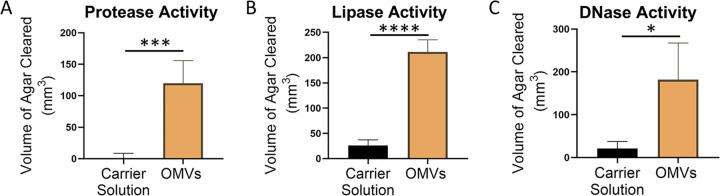
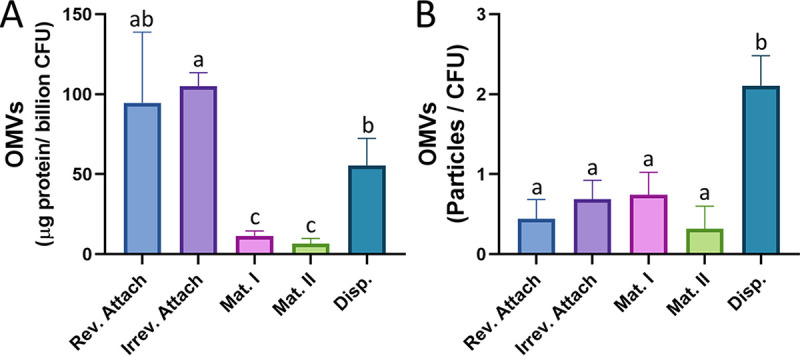
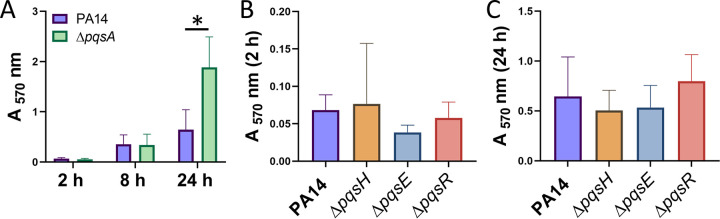
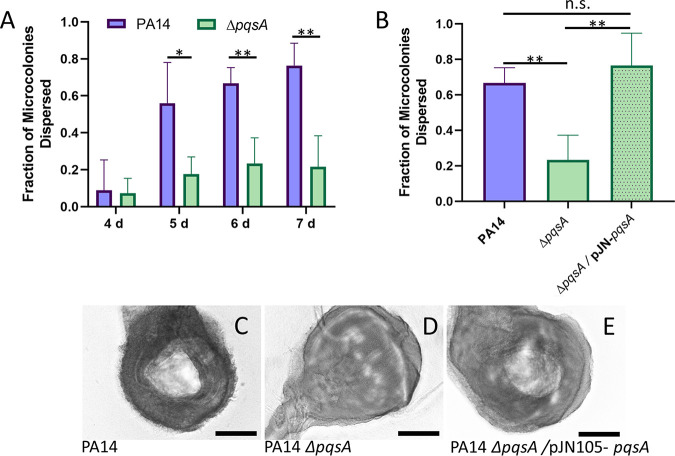
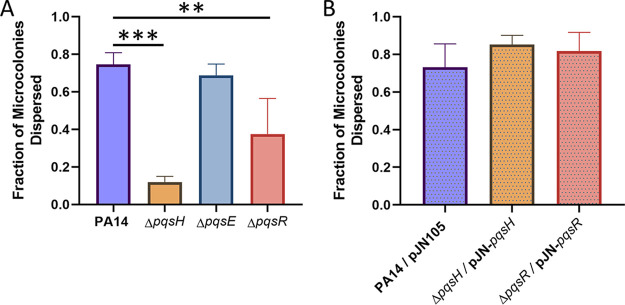
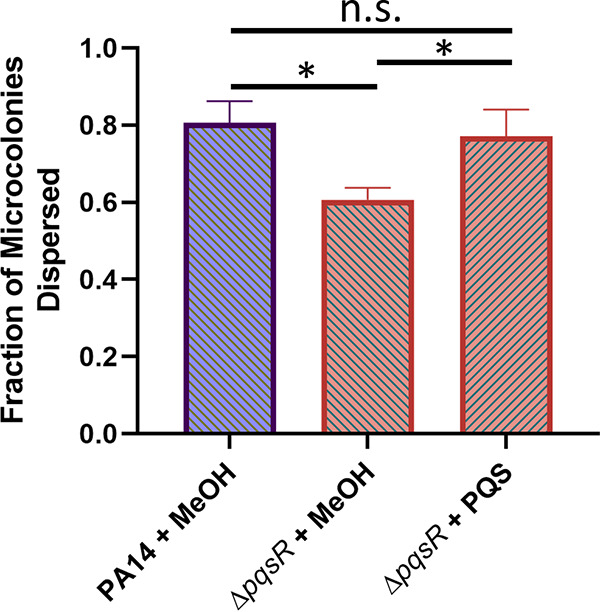
Bacterial biofilms are major contributors to chronic infections in humans. Because they are recalcitrant to conventional therapy, they present a particularly difficult treatment challenge. Identifying factors involved in biofilm development can help uncover novel targets and guide the development of antibiofilm strategies. causes surgical site, burn wound, and hospital-acquired infections and is also associated with aggressive biofilm formation in the lungs of cystic fibrosis patients. A potent but poorly understood contributor to virulence is the ability to produce outer membrane vesicles (OMVs). OMV trafficking has been associated with cell-cell communication, virulence factor delivery, and transfer of antibiotic resistance genes. Because OMVs have almost exclusively been studied using planktonic cultures, little is known about their biogenesis and function in biofilms. Several groups have shown that quinolone signal (PQS) induces OMV formation in Our group described a biophysical mechanism for this and recently showed it is operative in biofilms. Here, we demonstrate that PQS-induced OMV production is highly dynamic during biofilm development. Interestingly, PQS and OMV synthesis are significantly elevated during dispersion compared to attachment and maturation stages. PQS biosynthetic and receptor mutant biofilms were significantly impaired in their ability to disperse, but this phenotype was rescued by genetic complementation or exogenous addition of PQS. Finally, we show that purified OMVs can actively degrade extracellular protein, lipid, and DNA. We therefore propose that enhanced production of PQS-induced OMVs during biofilm dispersion facilitates cell escape by coordinating the controlled degradation of biofilm matrix components. Treatments that manipulate biofilm dispersion hold the potential to convert chronic drug-tolerant biofilm infections from protected sessile communities into released populations that are orders-of-magnitude more susceptible to antimicrobial treatment. However, dispersed cells often exhibit increased acute virulence and dissemination phenotypes. A thorough understanding of the dispersion process is therefore critical before this promising strategy can be effectively employed. quinolone signal (PQS) has been implicated in early biofilm development, but we hypothesized that its function as an outer membrane vesicle (OMV) inducer may contribute at multiple stages. Here, we demonstrate that PQS and OMVs are differentially produced during biofilm development and provide evidence that effective biofilm dispersion is dependent on the production of PQS-induced OMVs, which likely act as delivery vehicles for matrix-degrading enzymes. These findings lay the groundwork for understanding OMV contributions to biofilm development and suggest a model to explain the controlled matrix degradation that accompanies biofilm dispersion in many species.
细菌生物膜是导致人类慢性感染的主要因素。由于它们对常规治疗具有抗性,因此给治疗带来了特别大的挑战。鉴定生物膜形成过程中涉及的因素有助于发现新的靶点,并指导抗生物膜策略的制定。铜绿假单胞菌是引起手术部位、烧伤创面和医院获得性感染的主要病原体,也是囊性纤维化患者肺部侵袭性生物膜形成的相关因素。一种强有力但知之甚少的毒力因素是产生外膜囊泡(OMV)的能力。OMV 的运输与细胞间通讯、毒力因子传递和抗生素耐药基因转移有关。由于 OMV 几乎完全是在浮游培养物中进行研究的,因此对其在生物膜中的生物发生和功能知之甚少。有几个小组已经表明,铜绿假单胞菌信号(PQS)诱导铜绿假单胞菌形成 OMV。我们小组描述了这种现象的一种生物物理机制,最近还表明它在生物膜中起作用。在这里,我们证明了在生物膜发育过程中,PQS 诱导的 OMV 产生具有高度动态性。有趣的是,与附着和成熟阶段相比,PQS 和 OMV 合成在分散阶段显著升高。与野生型相比,PQS 生物合成和受体突变体生物膜在分散过程中明显受损,但通过遗传互补或外源添加 PQS 可挽救该表型。最后,我们表明纯化的 OMV 可以主动降解细胞外蛋白质、脂质和 DNA。因此,我们提出,在生物膜分散过程中,增强 PQS 诱导的 OMV 产生,通过协调生物膜基质成分的受控降解,促进细胞逃逸。操纵生物膜分散的治疗方法有可能将慢性药物耐受生物膜感染从受保护的静止社区转变为释放的群体,使其对抗菌治疗的敏感性提高几个数量级。然而,分散的细胞通常表现出增加的急性毒力和传播表型。因此,在有效地采用这一有希望的策略之前,必须对分散过程有一个透彻的了解。铜绿假单胞菌信号(PQS)已被牵涉到早期生物膜发育中,但我们假设,作为外膜囊泡(OMV)诱导物的功能可能在多个阶段发挥作用。在这里,我们证明了在铜绿假单胞菌生物膜的发育过程中,PQS 和 OMV 是不同的,并且有证据表明有效的生物膜分散依赖于 PQS 诱导的 OMV 的产生,而 PQS 诱导的 OMV 可能作为基质降解酶的输送载体。这些发现为理解 OMV 对生物膜发育的贡献奠定了基础,并提出了一个模型来解释许多物种生物膜分散时伴随的受控基质降解。