School of Psychology, Central China Normal University, Wuhan, 430079, China.
Key Laboratory of Adolescent Cyberpsychology and Behavior (CCNU), Ministry of Education, Wuhan, 430079, China.
Sci Rep. 2020 Nov 25;10(1):20515. doi: 10.1038/s41598-020-77538-5.
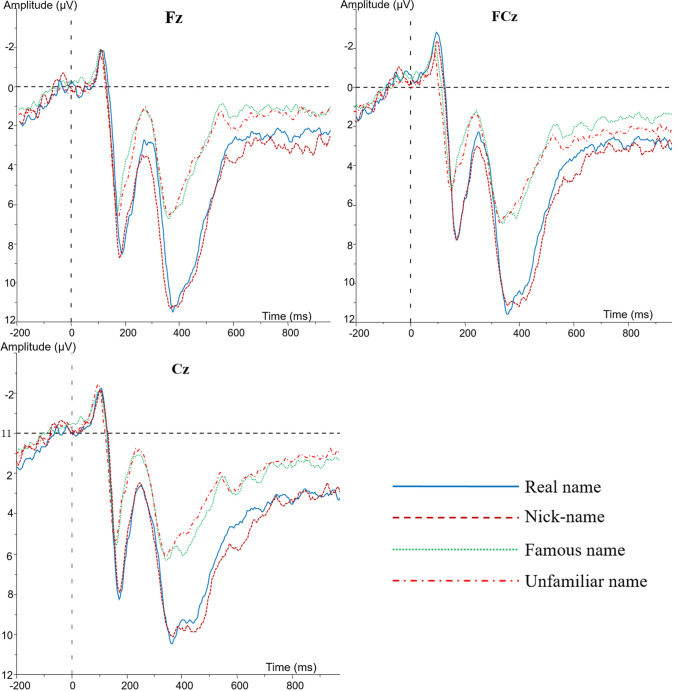
The present study examined whether individuals experienced the same cognitive advantage for online self-relevant information (nickname) as that experienced for information encountered in real life (real name) through two experiments at both the behavioural and neural levels (event-related potential, ERP). The results indicated that individuals showed the same cognitive advantage for nicknames and real names. At the behavioural level, a nickname was detected as quickly as the real name, and both were detected faster than a famous name; at the neural level, the P300 potential elicited by one's nickname was similar to that elicited by one's real name, and both the P300 amplitudes and latencies were larger and more prolonged than those elicited by other name stimuli. These results not only confirmed the cognitive advantage for one's own nickname and indicated that this self-advantage can be extended to online information, but also indicated that the virtual self could be integrated into the self and further expanded individuals' self-concept.
本研究通过两个行为和神经水平(事件相关电位,ERP)的实验,考察了个体是否对在线自我相关信息(昵称)和现实生活中遇到的信息(真名)有相同的认知优势。结果表明,个体对昵称和真名有相同的认知优势。在行为水平上,昵称的检测速度与真名一样快,两者的检测速度都快于著名名字;在神经水平上,一个人的昵称引发的 P300 电位与真名引发的 P300 电位相似,且两者的 P300 波幅和潜伏期都比其他名字刺激更大、更长。这些结果不仅证实了个体对自己的昵称有认知优势,表明这种自我优势可以扩展到在线信息,还表明虚拟自我可以融入自我,并进一步扩展个体的自我概念。