Archaeological Micromorphology and Biomarkers Laboratory (AMBI Lab), Instituto Universitario de Bio-Orgánica "Antonio González", Universidad de La Laguna, Tenerife, Spain.
Departamento de Biología Animal, Edafología y Geología, Universidad de La Laguna, Tenerife, Spain.
Sci Rep. 2020 Nov 25;10(1):20574. doi: 10.1038/s41598-020-77257-x.
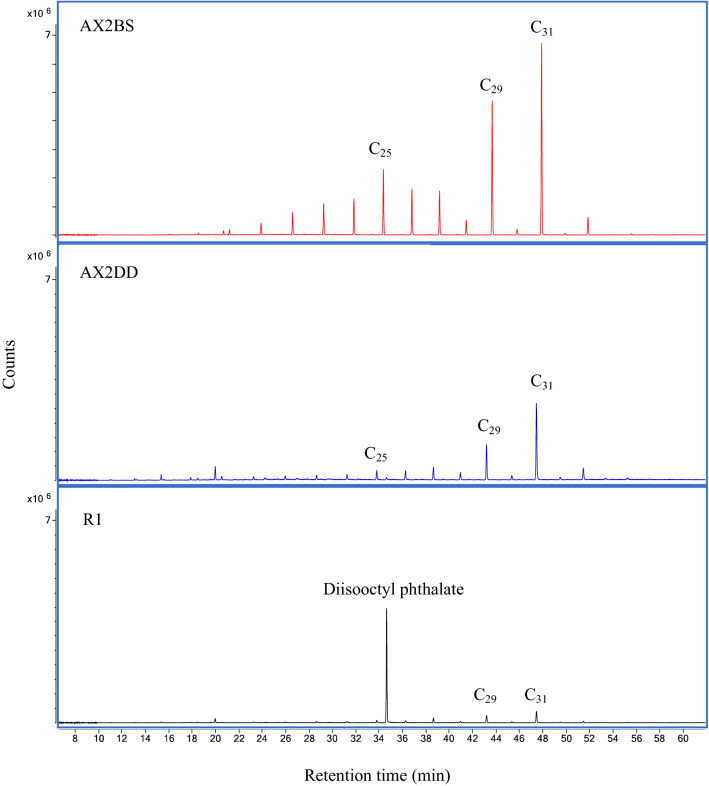
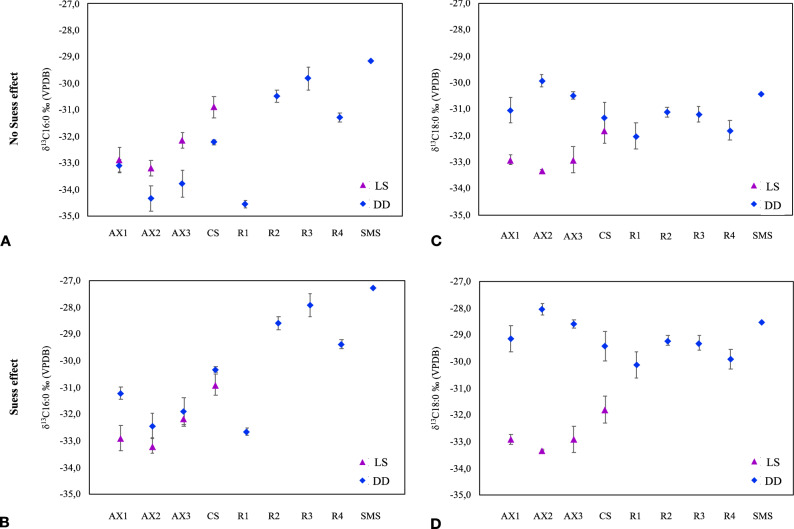
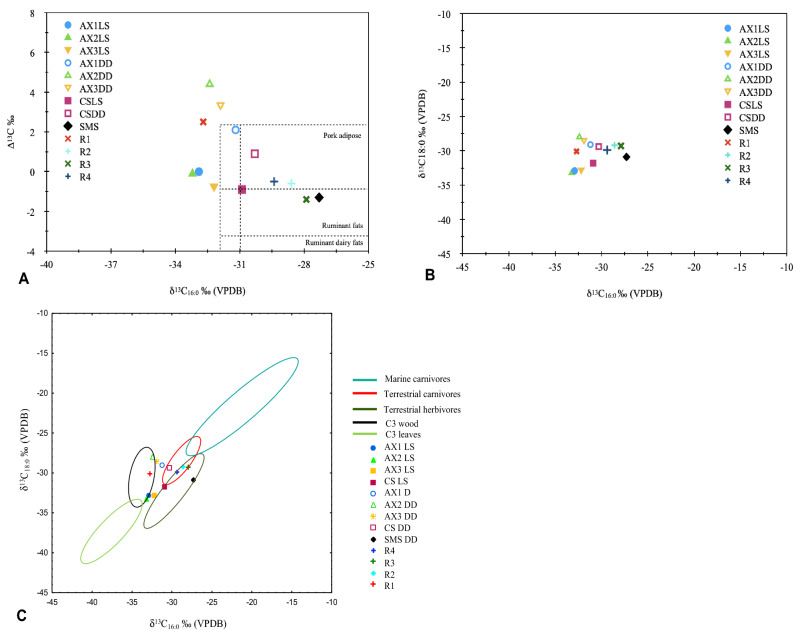
Characterizing organic matter preserved in archaeological sediment is crucial to behavioral and paleoenvironmental investigations. This task becomes particularly challenging when considering microstratigraphic complexity. Most of the current analytical methods rely on loose sediment samples lacking spatial and temporal resolution at a microstratigraphic scale, adding uncertainty to the results. Here, we explore the potential of targeted molecular and isotopic biomarker analysis on polyester resin-impregnated sediment slabs from archaeological micromorphology, a technique that provides microstratigraphic control. We performed gas chromatography-mass spectrometry (GC-MS) and gas chromatography-isotope ratio mass spectromety (GC-IRMS) analyses on a set of samples including drill dust from resin-impregnated experimental and archaeological samples, loose samples from the same locations and resin control samples to assess the degree of interference of polyester resin in the GC-MS and Carbon-IRMS signals of different lipid fractions (n-alkanes, aromatics, n-ketones, alcohols, fatty acids and other high polarity lipids). The results show that biomarkers within the n-alkane, aromatic, n-ketone, and alcohol fractions can be identified. Further work is needed to expand the range of identifiable lipid biomarkers. This study represents the first micro-contextual approach to archaeological lipid biomarkers and contributes to the advance of archaeological science by adding a new method to obtain behavioral or paleoenvironmental proxies.
对考古沉积物中保存的有机物进行特征描述,对于行为和古环境研究至关重要。当考虑到微地层的复杂性时,这项任务变得极具挑战性。目前大多数分析方法都依赖于缺乏微地层尺度时空分辨率的松散沉积物样本,这给结果带来了不确定性。在这里,我们探索了在考古微形态学中使用聚酯树脂浸渍的沉积物薄片进行靶向分子和同位素生物标志物分析的潜力,该技术可提供微地层控制。我们对一组样本进行了气相色谱-质谱(GC-MS)和气相色谱-同位素比质谱(GC-IRMS)分析,这些样本包括来自树脂浸渍实验和考古样本的钻尘、来自同一位置的松散样本和树脂对照样本,以评估聚酯树脂对不同脂质馏分(正烷烃、芳烃、正酮、醇、脂肪酸和其他高极性脂质)的 GC-MS 和碳同位素比质谱(Carbon-IRMS)信号的干扰程度。结果表明,可以识别正烷烃、芳烃、正酮和醇馏分中的生物标志物。需要进一步的工作来扩大可识别脂质生物标志物的范围。这项研究代表了对考古脂质生物标志物的首次微观方法研究,通过提供一种获取行为或古环境替代物的新方法,为考古学的发展做出了贡献。