Jones A T, Scheller C P, Prance J R, Kalyoncu Y B, Zumbühl D M, Haley R P
Department of Physics, Lancaster University, Lancaster, LA1 4YB UK.
Department of Physics, University of Basel, 4056 Basel, Switzerland.
J Low Temp Phys. 2020;201(5):772-802. doi: 10.1007/s10909-020-02472-9. Epub 2020 Jun 5.
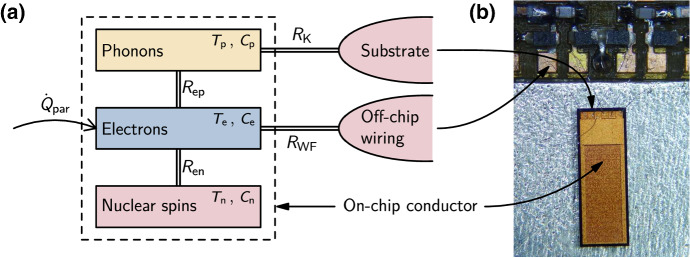
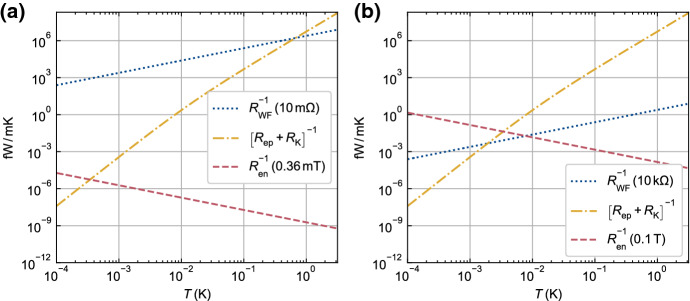
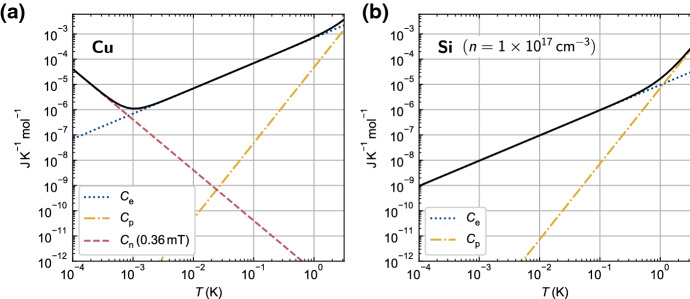
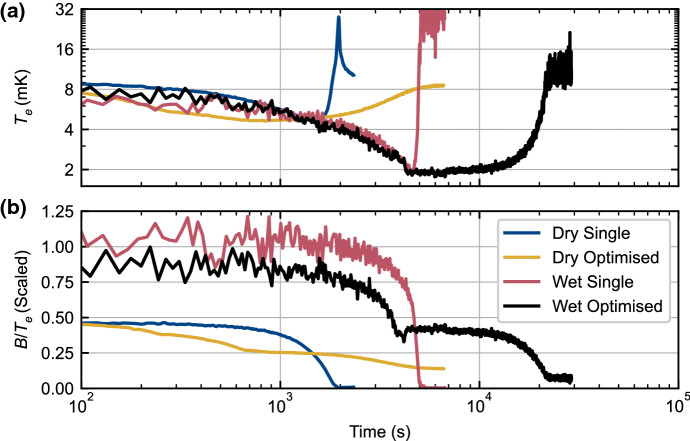
Here we review recent progress in cooling micro-/nanoelectronic devices significantly below 10 mK. A number of groups worldwide are working to produce sub-millikelvin on-chip electron temperatures, motivated by the possibility of observing new physical effects and improving the performance of quantum technologies, sensors and metrological standards. The challenge is a longstanding one, with the lowest reported on-chip electron temperature having remained around 4 mK for more than 15 years. This is despite the fact that microkelvin temperatures have been accessible in bulk materials since the mid-twentieth century. In this review, we describe progress made in the last 5 years using new cooling techniques. Developments have been driven by improvements in the understanding of nanoscale physics, material properties and heat flow in electronic devices at ultralow temperatures and have involved collaboration between universities and institutes, physicists and engineers. We hope that this review will serve as a summary of the current state of the art and provide a roadmap for future developments. We focus on techniques that have shown, in experiment, the potential to reach sub-millikelvin electron temperatures. In particular, we focus on on-chip demagnetisation refrigeration. Multiple groups have used this technique to reach temperatures around 1 mK, with a current lowest temperature below 0.5 mK.
在此,我们回顾了将微纳电子器件冷却至远低于10 mK的最新进展。受观测新物理效应以及提升量子技术、传感器和计量标准性能可能性的推动,全球多个团队致力于实现低于毫开尔文的片上电子温度。这一挑战由来已久,在过去15年多的时间里,所报道的最低片上电子温度一直维持在4 mK左右。尽管自20世纪中叶以来,大块材料就能达到微开尔文温度,但情况依然如此。在本综述中,我们描述了过去5年中利用新冷却技术所取得的进展。这些进展得益于对纳米尺度物理、材料特性以及超低温下电子器件中热流理解的提升,并且涉及大学与研究所、物理学家与工程师之间的合作。我们希望本综述能作为当前技术水平的总结,并为未来发展提供路线图。我们重点关注在实验中已显示出有潜力达到低于毫开尔文电子温度的技术。特别是,我们重点关注片上去磁制冷。多个团队已利用该技术达到了约1 mK的温度,目前的最低温度低于0.5 mK。