Laboratory of Evolutionary Genetics, Institute of Biosciences, University of São Paulo, São Paulo, Brazil.
Instituto de Matemática e Estatística, Universidade do Estado do Rio de Janeiro, Rio de Janeiro, Brazil.
Front Immunol. 2020 Nov 6;11:584950. doi: 10.3389/fimmu.2020.584950. eCollection 2020.
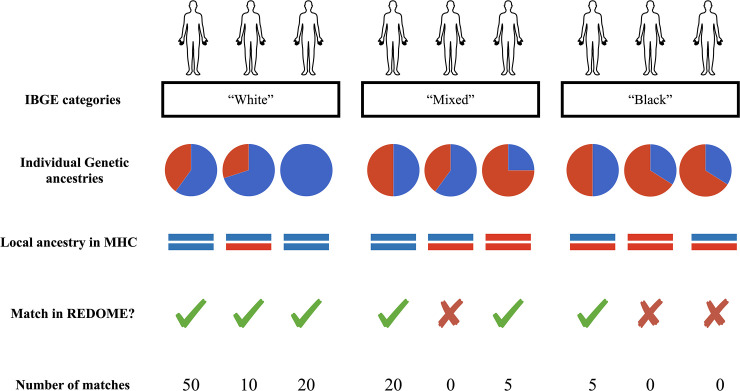
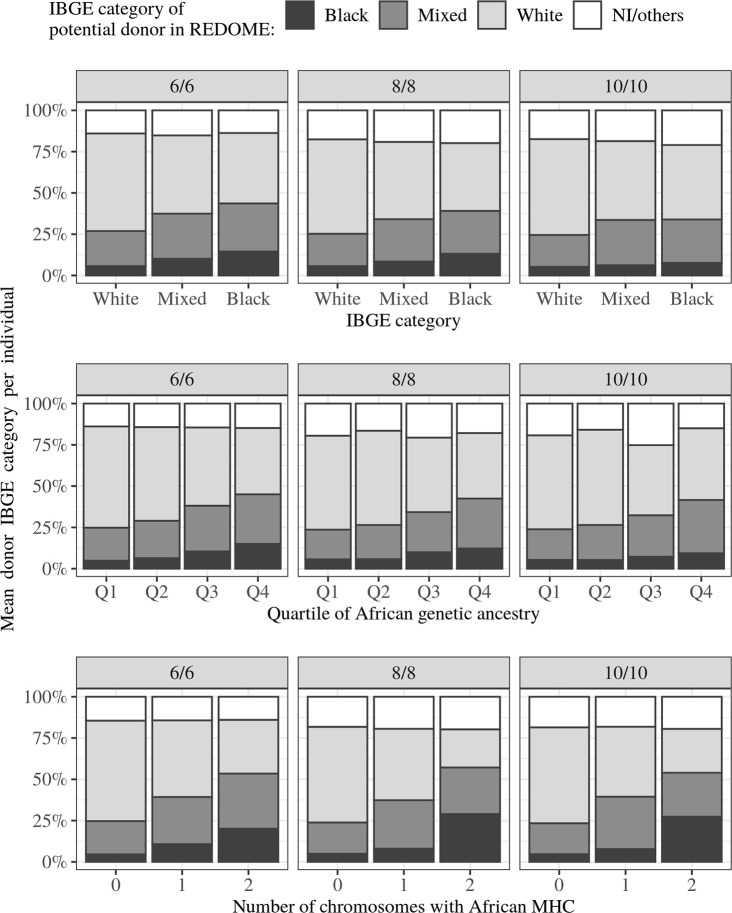
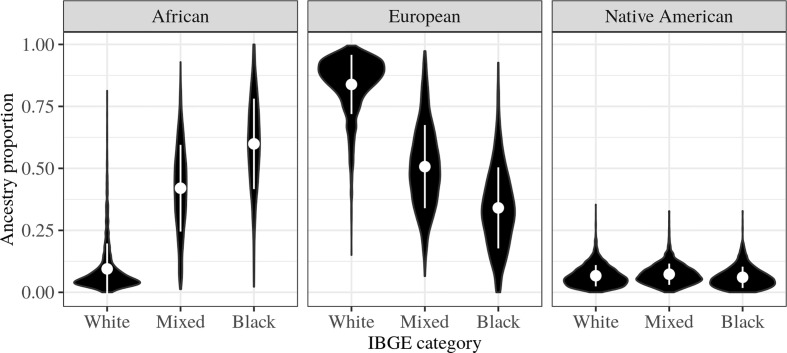
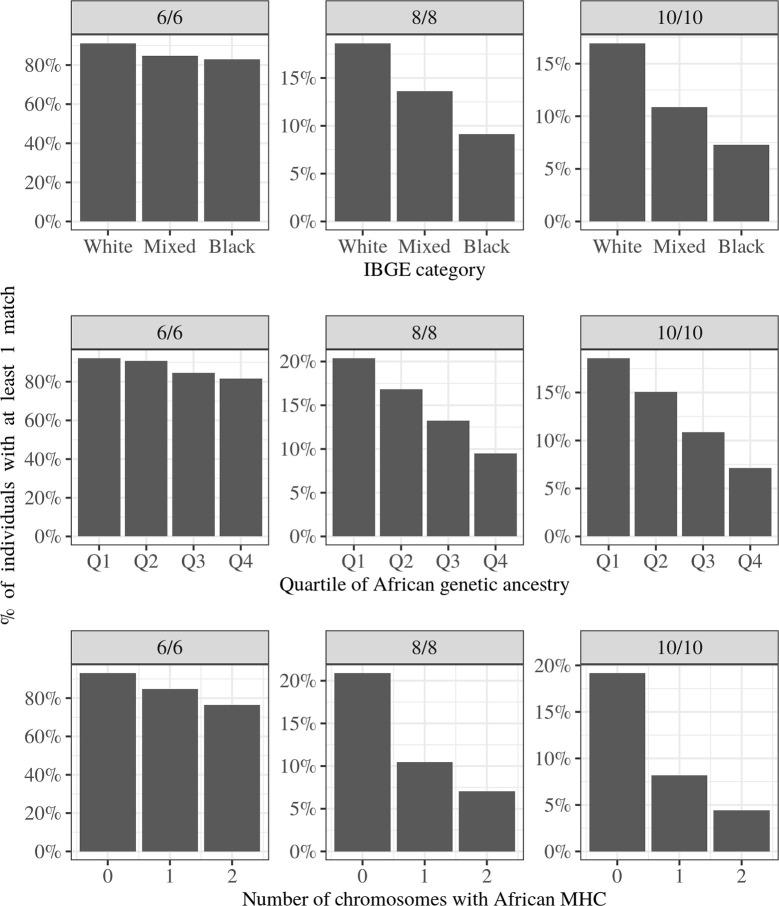
A match of HLA loci between patients and donors is critical for successful hematopoietic stem cell transplantation. However, the extreme polymorphism of HLA loci - an outcome of millions of years of natural selection - reduces the chances that two individuals will carry identical combinations of multilocus HLA genotypes. Further, HLA variability is not homogeneously distributed throughout the world: African populations on average have greater variability than non-Africans, reducing the chances that two unrelated African individuals are HLA identical. Here, we explore how self-identification (often equated with "ethnicity" or "race") and genetic ancestry are related to the chances of finding HLA compatible donors in a large sample from Brazil, a highly admixed country. We query REDOME, Brazil's Bone Marrow Registry, and investigate how different criteria for identifying ancestry influence the chances of finding a match. We find that individuals who self-identify as "Black" and "Mixed" on average have lower chances of finding matches than those who self-identify as "White" (up to 57% reduction). We next show that an individual's African genetic ancestry, estimated using molecular markers and quantified as the proportion of an individual's genome that traces its ancestry to Africa, is strongly associated with reduced chances of finding a match (up to 60% reduction). Finally, we document that the strongest reduction in chances of finding a match is associated with having an MHC region of exclusively African ancestry (up to 75% reduction). We apply our findings to a specific condition, for which there is a clinical indication for transplantation: sickle-cell disease. We show that the increased African ancestry in patients with this disease leads to reduced chances of finding a match, when compared to the remainder of the sample, without the condition. Our results underscore the influence of ancestry on chances of finding compatible HLA matches, and indicate that efforts guided to increasing the African component of registries are necessary.
患者和供者之间 HLA 基因座的匹配对于成功的造血干细胞移植至关重要。然而,HLA 基因座的极端多态性(自然选择数百万年的结果)降低了两个个体携带相同 HLA 多基因座基因型组合的可能性。此外,HLA 的变异性在全球范围内并非均匀分布:非洲人群的变异性平均高于非非洲人群,这降低了两个无关的非洲个体 HLA 完全相同的可能性。在这里,我们探讨了自我认同(通常等同于“种族”或“民族”)和遗传血统如何与在巴西的一个大型样本中找到 HLA 相容供者的机会相关,巴西是一个高度混合的国家。我们查询了巴西骨髓登记处 REDOME,并研究了不同的血统识别标准如何影响找到匹配的机会。我们发现,自我认同为“黑种人”和“混血儿”的个体平均比自我认同为“白种人”的个体找到匹配的机会更低(最多降低 57%)。我们接下来表明,个体的非洲遗传血统(使用分子标记估计,并以个体基因组中源自非洲的部分比例来量化)与找到匹配的机会降低密切相关(最多降低 60%)。最后,我们记录到找到匹配的机会最强的降低与 MHC 区域完全来自非洲血统有关(最多降低 75%)。我们将我们的发现应用于一种特定的疾病,即镰状细胞病,对于这种疾病,有移植的临床指征。我们表明,与没有该疾病的样本其余部分相比,患有这种疾病的个体的非洲遗传血统增加导致找到匹配的机会降低。我们的结果强调了血统对找到相容 HLA 匹配的机会的影响,并表明有必要指导努力增加登记处的非洲成分。