Benavent Diego, Plasencia-Rodríguez Chamaida, Franco-Gómez Karen, Nieto Romina, Monjo-Henry Irene, Peiteado Diana, Balsa Alejandro, Navarro-Compán Victoria
Rheumatology Service, Hospital Universitario la Paz-IdiPaz, Paseo de la Castellana 261, Madrid, 28046, Spain.
Rheumatology Service, Hospital Universitario la Paz-IdiPaz, Madrid, Spain.
Ther Adv Musculoskelet Dis. 2020 Nov 16;12:1759720X20971889. doi: 10.1177/1759720X20971889. eCollection 2020.
First, to compare clinical features and biological disease modifying anti-rheumatic drugs (bDMARDs) response in patients with axial spondyloarthritis (axSpA) and axial psoriatic arthritis (axPsA). Second, to identify possible predictors of treatment response in both entities.
One-year follow-up, observational, single-center study including all patients with axSpA or axPsA who started bDMARDs therapy. Clinical features were collected at baseline while disease activity was measured at baseline, 6 and 12 months by the Ankylosing Spondylitis Disease Activity Score and the Physician Global Assessment. The frequency of patients achieving inactive disease (ID), low disease activity (LDA), high or very high disease activity and clinical improvement were compared between axSpA and axPsA. Baseline predictor factors for achieving treatment response were identified through regression models, using odds ratio (OR) as an estimate.
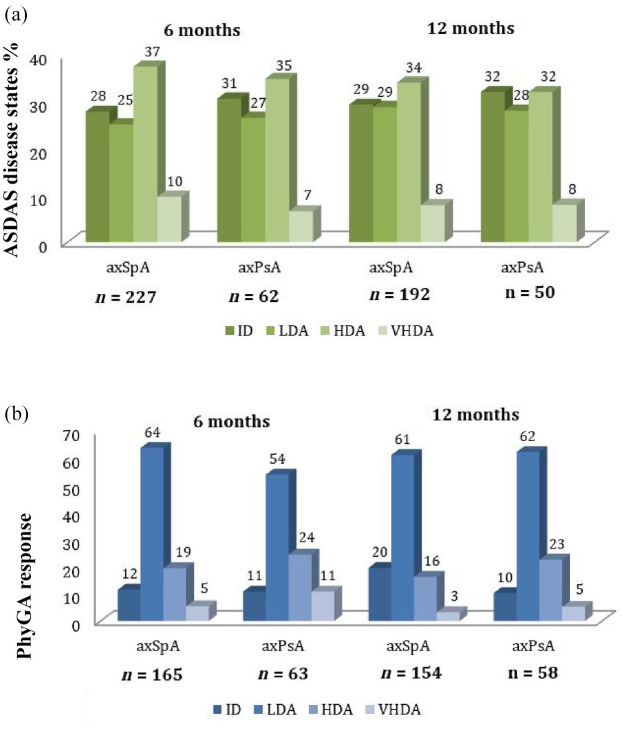
In total, 352 patients were included: 287 (81.5%) axSpA and 65 (18.5%) axPsA. No significant differences at baseline were observed between the two diseases for most of the characteristics. While HLA-B27 positivity was associated with axSpA (OR = 5.4; < 0.001), peripheral manifestations were associated with axPsA (OR = 4.7; < 0.001). The frequency of patients with axSpA and axPsA achieving ID/LDA after 6 and 12 months of bDMARDs was comparable: 53% 58%, = 0.5; and 58% 60%, = 0.9, respectively. Both diseases also presented similar clinical improvement. In axSpA and axPsA, male gender seemed to be associated with achieving LDA [OR at 12 months visit = 2.8 ( < 0.01) and 2.7 ( = 0.09)].
In clinical practice, patients with axSpA and axPsA present numerous similarities, including comparable medium-term clinical response to bDMARDs. Male gender could be a predictor of treatment response in both diseases.Keyword: axial spondyloarthritis, psoriatic arthritis, axial involvement, clinical characteristics.
第一,比较轴向性脊柱关节炎(axSpA)和轴向性银屑病关节炎(axPsA)患者的临床特征及生物性改善病情抗风湿药物(bDMARDs)反应。第二,确定这两种疾病治疗反应的可能预测因素。
一项为期一年的随访观察性单中心研究,纳入所有开始接受bDMARDs治疗的axSpA或axPsA患者。在基线时收集临床特征,同时在基线、6个月和12个月时通过强直性脊柱炎疾病活动评分和医生整体评估来测量疾病活动度。比较axSpA和axPsA患者达到疾病缓解(ID)、低疾病活动度(LDA)、高或非常高疾病活动度以及临床改善的频率。通过回归模型,以比值比(OR)作为估计值,确定达到治疗反应的基线预测因素。
总共纳入352例患者:287例(81.5%)axSpA和65例(18.5%)axPsA。在大多数特征方面,两种疾病在基线时未观察到显著差异。虽然HLA - B27阳性与axSpA相关(OR = 5.4;< 0.001),但外周表现与axPsA相关(OR = 4.7;< 0.001)。axSpA和axPsA患者在接受bDMARDs治疗6个月和12个月后达到ID/LDA的频率相当:分别为53%对58%,P = 0.5;以及58%对60%,P = 0.9。两种疾病也呈现出相似的临床改善情况。在axSpA和axPsA中,男性似乎与达到LDA相关[12个月随访时的OR分别为2.8(< 0.01)和2.7(P = 0.09)]。
在临床实践中,axSpA和axPsA患者存在许多相似之处,包括对bDMARDs的中期临床反应相当。男性可能是这两种疾病治疗反应的一个预测因素。关键词:轴向性脊柱关节炎,银屑病关节炎,轴向受累,临床特征