Lindström Ulf, Bremander Ann, Haglund Emma, Bergman Stefan, Petersson Ingemar F, Jacobsson Lennart T H
Department of Rheumatology and Inflammation Research, Institute of Medicine, Sahlgrenska Academy, University of Gothenburg, Guldhedsgatan 10A, 405 30, Gothenburg, Sweden.
Department of Clinical Sciences, Section of Rheumatology, Lund University, Lund, Sweden.
BMC Musculoskelet Disord. 2016 Feb 27;17:106. doi: 10.1186/s12891-016-0960-8.
In the broader spectrum of back pain, inflammatory back pain (IBP) is a symptom that may indicate axial spondyloarthritis (SpA). The objectives of this study were to determine the frequency of current IBP, as a hallmark sign of possible axial SpA, in patients with ankylosing spondylitis (AS), psoriatic arthritis (PsA) and other SpA and to compare self-reported health between the groups with current IBP.
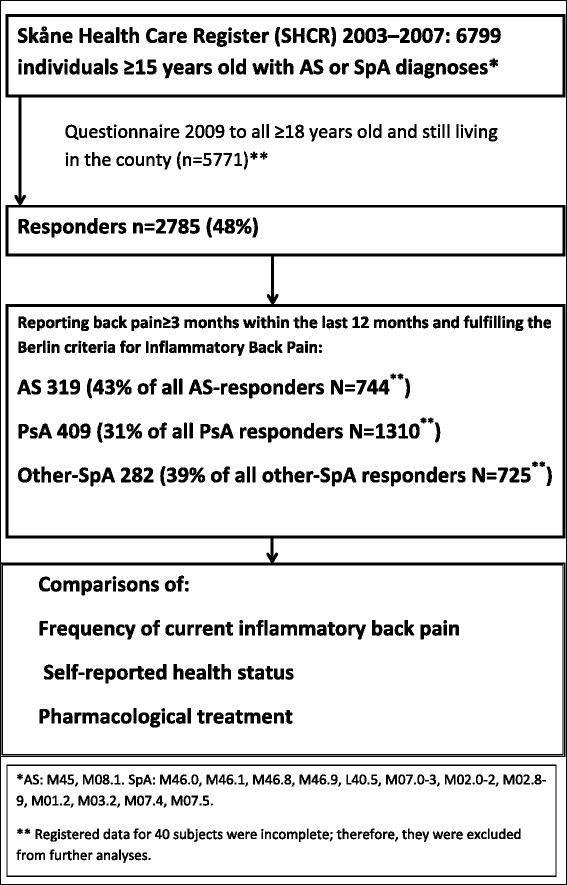
Five-thousand seven hundred seventy one patients identified in the regional healthcare register of the most southern county of Sweden, diagnosed at least once by a physician (based on ICD-codes) with any type of SpA in 2003-2007, were sent a postal survey in 2009. Patients with current IBP were identified, based on self-reported back pain ≥3 months in the preceding year and fulfilling the Berlin criteria for IBP. The frequencies of IBP in AS, PsA and other SpA (including the remaining subgroups of SpA) were determined, and the groups were compared with regard to patient reported outcome measures (PROMs).
The frequency and proportion of patients with current IBP in AS, PsA and other SpA were 319 (43 %), 409 (31 %) and 282 (39 %) respectively, within the responders to the survey (N = 2785). The proportion was statistically higher in AS, compared to PsA (p < 0.001), but not for AS compared to other SpA (p = 0.112). PsA and other SpA, with current IBP, had similar (BASFI, EQ-5D, patients global assessment, fatigue, spinal pain) or worse (BASDAI) PROMs, compared to AS with current IBP. PsA with current IBP received pharmacological, anti-rheumatic, treatment more frequently than AS with current IBP, while AS and other SpA received treatment to a similar degree.
The proportion of patients with current IBP was substantial in all three groups and health reports in the non-AS groups were similar or worse compared to the AS group supporting the severity of IBP in these non-AS SpA groups. These findings may indicate a room for improvement concerning detection of axial disease within different subtypes of non-AS SpA, and possibly also for treatment.
在更广泛的背痛范畴中,炎性背痛(IBP)是一种可能提示轴性脊柱关节炎(SpA)的症状。本研究的目的是确定强直性脊柱炎(AS)、银屑病关节炎(PsA)和其他SpA患者中当前IBP(作为可能的轴性SpA的标志性体征)的发生率,并比较有当前IBP的各组之间自我报告的健康状况。
在瑞典最南部县的地区医疗保健登记册中识别出的5771例患者,在2003年至2007年期间至少被医生诊断过一次(基于国际疾病分类代码)患有任何类型的SpA,于2009年进行了邮寄调查。根据患者自我报告在前一年背痛≥3个月且符合IBP的柏林标准,确定有当前IBP的患者。确定AS、PsA和其他SpA(包括SpA的其余亚组)中IBP的发生率,并就患者报告结局指标(PROMs)对各组进行比较。
在调查的应答者(N = 2785)中,AS、PsA和其他SpA中有当前IBP的患者的发生率和比例分别为319例(43%)、409例(31%)和282例(39%)。与PsA相比,AS中的比例在统计学上更高(p < 0.001),但与其他SpA相比,AS中的比例无统计学差异(p = 0.112)。与有当前IBP的AS相比,有当前IBP的PsA和其他SpA具有相似(BASFI、EQ - 5D、患者整体评估、疲劳、脊柱疼痛)或更差(BASDAI)的PROMs。有当前IBP的PsA比有当前IBP的AS更频繁地接受药物抗风湿治疗,而AS和其他SpA接受治疗的程度相似。
所有三组中有当前IBP的患者比例都相当大,非AS组的健康报告与AS组相比相似或更差,这支持了这些非AS SpA组中IBP的严重性。这些发现可能表明在非AS SpA的不同亚型中轴性疾病的检测以及可能的治疗方面仍有改进空间。