Mohamed Mona Yasin, Masocha Willias
Department of Pharmacology and Therapeutics, Faculty of Pharmacy, Kuwait University, Safat, Kuwait.
PeerJ. 2020 Nov 18;8:e10391. doi: 10.7717/peerj.10391. eCollection 2020.
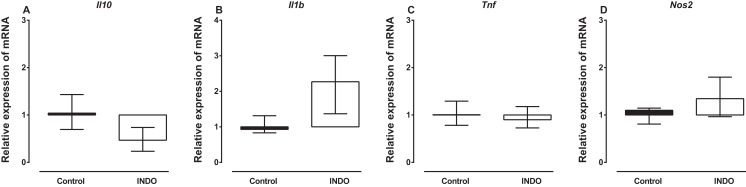
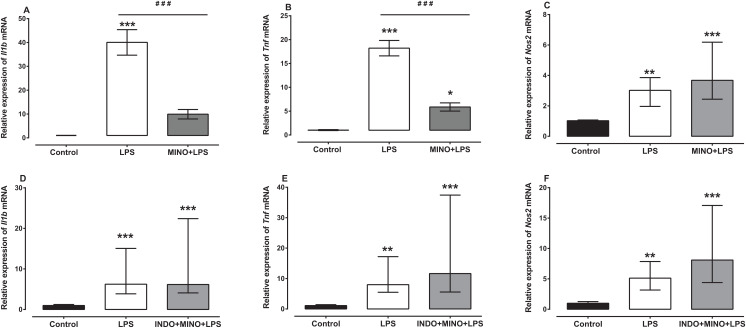
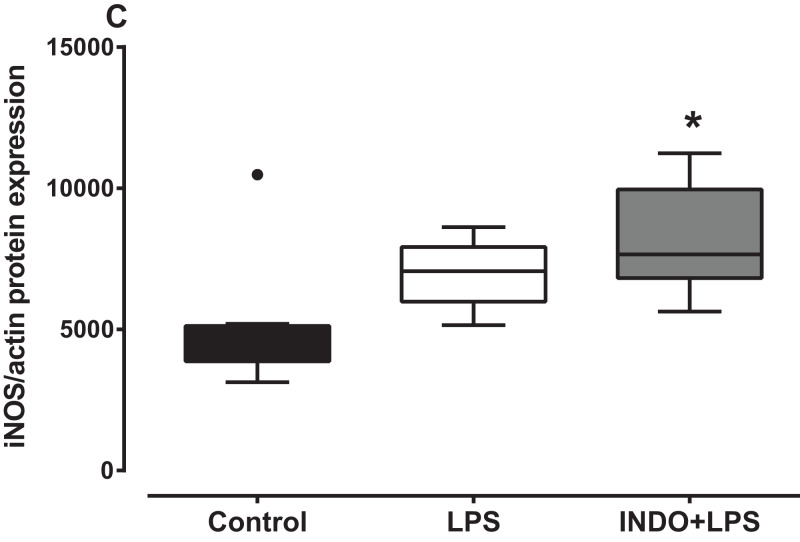
Indomethacin and other non-steroidal anti-inflammatory drugs (NSAIDs) are used to relieve pain and fever including during infections. However, some studies suggest that NSAIDs protect against neuroinflammation, while some find no effects or worsening of neuroinflammation. We evaluated the effect of indomethacin alone on in combination with minocycline, a drug that inhibits neuroinflammation, on the expression of transcripts of neuroinflammatory molecules-induced by lipopolysaccharide (LPS) in the brain of mice. Inoculation of male BALB/c mice with LPS induced the expression of the microglia marker ionized calcium binding adaptor molecule protein, mRNA expression of the genes for cytokines interleukin-1beta () and tumor necrosis factor-alpha () and inducible nitric oxide synthase gene (), but not , in the brain. Treatment with indomethacin had no significant effect on the cytokines or mRNA expression in naïve animals. However, pretreatment with indomethacin increased LPS-induced mRNA and inducible nitric oxide (iNOS) protein expression, but had no significant effect on LPS-induced mRNA expression of the cytokines. Minocycline reduced LPS-induced and , but not , mRNA expression. Treatment with indomethacin plus minocycline had no effect on LPS-induced and mRNA expression. In conclusion these results show that indomethacin significantly augments LPS-induced mRNA and iNOS protein expression in the brain. In the presence of indomethacin, minocycline could not inhibit LPS-induced pro-inflammatory cytokine expression. Thus, indomethacin could exacerbate neuroinflammation by increasing the expression of iNOS and also block the anti-inflammatory effects of minocycline.
吲哚美辛和其他非甾体抗炎药(NSAIDs)可用于缓解疼痛和发热,包括在感染期间。然而,一些研究表明NSAIDs可预防神经炎症,而另一些研究则未发现其对神经炎症有影响或使其恶化。我们评估了单独使用吲哚美辛以及与米诺环素(一种抑制神经炎症的药物)联合使用时,对脂多糖(LPS)诱导的小鼠脑内神经炎症分子转录本表达的影响。用LPS接种雄性BALB/c小鼠可诱导小胶质细胞标志物离子化钙结合衔接分子蛋白的表达、细胞因子白细胞介素-1β(IL-1β)和肿瘤坏死因子-α(TNF-α)基因的mRNA表达以及诱导型一氧化氮合酶基因(iNOS)的表达,但不诱导[此处原文似乎缺失某个基因名称]的表达。在未处理的动物中,吲哚美辛治疗对细胞因子或[此处原文似乎缺失某个基因名称]mRNA表达无显著影响。然而,吲哚美辛预处理可增加LPS诱导的[此处原文似乎缺失某个基因名称]mRNA和诱导型一氧化氮(iNOS)蛋白表达,但对LPS诱导的细胞因子mRNA表达无显著影响。米诺环素可降低LPS诱导的[此处原文似乎缺失某个基因名称]和[此处原文似乎缺失某个基因名称]mRNA表达,但不降低[此处原文似乎缺失某个基因名称]mRNA表达。吲哚美辛加米诺环素治疗对LPS诱导的[此处原文似乎缺失某个基因名称]和[此处原文似乎缺失某个基因名称]mRNA表达无影响。总之,这些结果表明吲哚美辛可显著增强LPS诱导的脑内[此处原文似乎缺失某个基因名称]mRNA和iNOS蛋白表达。在存在吲哚美辛的情况下,米诺环素无法抑制LPS诱导的促炎细胞因子表达。因此,吲哚美辛可通过增加iNOS表达来加重神经炎症,还可阻断米诺环素的抗炎作用。