Qian Shushu, Zhang Hong, Dai Huibo, Ma Bangyun, Tian Fang, Jiang PengJun, Gao Haoran, Sha Xiaocao, Sun Xuemei
Department of Hematology, Affiliated Hospital of Nanjing University of Chinese Medicine, Nanjing, China.
Department of Center Laboratory, Affiliated Hospital of Nanjing University of Chinese Medicine, Nanjing, China.
Front Oncol. 2020 Nov 10;10:585297. doi: 10.3389/fonc.2020.585297. eCollection 2020.
Tumor associated macrophages (TAMs), a kind of inflammatory cells in the tumor microenvironment, are crucial for the occurrence and development of various tumors which increased the expression of CD163. Nevertheless, not much has been established regarding soluble CD163 and its connection to tumor diagnosis. In this case, a meta-analysis was conducted to determine the tumor diagnostic importance of serum sCD163.
In order to assess the correlation between sCD163 and the overall survival (OS) or progression-free survival (PFS) among tumor patients, a systematic perusal of literature published until June 2020 was conducted. Relevant data were primarily obtained from papers that have the following qualifications: 1) a confidence interval (CI) of 95%; 2) a report of the hazard ratios; and, 3) pooled by means of the Mantel-Haenszel random-effect representation.
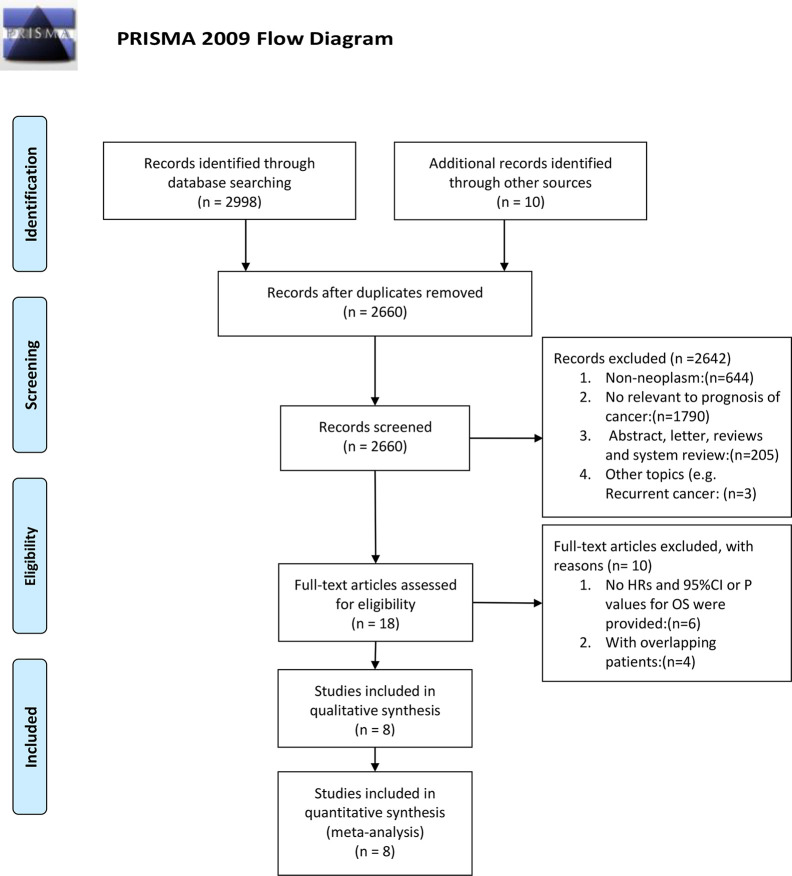
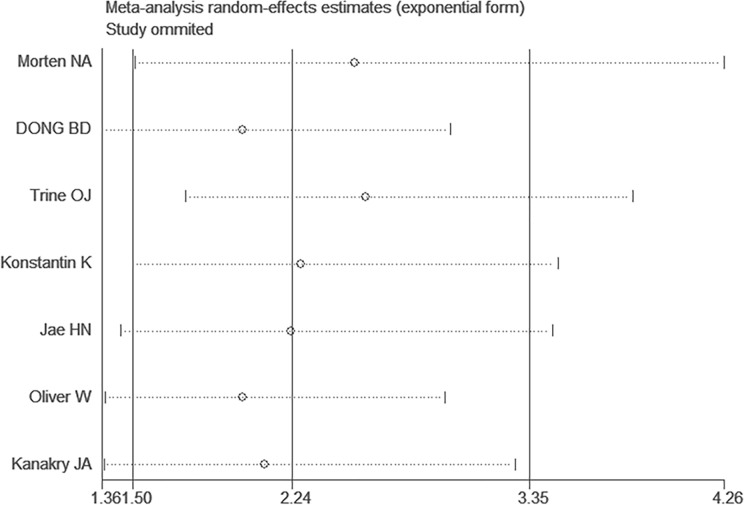
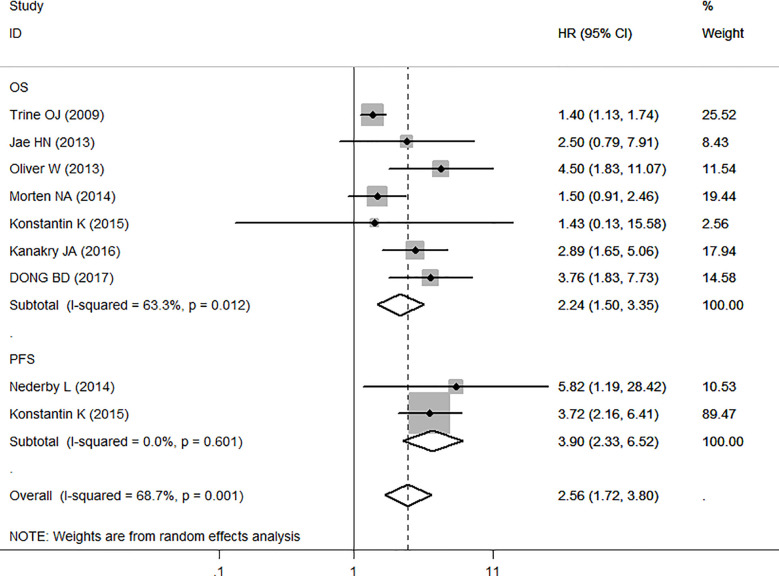
For the final meta-analysis, eight papers comprised of 1,236 cases were involved. Through pooled investigation, it was determined that a correlation exists between elevated serum sCD163 and worse OS (HR = 2.24, 95% CI: 1.50-3.35, < 0.001) and PFS (HR = 3.90, 95% CI: 2.33-6.52, < 0.001) among tumor cases. Subgroup analysis stratified by medium age at diagnosis demonstrated that patients over 60 years old with high sCD163 had worse OS (HR 2.28, 95% CI: 1.58-3.29, P < 0.001) than under 60 (HR 1.43, 95% CI: 1.15-1.77, = 0.001). Subgroup analysis revealed that analysis method and medium age at diagnosis were the potential source of heterogeneity.
Overall, diagnosis of tumor cases can be adversely determined through substantial sCD163 levels. Consequently, it is encouraged that extensive researches regarding the rates of cancer survival be accomplished.
肿瘤相关巨噬细胞(TAMs)是肿瘤微环境中的一种炎症细胞,对多种肿瘤的发生和发展至关重要,其CD163表达增加。然而,关于可溶性CD163及其与肿瘤诊断的关系,目前尚未有太多研究。在此情况下,进行了一项荟萃分析以确定血清sCD163在肿瘤诊断中的重要性。
为了评估sCD163与肿瘤患者总生存期(OS)或无进展生存期(PFS)之间的相关性,对截至2020年6月发表的文献进行了系统检索。相关数据主要来自符合以下条件的论文:1)95%置信区间(CI);2)风险比报告;3)采用Mantel-Haenszel随机效应模型进行汇总。
最终的荟萃分析纳入了8篇论文,共1236例病例。通过汇总研究发现,肿瘤病例中血清sCD163升高与较差的OS(HR = 2.24,95% CI:1.50 - 3.35,P < 0.001)和PFS(HR = 3.90,95% CI:2.33 - 6.52,P < 0.001)相关。按诊断时中位年龄分层的亚组分析表明,60岁以上sCD163水平高的患者OS较差(HR 2.28,95% CI:1.58 - 3.29,P < 0.001),而60岁以下患者为(HR 1.43,95% CI:1.15 - 1.77,P = 0.001)。亚组分析显示,分析方法和诊断时中位年龄是异质性的潜在来源。
总体而言,肿瘤病例的诊断可能会因sCD163水平升高而受到不利影响。因此,鼓励开展关于癌症生存率的广泛研究。