Zhu Gaoyang, Pan Chaoyun, Bei Jin-Xin, Li Bo, Liang Chen, Xu Yang, Fu Xuemei
Postdoctoral Research Center, Shunde Hospital, Southern Medical University (The First People's Hospital of Shunde), Foshan, China.
Department of Biochemistry and Molecular Biology, Zhongshan School of Medicine, Sun Yat-sen University, Guangzhou, China.
Front Oncol. 2020 Nov 6;10:595187. doi: 10.3389/fonc.2020.595187. eCollection 2020.
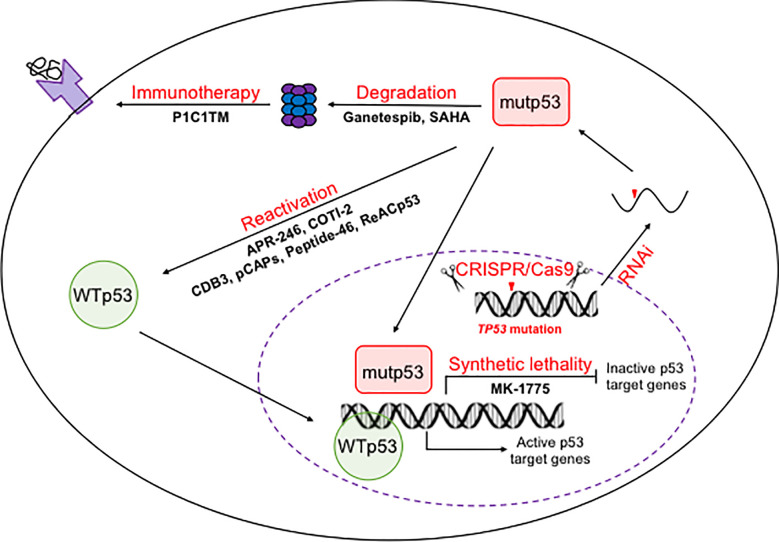
is the most frequently mutated tumor suppressor gene in human cancer. The majority of mutations of p53 are missense mutations, leading to the expression of the full length p53 mutant proteins. Mutant p53 (Mutp53) proteins not only lose wild-type p53-dependent tumor suppressive functions, but also frequently acquire oncogenic gain-of-functions (GOF) that promote tumorigenesis. In this review, we summarize the recent advances in our understanding of the oncogenic GOF of mutp53 and the potential therapies targeting mutp53 in human cancers. In particular, we discuss the promising drugs that are currently under clinical trials as well as the emerging therapeutic strategies, including CRISPR/Cas9 based genome edition of mutant allele, small peptide mediated restoration of wild-type p53 function, and immunotherapies that directly eliminate mutp53 expressing tumor cells.
是人类癌症中最常发生突变的肿瘤抑制基因。p53的大多数突变是错义突变,导致全长p53突变蛋白的表达。突变型p53(Mutp53)蛋白不仅失去了野生型p53依赖的肿瘤抑制功能,还经常获得促进肿瘤发生的致癌性功能获得(GOF)。在这篇综述中,我们总结了对Mutp53致癌性GOF的最新认识以及针对人类癌症中Mutp53的潜在治疗方法。特别是,我们讨论了目前正在进行临床试验的有前景的药物以及新兴的治疗策略,包括基于CRISPR/Cas9的突变等位基因基因组编辑、小肽介导的野生型p53功能恢复以及直接消除表达Mutp53的肿瘤细胞的免疫疗法。