Kong Min, Shen Jianfei, Zhou Chao, Yang Haihua, Chen Baofu, Zhu Chengchu, Wang Gongchao
Department of Thoracic Surgery, Shandong Provincial Hospital, Cheeloo College of Medicine, Shandong University, Jinan, China.
Department of Cardiothoracic Surgery, Taizhou Hospital of Zhejiang Province Affiliated to Wenzhou Medical University, Taizhou, China.
Ann Transl Med. 2020 Sep;8(18):1129. doi: 10.21037/atm-20-4864.
There are also differences in survival prognosis among esophageal squamous cell carcinoma (ESCC) patients with a complete regression of the primary tumor (ypT0) after Neoadjuvant chemoradiotherapy (NCRT) followed by surgery. And the purpose of this study was to investigate influencing factors from these different prognostic outcomes and their possible causes.
The clinical data of 88 cases of ESCC patients with ypT0 after NCRT followed by surgery between 2011 and 2019 were retrospectively analyzed. The clinical and pathological prognostic factors that affect the survival were analyzed.
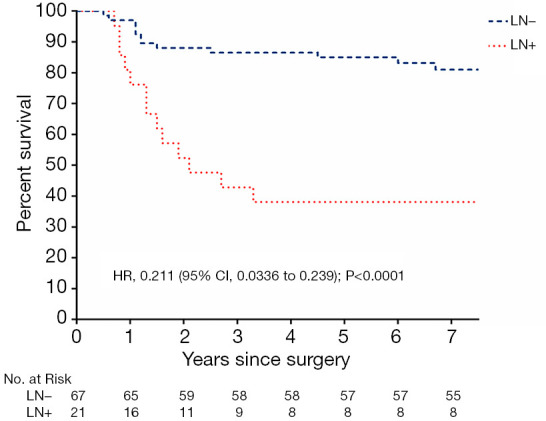
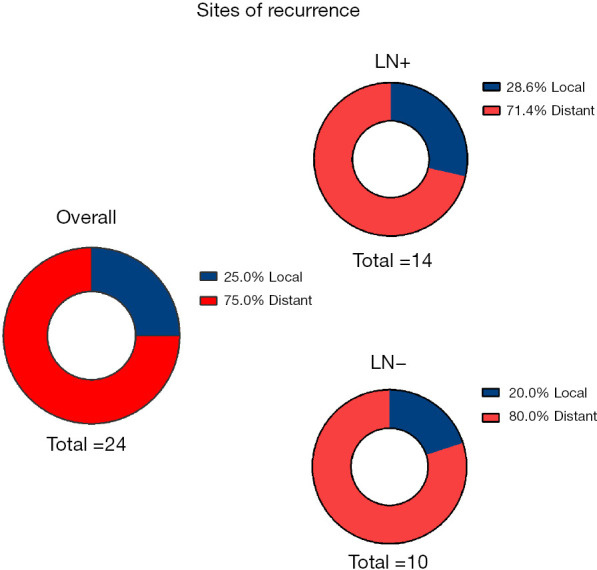
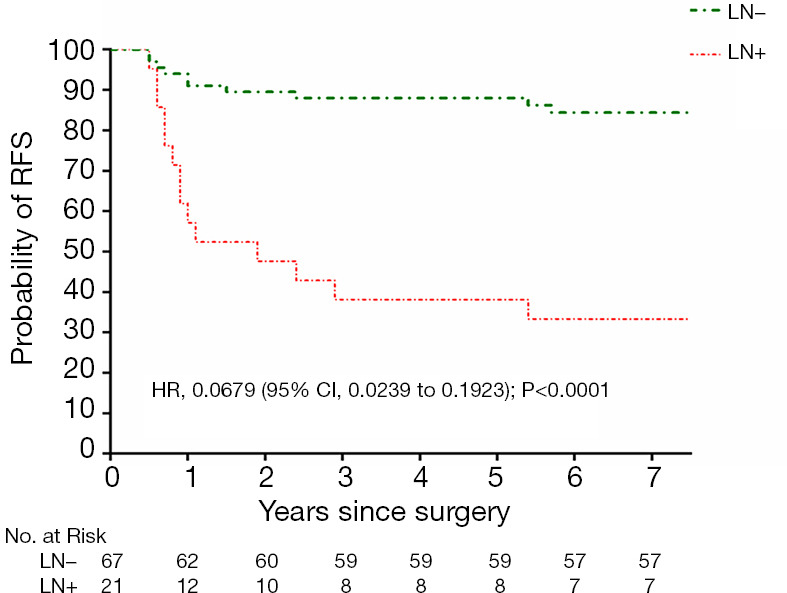
Sex, number of lymph nodes dissected, and pathologic positivity of lymph nodes may be significant in univariate analysis (P<0.1). Further multivariate analysis suggested that the pathologic positivity of the lymph nodes was an independent factor affecting prognosis (HR: 4.757, 95% CI: 2.195-10.313, P=0.000). Subsequently, the whole group was divided into a positive lymph node group (group LN+) and a negative lymph node group (group LN-) for comparison. The overall survival (OS) of group LN+ was significantly worse (HR: 0.211, 95% CI: 0.0336-0.239; P<0.0001), and recurrence-free survival (RFS) was significantly poorer in the LN+ group (HR: 0.0679, 95% CI: 0.0239-0.1923, P<0.0001). There were 14 cases of recurrence and metastasis in the LN+ group (14/21, 66.7%) and 10 cases in the group LN- (10/67, 14.9%). Among the sites of recurrence and metastasis, there were 10 (10/14, 71.4%) and 4 (4/14, 28.6%) cases of distant metastasis, respectively, and 4 (4/14, 28.6%) cases of local metastasis in the LN+ group; meanwhile, there were 8 (8/10, 80.0%) cases of distant metastasis and 2 (2/10, 20.0%) cases of local metastasis in the LN- group.
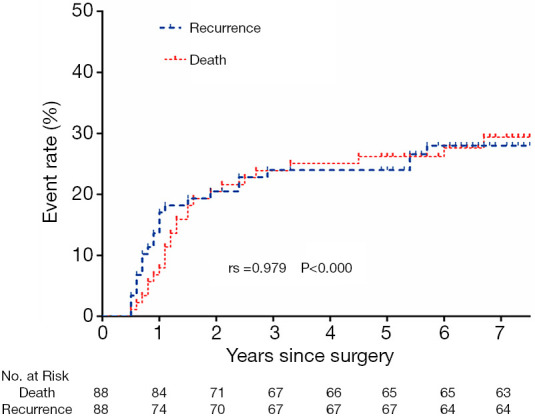
The independent risk factor for survival prognosis in ESCC patients with ypT0 after NCRT followed by surgery was positive postoperative pathological lymph nodes. The reason for the shortened survival time associated with this group of patients was their susceptibility to recurrence and metastasis.
接受新辅助放化疗(NCRT)后行手术治疗且原发肿瘤完全消退(ypT0)的食管鳞状细胞癌(ESCC)患者的生存预后也存在差异。本研究旨在探讨这些不同预后结果的影响因素及其可能原因。
回顾性分析2011年至2019年间88例NCRT后行手术治疗且ypT0的ESCC患者的临床资料。分析影响生存的临床和病理预后因素。
单因素分析中,性别、清扫淋巴结数量及淋巴结病理阳性可能具有统计学意义(P<0.1)。进一步多因素分析表明,淋巴结病理阳性是影响预后的独立因素(HR:4.757,95%CI:2.195 - 10.313,P = 0.000)。随后,将全组分为淋巴结阳性组(LN+组)和淋巴结阴性组(LN-组)进行比较。LN+组的总生存期(OS)明显更差(HR:0.211,95%CI:0.0336 - 0.239;P<0.0001),无复发生存期(RFS)在LN+组也明显更差(HR:0.0679,95%CI:0.0239 - 0.1923,P<0.0001)。LN+组有14例复发转移(14/21,66.7%),LN-组有10例(10/67,14.9%)。在复发转移部位中,LN+组远处转移分别有10例(10/14,71.4%)和4例(4/14,28.6%),局部转移有4例(4/14,28.6%);同时,LN-组远处转移有8例(8/10,80.0%),局部转移有2例(2/10,20.0%)。
NCRT后行手术治疗且ypT0的ESCC患者生存预后的独立危险因素是术后病理淋巴结阳性。该组患者生存时间缩短的原因是其易复发转移。