State Key Laboratory of Molecular Oncology and Department of Radiation Oncology, National Cancer Center/National Clinical Research Center for Cancer/Cancer Hospital, Chinese Academy of Medical Sciences and Peking Union Medical College, Beijing, 100021, China.
Department of Radiation Oncology, Sun Yat-sen University Cancer Center, State Key Laboratory of Oncology in South China, Collaborative Innovation Center of Cancer Medicine, Guangzhou, 510060, China.
BMC Cancer. 2020 Nov 26;20(1):1155. doi: 10.1186/s12885-020-07646-y.
To compare the survival outcomes between breast-conserving surgery (BCS) and modified radical mastectomy (MRM), and to investigate the role of radiotherapy (RT) in patients with pT1-2N1M0 breast cancer.
A total of 4262 women with T1-2N1M0 breast cancer treated at two institutions were retrospectively reviewed. A total of 3858 patients underwent MRM, and 832 (21.6%) of them received postoperative RT (MRM + RT). A total of 404 patients received BCS plus postoperative RT (BCS + RT). All patients received axillary lymph node dissection, while 3.8% of them had upfront sentinel node biopsy. The association of survival outcomes with different surgical modalities (BCS vs. MRM) and the role of RT were evaluated using multivariable proportional hazards regression and confirmed by the propensity score-matching (PSM) method.
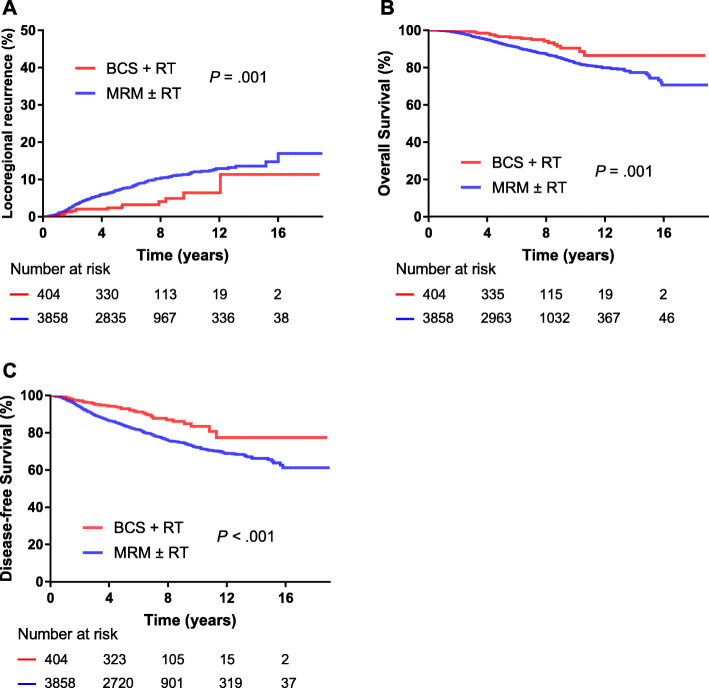
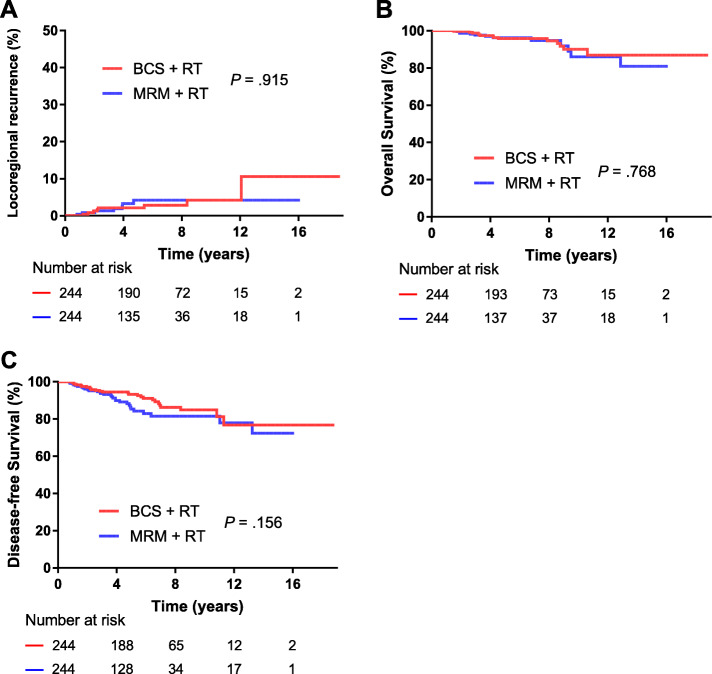
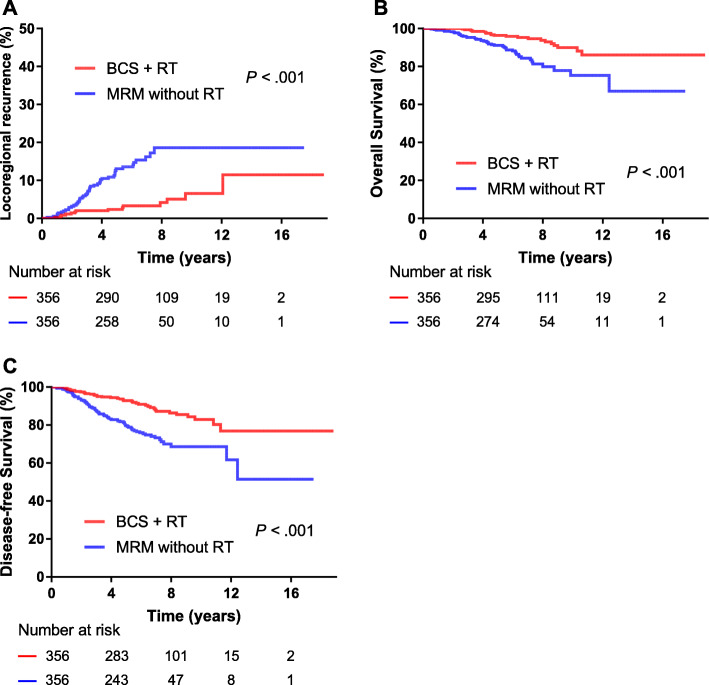
At a median follow-up of 71 months (range of 6-230 months), the 5-year overall survival (OS) rates of the BCS and MRM groups were 96.5 and 92.7%, respectively (P = .001), and the corresponding 5-year disease-free-survival (DFS) and locoregional recurrence (LRR) rates were 92.9 and 84.0%, and 2.0 and 7.0% (P = .001), respectively (P < .001). Multivariate analysis revealed that RT was an independent prognostic factor for improved OS (P = .001) and DFS (P = .009), and decreased LRR (P < .001). However, surgery procedure was not independently associated with either OS (P = .495), DFS (P = .204), or LRR (P = .996), which was confirmed by PSM analysis.
Postoperative radiotherapy rather than the surgery procedures was associated with superior survival outcomes in patients with T1-2N1M0 breast cancer.
本研究旨在比较保乳手术(BCS)与改良根治性乳房切除术(MRM)在治疗 pT1-2N1M0 乳腺癌患者中的生存结局,并探讨放疗(RT)在该类患者中的作用。
本研究回顾性分析了两家医疗机构收治的 4262 例 T1-2N1M0 乳腺癌患者。其中 3858 例行 MRM,832 例(21.6%)患者术后接受 RT(MRM+RT),404 例行 BCS+术后 RT(BCS+RT)。所有患者均接受腋窝淋巴结清扫术,其中 3.8%的患者行前哨淋巴结活检。采用多变量比例风险回归模型评估生存结局与不同手术方式(BCS 与 MRM)之间的关系,并通过倾向评分匹配(PSM)方法进行验证。
中位随访 71 个月(6-230 个月),BCS 组和 MRM 组的 5 年总生存率(OS)分别为 96.5%和 92.7%(P=0.001),5 年无病生存率(DFS)和局部区域复发率(LRR)分别为 92.9%和 84.0%,2.0%和 7.0%(P=0.001)(P<0.001)。多因素分析显示,RT 是改善 OS(P=0.001)和 DFS(P=0.009)以及降低 LRR(P<0.001)的独立预后因素。然而,手术方式与 OS(P=0.495)、DFS(P=0.204)或 LRR(P=0.996)均无显著相关性,PSM 分析结果一致。
对于 T1-2N1M0 乳腺癌患者,术后 RT 而非手术方式与生存结局的改善相关。