Health Research Institute, Faculty of Health, University of Canberra, Canberra, Australian Capital Territory, 2617, Australia.
Psychology, Faculty of Health, University of Canberra, Canberra, Australian Capital Territory, 2617, Australia.
BMC Public Health. 2020 Nov 26;20(1):1801. doi: 10.1186/s12889-020-09874-0.
Informal carers suffer from worse health outcomes than non-carers due to their caregiving role. Yet, in a society carers health is as important as that of their care recipients. This study investigated the self-assessed mental and general health outcomes of informal carers in Australia. It evaluated the influence of carers' personal social capital- a logically linked sequence of their social behaviour such as community participation, social support and trust in others- on their health outcomes. The study estimated the magnitude of small area level variation at Statistical Area Level 1 (SA1) along with individual level variation in carers' health outcomes.
The study used a multilevel mixed effects cross-sectional design using data from the Household Income and Labour Dynamics of Australia survey, wave 14. It included Australians aged 15 years and older that were surveyed in the year 2014. The sample consisted of 12,767 individuals and 5004 SA1s. The outcome measures included- mental health, general health and physical functioning, domains of the Short Form 36 Questionnaire, a widely used multi-dimensional measure of health-related quality of life.
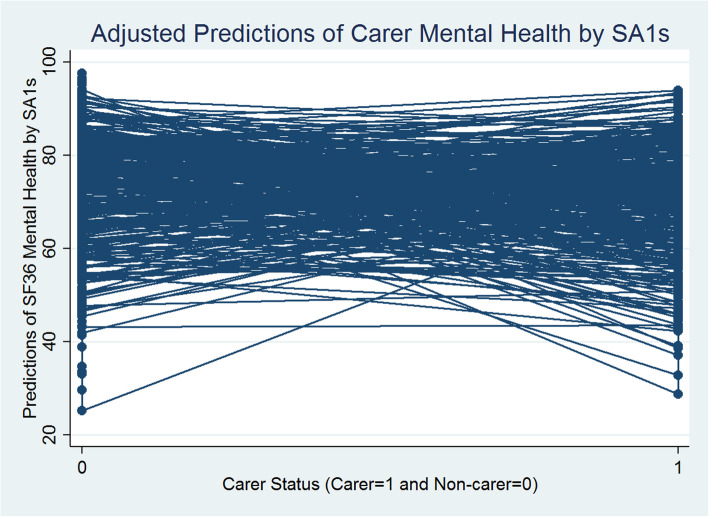
Informal carers suffered from poor mental (Beta = - 0.587, p = 0.003) and general health (Beta = - 0.670, p = 0.001) outcomes compared to non-carers in Australia. These health outcomes exhibited significant variation acrossSA1s in Australia, with 12-13% variation in general and mental health. However, within small local areas, differences at the individual level, accounted for most of the variation in outcomes. Moreover, levels of community participation, personal social connection and trust, as perceived by individuals in the communities, had a positive influence on both mental and general health of carers and non-carers, and were more beneficial for carers compared to non-carers.
It seems that the positive influence of social capital for carers helps them in coping with the negative impact of their caregiving duty on health outcomes. Findings suggested that some targeted community support programs for carers to build on their personal social cohesion and trust in their community could help in improving their poor health profiles. Moreover, improved informal carers' health may help the health system in better managing their resources.
由于照顾者的照顾角色,他们的健康状况比非照顾者差。然而,在一个社会中,照顾者的健康与他们的被照顾者一样重要。本研究调查了澳大利亚非正式照顾者的自我评估的心理健康和一般健康结果。它评估了照顾者个人社会资本(逻辑上与其社会行为相关联的一系列社会行为,如社区参与、社会支持和对他人的信任)对其健康结果的影响。该研究估计了在统计区域一级(SA1)的小区域水平变化的幅度,以及照顾者健康结果的个体水平变化。
本研究使用了基于澳大利亚家庭收入和劳动力动态调查第 14 波的多水平混合效应横断面设计。它包括在 2014 年接受调查的 15 岁及以上的澳大利亚人。样本包括 12767 人和 5004 个 SA1。结果测量包括心理健康、一般健康和身体功能,这些都是广泛使用的健康相关生活质量的多维测量的短形式 36 问卷的领域。
与澳大利亚的非照顾者相比,非正式照顾者的心理健康(β= - 0.587,p = 0.003)和一般健康(β= - 0.670,p = 0.001)结果较差。这些健康结果在澳大利亚的 SA1 之间存在显著差异,一般和心理健康的差异为 12-13%。然而,在小的地方社区内,个体层面的差异占结果差异的大部分。此外,个人在社区中感知到的社区参与、个人社会联系和信任程度,对照顾者和非照顾者的心理健康和一般健康都有积极的影响,并且对照顾者的影响比对非照顾者的影响更大。
似乎社会资本对照顾者的积极影响有助于他们应对照顾职责对健康结果的负面影响。研究结果表明,一些针对照顾者的有针对性的社区支持计划,以建立他们的个人社会凝聚力和对社区的信任,可以帮助改善他们较差的健康状况。此外,改善非正式照顾者的健康状况可能有助于卫生系统更好地管理他们的资源。