Damiris Konstantinos, Tafesh Zaid H, Pyrsopoulos Nikolaos
Department of Medicine, Rutgers-New Jersey Medical School, Newark, NJ 07103, United States.
Medicine-Gastroenterology and Hepatology, Rutgers-New Jersey Medical School, Newark, NJ 07103, United States.
World J Gastroenterol. 2020 Nov 7;26(41):6304-6321. doi: 10.3748/wjg.v26.i41.6304.
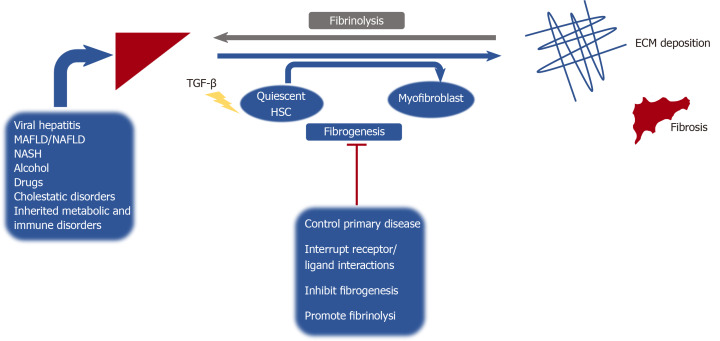
Recent progress in our understanding of the pathways linked to progression from hepatic insult to cirrhosis has led to numerous novel therapies being investigated as potential cures and inhibitors of hepatic fibrogenesis. Liver cirrhosis is the final result of prolonged fibrosis, which is an intimate balance between fibrogenesis and fibrinolysis. A number of these complex mechanisms are shared across the various etiologies of liver disease. Thankfully, investigation has yielded some promising results in regard to reversal of fibrosis, particularly the indirect benefits associated with antiviral therapy for the treatment of hepatitis B and C and the farnesoid receptor agonist for the treatment of primary biliary cholangitis and metabolic associated fatty liver disease. A majority of current clinical research is focused on targeting metabolic associated fatty liver disease and its progression to metabolic steatohepatitis and ultimately cirrhosis, with some hope of potential standardized therapeutics in the near future. With our ever-evolving understanding of the underlying pathophysiology, these therapeutics focus on either controlling the primary disease (the initial trigger of fibrogenesis), interrupting receptor ligand interactions and other intracellular communications, inhibiting fibrogenesis, or even promoting resolution of fibrosis. It is imperative to thoroughly test these potential therapies with the rigorous standards of clinical therapeutic trials in order to ensure the highest standards of patient safety. In this article we will briefly review the key pathophysiological pathways that lead to liver fibrosis and present current clinical and experimental evidence that has shown reversibility of liver fibrosis and cirrhosis, while commenting on therapeutic safety.
我们对从肝损伤发展到肝硬化相关途径的理解取得了最新进展,这促使众多新型疗法正在作为肝纤维化的潜在治愈方法和抑制剂进行研究。肝硬化是长期纤维化的最终结果,而纤维化是纤维生成与纤维蛋白溶解之间的一种密切平衡。这些复杂机制中有许多在各种肝病病因中是共有的。幸运的是,在纤维化逆转方面的研究已经取得了一些有希望的结果,特别是与治疗乙型和丙型肝炎的抗病毒疗法以及治疗原发性胆汁性胆管炎和代谢相关脂肪性肝病的法尼酯受体激动剂相关的间接益处。当前大多数临床研究都集中在针对代谢相关脂肪性肝病及其向代谢性脂肪性肝炎以及最终肝硬化的进展,有望在不久的将来实现潜在的标准化治疗。随着我们对潜在病理生理学的不断深入理解,这些疗法要么侧重于控制原发性疾病(纤维生成的初始触发因素),要么中断受体配体相互作用和其他细胞内通讯,抑制纤维生成,甚至促进纤维化的消退。必须按照严格的临床治疗试验标准对这些潜在疗法进行全面测试,以确保患者安全的最高标准。在本文中,我们将简要回顾导致肝纤维化的关键病理生理途径,并介绍目前已显示肝纤维化和肝硬化具有可逆性的临床和实验证据,同时对治疗安全性进行评论。