Department of Gastroenterology, Sir Run Run Shaw Hospital, College of Medicine, Zhejiang University, Hangzhou 310016, Zhejiang Province, China.
Department of Project, Changsha Normin Health Technology Ltd, Changsha 410013, Hunan Province, China.
World J Gastroenterol. 2020 Nov 7;26(41):6455-6474. doi: 10.3748/wjg.v26.i41.6455.
Infliximab was the first approved biologic treatment for moderate to severe Crohn's disease (MS-CD) in China. However, the cost-effectiveness of infliximab maintenance therapy (IMT) for MS-CD relative to conventional maintenance therapy remained unclarified.
To assess the cost-effectiveness of IMT for MS-CD in Chinese patients from the perspective of Chinese public insurance payer.
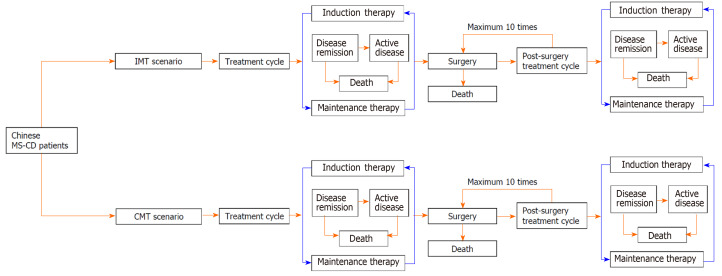
A cohort of MS-CD patients managed in a Chinese tertiary care hospital was created to compare IMT with conventional maintenance therapy (CMT) for clinical outcomes and direct medical costs over a 1-year observation time using conventional regression analyses. A decision-analytic model with the generated evidence was constructed to assess the cost-effectiveness of IMT relative to CMT using reimbursed medical costs.
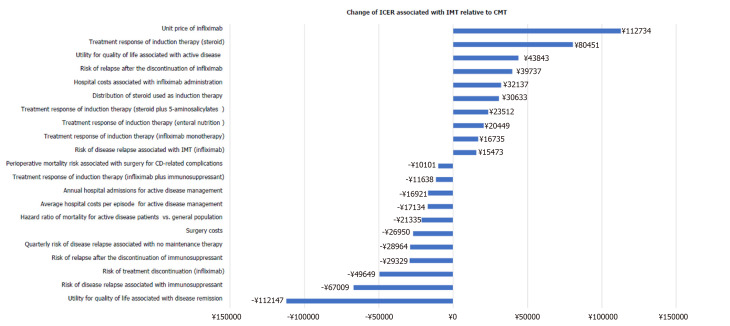
Based on the included 389 patients, IMT was associated with significantly higher disease remission chance [odds ratio: 4.060, = 0.003], lower risk of developing new complications (odds ratio: 0.527, = 0.010), higher utility value for quality of life (coefficient 0.822, = 0.008), and lower total hospital costs related to disease management (coefficient -0.378, = 0.008) than CMT. Base-case cost-effectiveness analysis estimated that IMT could cost Chinese health insurance payers ¥55260 to gain one quality-adjusted life year (QALY). The cost-effectiveness of IMT was mainly driven by the estimate of quality of life, treatment efficacy of maintenance therapy, mortality risk associated with active disease, and unit price of infliximab. The probability that IMT was cost-effective at a willingness-to-pay threshold of three times gross domestic product [2018 Chinese gross domestic product per capita (GDPPC)] was 86.4%.
IMT significantly improved real-world health outcomes and cost the Chinese public health insurance payers less than one GDPPC to gain one QALY in Chinese MS-CD patients.
英夫利昔单抗是中国批准用于治疗中重度克罗恩病(MS-CD)的第一种生物制剂。然而,英夫利昔单抗维持治疗(IMT)相对于传统维持治疗对 MS-CD 的成本效益仍不清楚。
从中国公共保险支付者的角度评估 IMT 对中国 MS-CD 患者的成本效益。
创建了一个在中国三级医院管理的 MS-CD 患者队列,以比较 IMT 与传统维持治疗(CMT)在 1 年观察期内的临床结果和直接医疗成本,使用常规回归分析。使用报销医疗费用构建了一个基于生成证据的决策分析模型,以评估 IMT 相对于 CMT 的成本效益。
基于纳入的 389 名患者,IMT 与更高的疾病缓解机会显著相关[优势比:4.060, = 0.003],发生新并发症的风险较低(优势比:0.527, = 0.010),生活质量的效用值更高(系数 0.822, = 0.008),与疾病管理相关的总医院费用更低(系数-0.378, = 0.008)。基于案例的成本效益分析估计,IMT 可为中国健康保险支付者带来一个质量调整生命年(QALY)需花费 55260 元人民币。IMT 的成本效益主要受生活质量估计、维持治疗的疗效、与疾病活动相关的死亡率风险和英夫利昔单抗的单位价格驱动。在愿意支付三次国内生产总值[2018 年中国人均国内生产总值(GDPPC)]的阈值下,IMT 具有成本效益的概率为 86.4%。
IMT 显著改善了真实世界的健康结果,在中国 MS-CD 患者中,中国公共医疗保险支付者每获得一个 QALY 的成本不到一个 GDPPC。