Aizawa Junya, Hirohata Kenji, Ohji Shunsuke, Ohmi Takehiro, Koga Hideyuki, Yagishita Kazuyoshi
Department of Physical Therapy, Faculty of Health Science, Juntendo University, Tokyo, Japan.
Clinical Center for Sports Medicine, Tokyo Medical and Dental University, Tokyo, Japan.
Orthop J Sports Med. 2020 Nov 17;8(11):2325967120964484. doi: 10.1177/2325967120964484. eCollection 2020 Nov.
High psychological readiness is an important element for returning to sports after anterior cruciate ligament (ACL) reconstruction. Identifying factors that contribute to psychological readiness is essential for planning interventions to return to play. No studies have used multivariate analysis to clarify factors associated with psychological readiness to return to specific sports.
To identify factors that contribute to an athlete's psychological readiness to return after ACL reconstruction to sports that require cutting, pivoting, and jump-landings.
Cross-sectional study; Level of evidence, 3.
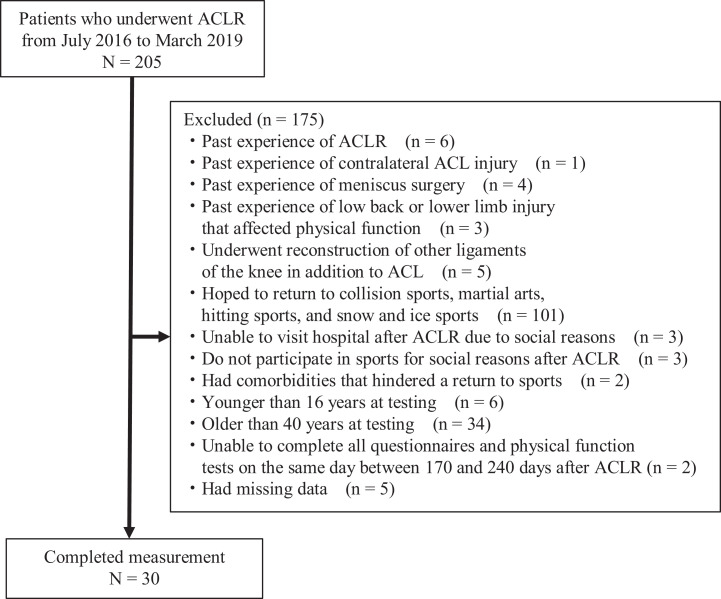
Study participants were athletes who before injury had participated in sports with limited contact that required cutting, pivoting, and jump-landings (basketball, soccer, futsal, volleyball, badminton, tennis, and frisbee) and hoped to return to the same sport after reconstruction. Psychological readiness was measured using the Anterior Cruciate Ligament-Return to Sport After Injury Scale (ACL-RSI) in athletes more than 6 months after primary ACL reconstruction. To clarify factors associated with the ACL-RSI, univariate regression analysis and multivariate regression analysis were performed using the following independent variables: age, sex, body mass index, time from injury to reconstruction, time from reconstruction to testing, meniscal surgery, modified Tegner activity scale before injury, kinesiophobia, limb symmetry index of knee strength, limb symmetry indices of single-leg hop (SLH) distances, and subjective running ability.
Higher subjective running ability, a lower kinesiophobia score, and greater limb symmetry in the lateral SLH were positively associated with psychological readiness.
The psychological readiness of athletes aiming to return after ACL reconstruction to limited-contact sports that require cutting, pivoting, and jump-landings was affected by subjective running ability, kinesiophobia, and asymmetry of lateral SLH distance. This information may be useful in planning appropriate interventions and thereby increasing the likelihood of an athlete's returning to such sports.
较高的心理准备状态是前交叉韧带(ACL)重建术后恢复运动的重要因素。确定有助于心理准备的因素对于规划重返运动的干预措施至关重要。尚无研究使用多变量分析来阐明与重返特定运动的心理准备相关的因素。
确定有助于运动员在前交叉韧带重建术后恢复到需要急停、转身和跳跃落地动作的运动项目的心理准备的因素。
横断面研究;证据等级,3级。
研究参与者为受伤前参加过需要急停、转身和跳跃落地动作的有限接触性运动项目(篮球、足球、室内五人足球、排球、羽毛球、网球和飞盘)且希望在重建术后重返同一运动项目的运动员。在初次ACL重建术后6个月以上的运动员中,使用前交叉韧带损伤后重返运动量表(ACL-RSI)测量心理准备状态。为了阐明与ACL-RSI相关的因素,使用以下自变量进行单变量回归分析和多变量回归分析:年龄、性别、体重指数、受伤至重建的时间、重建至测试的时间、半月板手术、受伤前改良的Tegner活动量表、运动恐惧、膝关节力量的肢体对称指数、单腿跳(SLH)距离的肢体对称指数以及主观跑步能力。
较高的主观跑步能力、较低的运动恐惧得分以及外侧SLH中更大的肢体对称性与心理准备呈正相关。
旨在在前交叉韧带重建术后恢复到需要急停、转身和跳跃落地动作的有限接触性运动项目的运动员的心理准备受主观跑步能力、运动恐惧和外侧SLH距离不对称性的影响。这些信息可能有助于规划适当的干预措施,从而增加运动员重返此类运动的可能性。