International Food Policy Research Institute, Washington, DC, USA.
Institut de Statistiques et d'Études Économiques du Burundi, Bujumbura, Burundi.
J Nutr. 2021 Jan 4;151(1):197-205. doi: 10.1093/jn/nxaa330.
Little is known about the impact of food-assisted maternal and child health programs (FA-MCHN) on child wasting.
We assessed the impact of Tubaramure, a FA-MCHN program in Burundi, on child (0 to 24 months) wasting and the differential impacts by socio-economic characteristics and age. The program targeted women and their children during the first 1000 days and included 1) food rations, 2) strengthening and promotion of use of health services, and 3) behavior change communication (BCC).
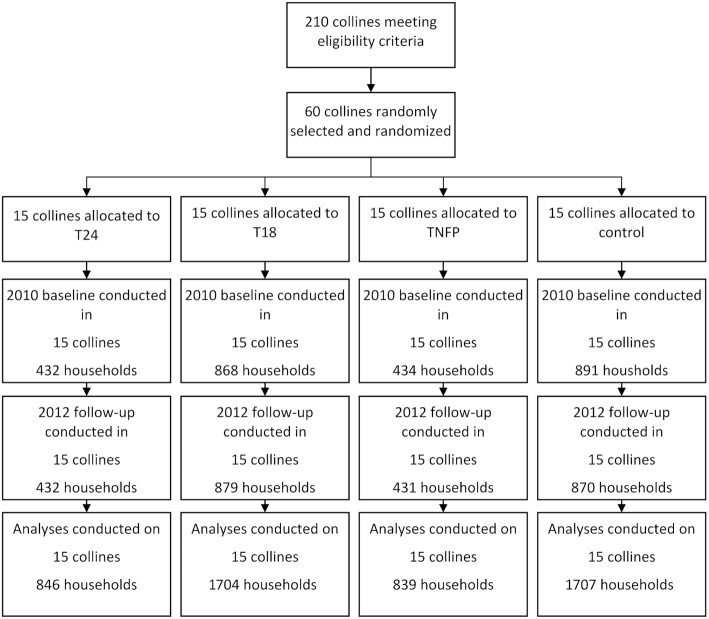
We conducted a 4-arm, cluster-randomized, controlled trial (2010-2012). Clusters were defined as "collines" (communities). Impact was estimated using repeated cross-sectional data (n = ∼2620 children in each round). Treatment arms received household and individual (mother or child in the first 1000 days) food rations (corn-soy blend and micronutrient-fortified vegetable oil) from pregnancy to 24 months (T24 arm), from pregnancy to 18 months (T18), or from birth to 24 months (TNFP). All beneficiaries received the same BCC for the first 1000 days. The control arm received no rations or BCC.
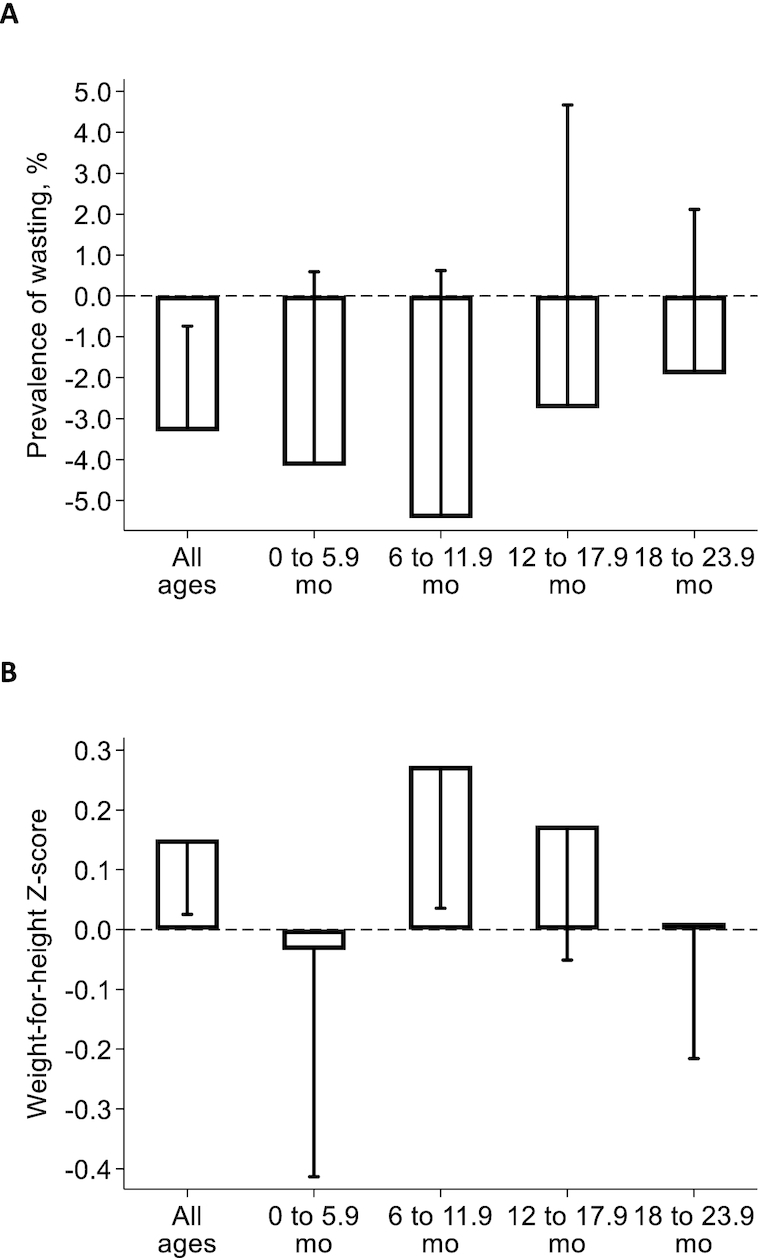
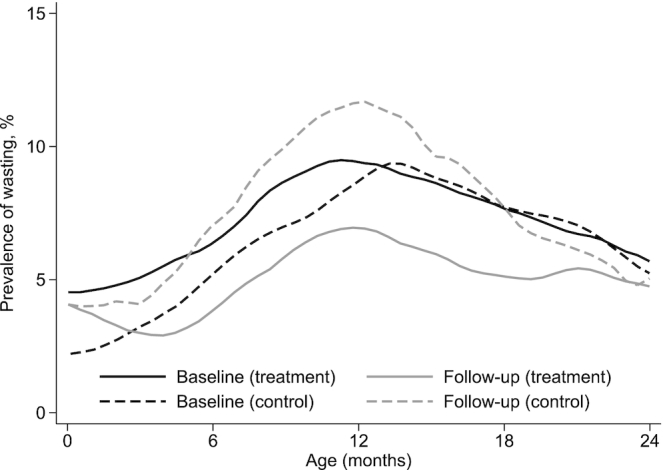
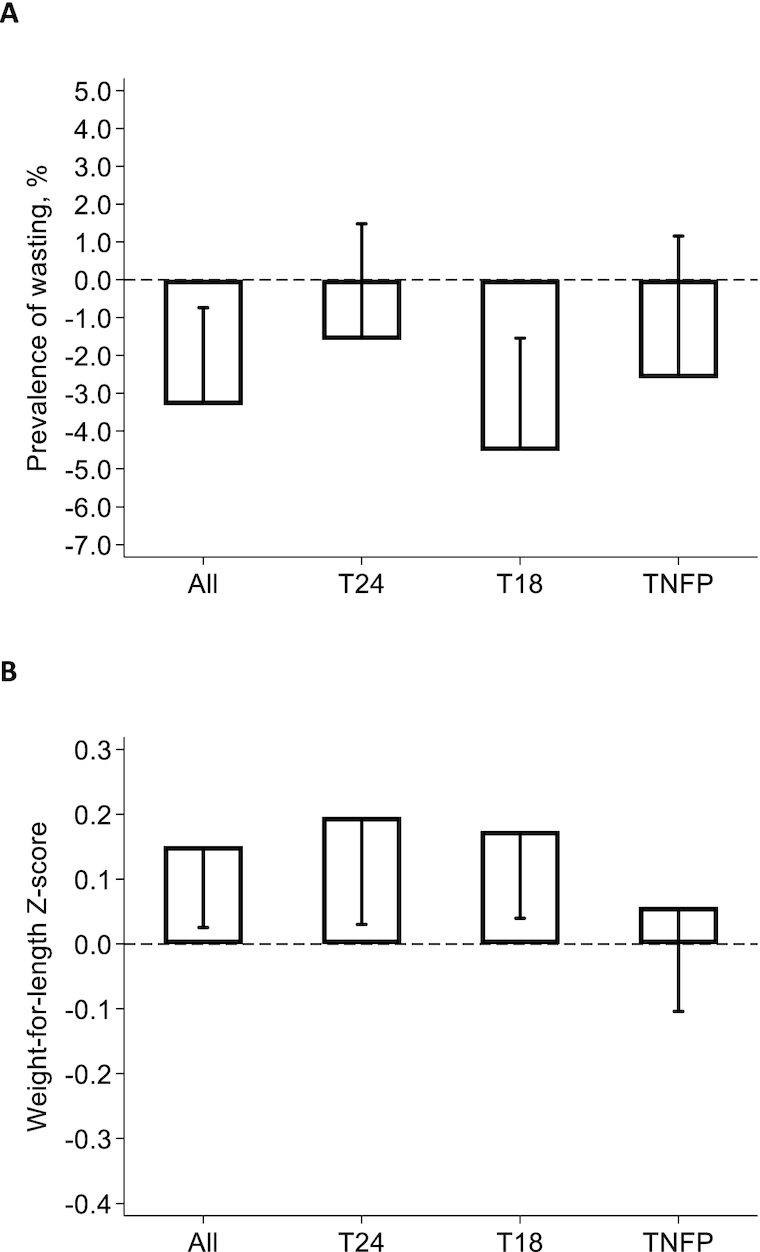
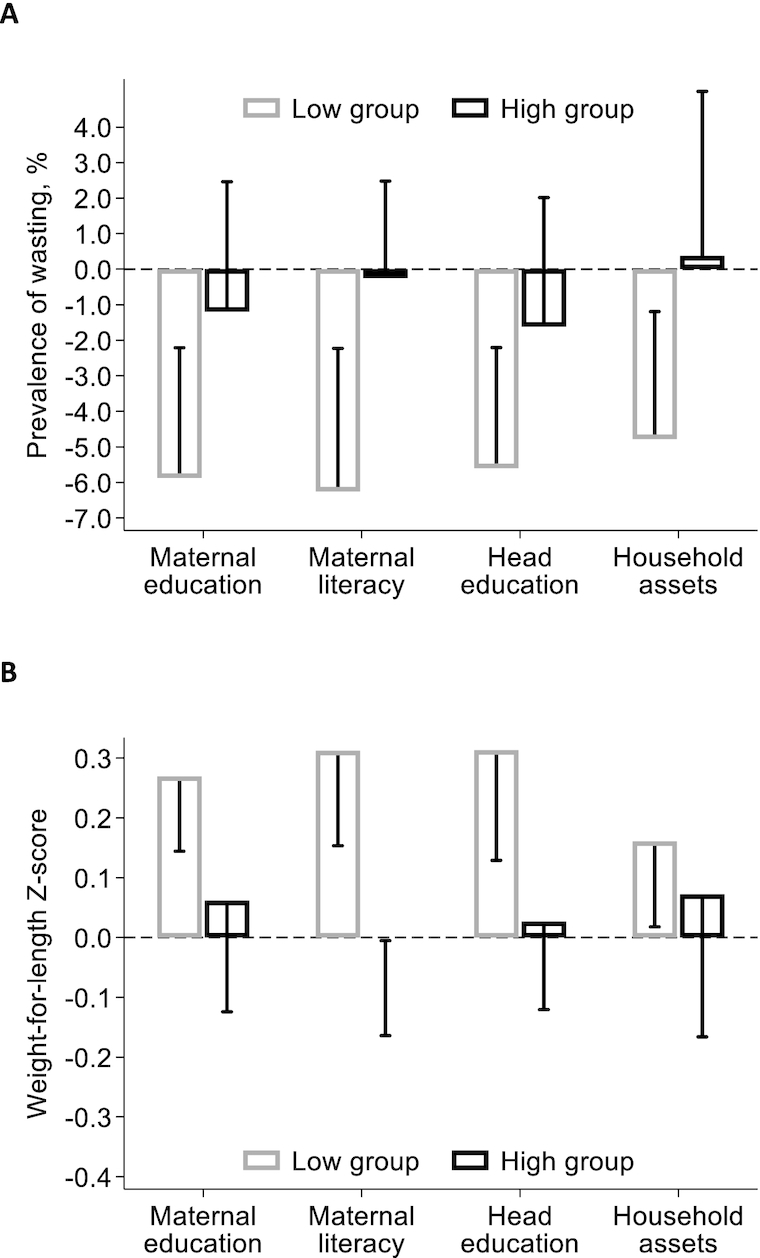
Wasting (weight-for-length Z-score <2 SD) increased from baseline to follow-up in the control group (from 6.5% to 8%), but Tubaramure had a significant (P < 0.05) protective effect on wasting [treatment arms combined, -3.3 percentage points (pp); T18, -4.5 pp] and on the weight-for-length z-score (treatment arms combined, +0.15; T24, +0.20; T18, +0.17). The effects were limited to children whose mother and household head had no education, and who lived in the poorest households. The largest effect was found in children 6 to 12 months of age: the group with the highest wasting prevalence.
FA-MCHN programs in highly food-insecure regions can protect the most disadvantaged children from wasting. These findings are particularly relevant in the context of the economic crisis due to the coronavirus disease 2019 pandemic, which is expected to dramatically increase child wasting.
对于食品辅助母婴健康计划(FA-MCHN)对儿童消瘦的影响,我们知之甚少。
我们评估了图巴雷穆雷(Tubaramure)计划,这是布隆迪的一项 FA-MCHN 计划,对儿童(0 至 24 个月)消瘦的影响,以及按社会经济特征和年龄划分的差异影响。该计划针对妇女及其子女在生命最初的 1000 天内开展,包括 1)食品配给,2)加强和促进利用卫生服务,以及 3)行为改变沟通(BCC)。
我们进行了一项 4 臂、集群随机对照试验(2010-2012 年)。集群定义为“丘陵”(社区)。使用重复的横截面数据(每轮约 2620 名儿童)来评估影响。治疗组从怀孕到 24 个月(T24 组)、从怀孕到 18 个月(T18 组)或从出生到 24 个月(TNFP 组)接受家庭和个人(母亲或儿童在生命最初的 1000 天内)的食品配给(玉米-大豆混合物和强化微量营养素的植物油)。所有受益者在前 1000 天内接受相同的 BCC。对照组既没有获得配给,也没有获得 BCC。
在对照组中,消瘦(体重长度 Z 得分<2 SD)从基线到随访期间增加(从 6.5%增加到 8%),但图巴雷穆雷计划对消瘦(治疗组合并,-3.3 个百分点(pp);T18 组,-4.5 pp)和体重长度 z 得分(治疗组合并,+0.15;T24 组,+0.20;T18 组,+0.17)有显著(P<0.05)的保护作用。这些影响仅限于其母亲和家庭负责人没有受过教育且生活在最贫困家庭的儿童。效果在 6 至 12 个月龄的儿童中最大,该组消瘦的患病率最高。
在高度粮食不安全地区,食品辅助母婴健康计划可以保护最弱势儿童免受消瘦的影响。在因 2019 年冠状病毒病疫情而导致的经济危机背景下,这些发现尤其相关,预计这场经济危机将大幅增加儿童消瘦的比例。