Poverty, Health and Nutrition, International Food Policy Research Institute, Washington, DC, USA.
J Nutr. 2019 Dec 1;149(12):2219-2227. doi: 10.1093/jn/nxz175.
Food-assisted maternal and child health and nutrition (FA-MCHN) programs are widely used to reduce household food insecurity and maternal and child undernutrition in low- and middle-income countries. These programs, however, may unintentionally lead to excessive energy intake and unhealthy weight gain, especially in food-secure populations.
We evaluated the impact of an FA-MCHN program implemented in Guatemala on maternal weight from pregnancy to 24 mo postpartum. The program was earlier shown to reduce stunting.
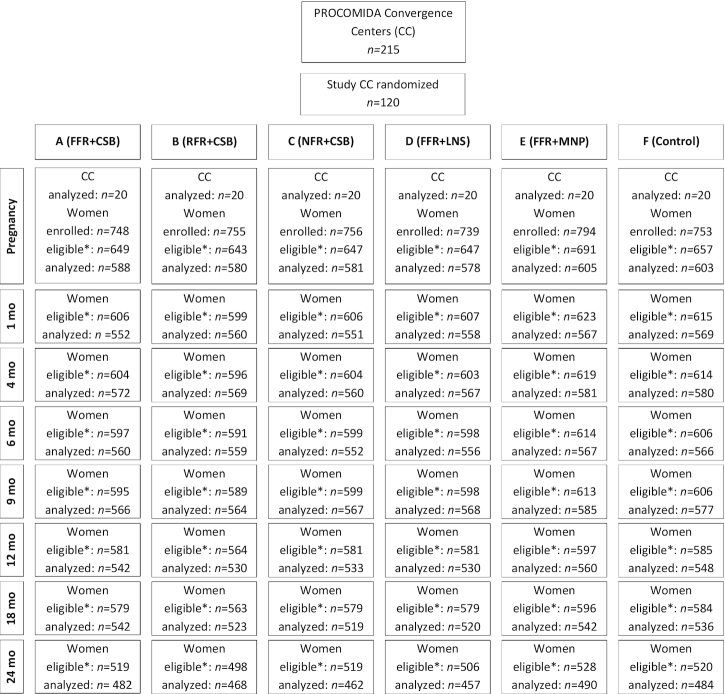
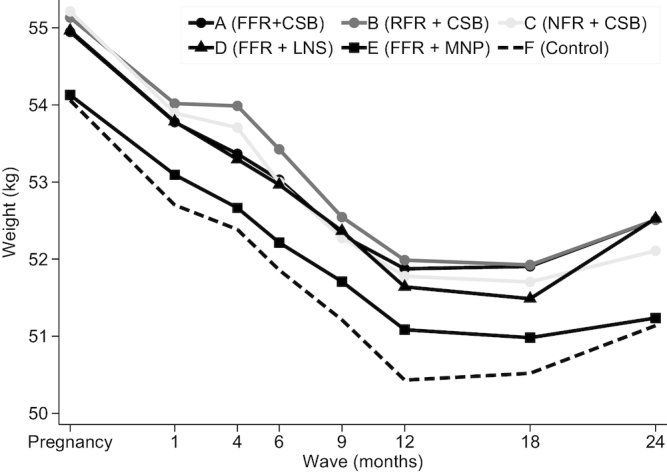
We used a longitudinal, cluster-randomized controlled trial with arms varying in family ration size [full (FFR), reduced (RFR), none (NFR)] and individual maternal ration type [corn-soy blend (CSB), lipid-based nutrient supplement (LNS), micronutrient powder (MNP)]: A: FFR + CSB; B: RFR + CSB; C: NFR + CSB; D: FFR + LNS; E: FFR + MNP; F: control. Weight was measured during pregnancy and at 1, 4, 6, 9, 12, 18, and 24 mo postpartum. We used linear mixed models controlling for pregnancy weight with random cluster and mother effects. Data on 3535 women were analyzed.
Significant (P < 0.05) or marginally significant (P < 0.10) effects of 0.50-0.65 kg were found at all time points (except 9 mo) in arm A. Similar-sized effects were found in arms B (1, 4, 6, and 12 mo) and C (1 and 12 mo). Marginally significant effects (0.51-0.66 kg) were found in arm D (1, 6, 9, and 12 mo); in arm E, marginally significant effects (0.48-0.75 kg) were found from 6 to 24 mo.
The effect on maternal postpartum weight is of concern because of the high existing prevalence of overweight. Programs need to include "double-duty" objectives and actions, to ensure that addressing child undernutrition does not exacerbate the problem of unhealthy weight gain. This trial was registered at clinicaltrials.gov as NCT01072279.
食品辅助母婴健康和营养(FA-MCHN)计划在中低收入国家被广泛用于减少家庭粮食不安全和母婴营养不良。然而,这些计划可能会无意中导致过度的能量摄入和不健康的体重增加,尤其是在粮食安全的人群中。
我们评估了危地马拉实施的一项 FA-MCHN 计划对母亲产后 24 个月体重的影响。该计划此前已被证明可减少发育迟缓。
我们使用了一个纵向、集群随机对照试验,其干预组的家庭配给量大小不同(全量(FFR)、减量(RFR)、无配给(NFR)),母亲个人配给类型也不同(玉米-大豆混合物(CSB)、脂质营养素补充剂(LNS)、微量营养素粉(MNP)):A:FFR+CSB;B:RFR+CSB;C:NFR+CSB;D:FFR+LNS;E:FFR+MNP;F:对照组。在怀孕期间和产后 1、4、6、9、12、18 和 24 个月时测量体重。我们使用线性混合模型,随机聚类和母亲效应进行控制。共分析了 3535 名女性的数据。
在所有时间点(9 个月除外),A 臂发现了 0.50-0.65 公斤的显著(P<0.05)或边缘显著(P<0.10)的效果。B 臂(1、4、6 和 12 个月)和 C 臂(1 和 12 个月)也发现了类似大小的效果。D 臂(1、6、9 和 12 个月)发现了边缘显著的效果(0.51-0.66 公斤);E 臂在 6 至 24 个月期间发现了边缘显著的效果(0.48-0.75 公斤)。
由于超重的高患病率,产后体重的影响令人担忧。计划需要包括“双重职责”的目标和行动,以确保解决儿童营养不良不会加剧不健康体重增加的问题。该试验在 clinicaltrials.gov 注册,编号为 NCT01072279。