OhioHealth Multiple Sclerosis Center, Riverside Methodist Hospital, Columbus, OH, USA.
KMK Consulting Inc., Morristown, NJ, USA.
Adv Ther. 2021 Jan;38(1):758-771. doi: 10.1007/s12325-020-01570-0. Epub 2020 Nov 27.
The severity of relapses varies in multiple sclerosis (MS) and may lead to a differential cost burden. This study aimed to characterize the direct healthcare costs associated with relapses in patients with MS by the level of relapse severity.
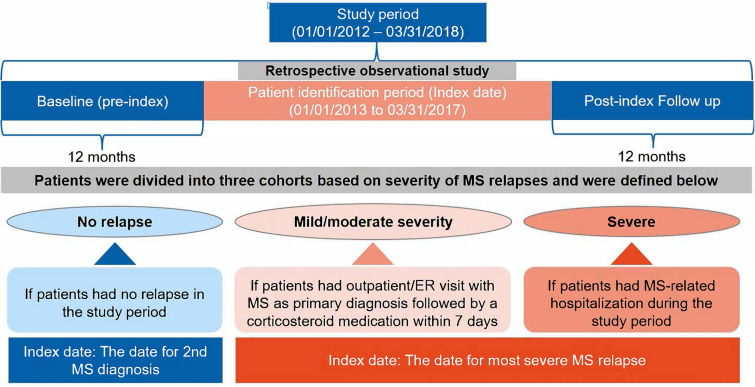
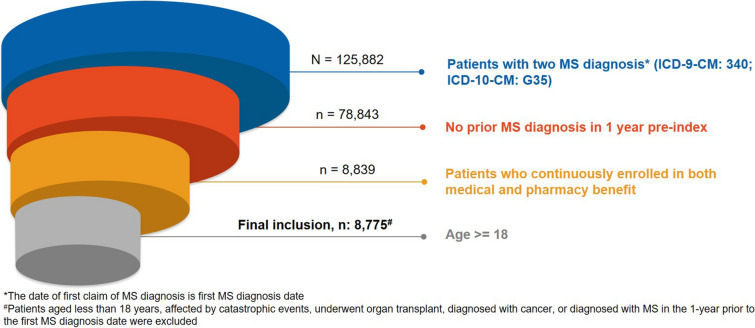
This retrospective analysis used claims data extracted from the MarketScan Databases from January 1, 2013 to March 31, 2017 (study period January 1, 2012 to March 31, 2018). Adult patients with at least one diagnosis of MS and 12 months of continuous enrollment prior to the first MS diagnosis to 12 months after the index date were included. On the basis of the severity of the relapse, patients were stratified into three cohorts: severe relapse (SR), mild/moderate relapse (MMR), and no relapse (NR). All-cause and MS-related costs were analyzed during the 12-month follow-up period. Group differences were assessed using descriptive and multivariate statistical analyses.
In total, 8775 patients with MS were analyzed: 6341 (72%) in the NR cohort, 1929 (22%) in the MMR cohort, and 505 (6%) in the SR cohort. Overall, patients were mostly female (76%), mean age was 50 years, and 25% were on a disease-modifying therapy. Mean (standard deviation [SD]) all-cause and MS-related costs among patients with a relapse were higher vs patients without a relapse (all-cause $66,489 [$56,264] vs $41,494 [$48,417]; MS-related $48,700 [$43,364] vs $24,730 [$33,821]). Among patients with a relapse, the mean (SD) all-cause costs were $87,979 [$65,991] vs $60,863 [$51,998] and MS-related costs were $69,586 ($51,187) vs $43,233 [$39,292] for patients in the SR vs MMR cohorts, respectively. A similar trend for increase in cost by relapse severity was observed in the adjusted analysis.
Total annual all-cause and MS-related costs increased with severity of the relapses. High-efficacy treatments might reduce the severity of the relapses, thereby reducing the cost of care in patients with MS.
多发性硬化症(MS)患者的复发严重程度各异,可能导致费用负担存在差异。本研究旨在通过复发严重程度来描述 MS 患者复发相关的直接医疗保健费用。
本回顾性分析使用了从 2013 年 1 月 1 日至 2017 年 3 月 31 日(研究期间为 2012 年 1 月 1 日至 2018 年 3 月 31 日)从 MarketScan 数据库中提取的索赔数据。纳入至少有一次 MS 诊断且在首次 MS 诊断前 12 个月至索引日期后 12 个月期间连续入组 12 个月的成年患者。根据复发的严重程度,患者被分为三组:重度复发(SR)、轻度/中度复发(MMR)和无复发(NR)。在 12 个月的随访期间分析了全因和 MS 相关成本。使用描述性和多变量统计分析评估组间差异。
共分析了 8775 例 MS 患者:NR 队列 6341 例(72%)、MMR 队列 1929 例(22%)和 SR 队列 505 例(6%)。总体而言,患者主要为女性(76%),平均年龄为 50 岁,25%正在接受疾病修正治疗。与无复发患者相比,有复发患者的全因和 MS 相关费用更高(全因费用:$66489[56264] vs $41494[48417];MS 相关费用:$48700[43364] vs $24730[33821])。在有复发的患者中,与 MMR 队列相比,SR 队列的全因费用分别为$87979[65991] vs $60863[51998],MS 相关费用分别为$69586[51187] vs $43233[39292]。在调整后的分析中,也观察到随着复发严重程度的增加,成本呈类似的增加趋势。
全因和 MS 相关的年度总费用随着复发的严重程度而增加。高效治疗可能会降低复发的严重程度,从而降低 MS 患者的医疗费用。