Multiple Sclerosis Center, Swedish Neuroscience Institute, Seattle, WA, USA.
Bristol Myers Squibb, Summit, NJ, USA.
Adv Ther. 2020 Jul;37(7):3163-3177. doi: 10.1007/s12325-020-01367-1. Epub 2020 May 20.
Disease-modifying therapies (DMTs) can reduce multiple sclerosis (MS) relapse rates; however, effectiveness of treatments may vary. It is important to understand real-world treatment patterns in the context of MS relapses. We describe MS relapses related to treatment patterns among patients who switch treatment after their first DMT.
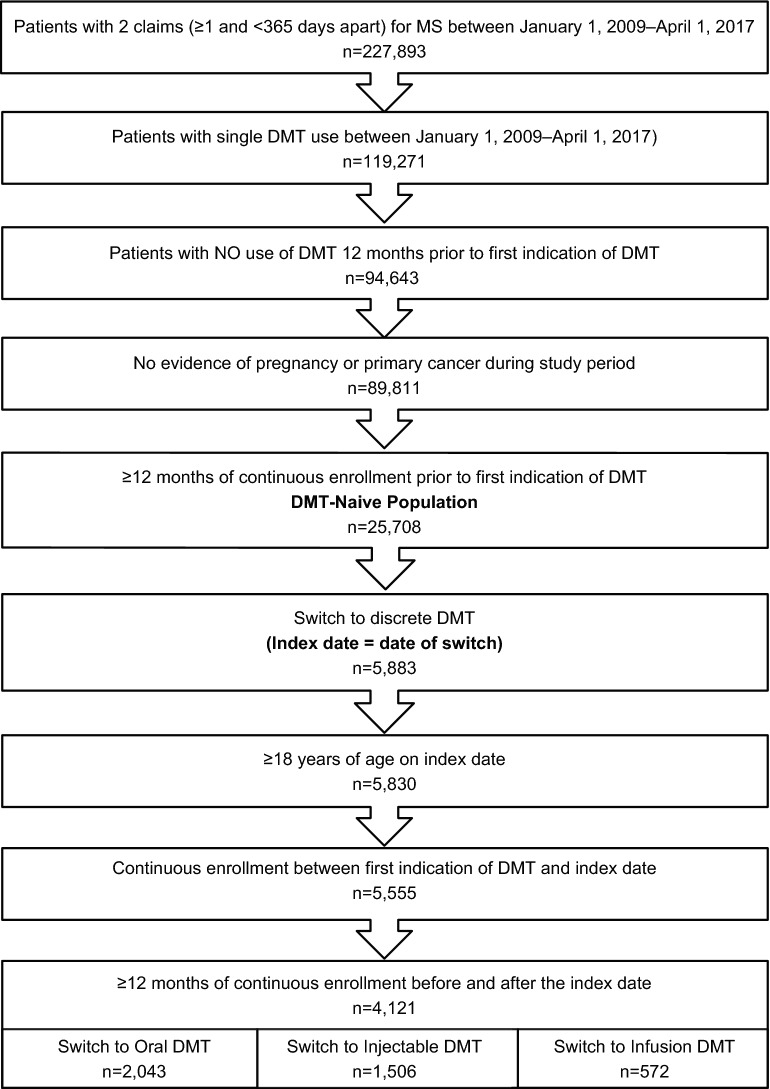
IBM MarketScan research databases were used to identify adult patients with MS who switched DMTs (index-first switch) after being newly treated with a DMT from January 2009 through March 2017, with 12 months of continuous enrollment pre- and post-index. Non-persistence was defined as discontinuing (at least 60 days without DMT) or switching DMTs. MS relapses were defined using a validated claims-based algorithm. Multivariable analysis was used to examine odds of 12-month persistence, odds of post-index relapse, and number of relapses.
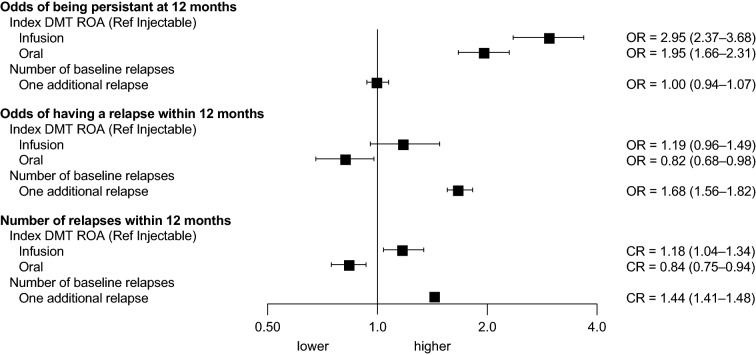
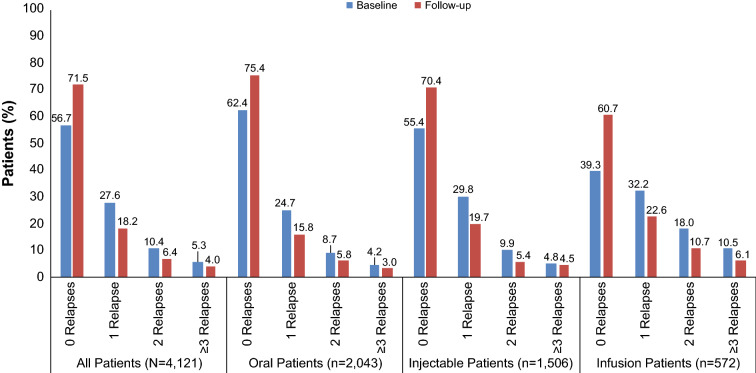
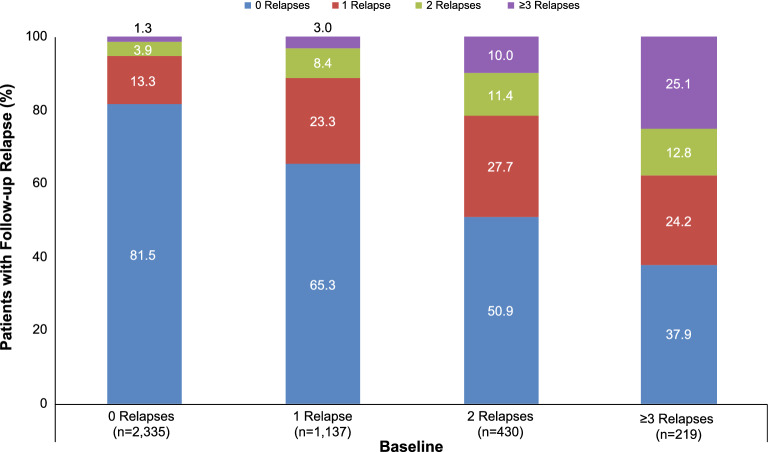
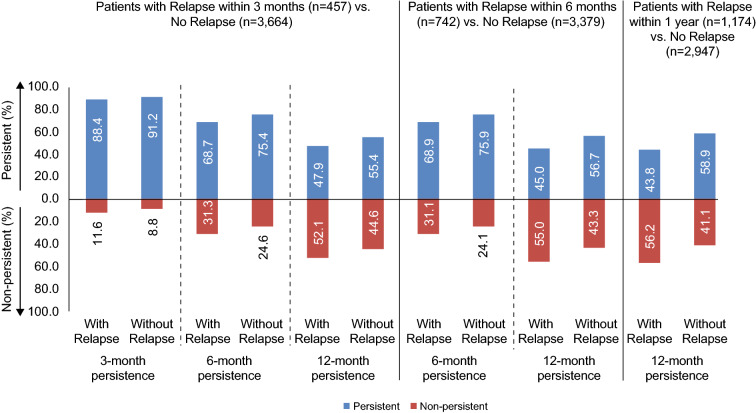
In total, 4121 patients with MS met all inclusion criteria (mean age 46.4 years; female 76.2%). Overall, 49.6% switched to an oral DMT, 36.5% to an injectable DMT, and 13.9% to an infusion DMT. Switching DMTs resulted in a 32.4% reduction in relapses between pre- and post-index. Only 54.6% of patients were persistent throughout the first year. Patients who switched to oral DMTs had 95% higher adjusted odds of persistence and 18% lower adjusted odds of a post-index period relapse than patients who switched to injectable DMTs. The number of baseline relapses was not associated with persistence but with 68% higher odds of a post-index relapse, with each additional baseline relapse associated with a 44% increase in number of post-index relapses.
Among patients with MS who switched DMTs, persistence was consistently low regardless of treatment. Although persistence with oral DMTs was slightly higher than with injectable DMTs, overall results indicate poor persistence to second-line therapy and highlight the need to improve long-term persistence with DMTs.
疾病修正疗法(DMTs)可降低多发性硬化症(MS)的复发率;然而,治疗效果可能存在差异。了解 MS 复发背景下的实际治疗模式非常重要。我们描述了在首次接受 DMT 治疗后转换治疗的患者中,与治疗模式相关的 MS 复发情况。
利用 IBM MarketScan 研究数据库,从 2009 年 1 月至 2017 年 3 月期间,筛选出首次使用 DMT 治疗后转换 DMT(索引-首次转换)的成年 MS 患者,且在索引前和索引后均有 12 个月的连续入组。非持续性定义为停药(至少 60 天无 DMT)或转换 DMT。采用经过验证的基于索赔的算法定义 MS 复发。多变量分析用于检查 12 个月持续性、索引后复发的可能性以及复发次数。
共有 4121 例 MS 患者符合所有纳入标准(平均年龄 46.4 岁;女性占 76.2%)。总体而言,49.6%的患者转换为口服 DMT,36.5%转换为注射用 DMT,13.9%转换为输注用 DMT。与索引前相比,转换 DMT 可使复发率降低 32.4%。只有 54.6%的患者在整个第一年保持持续治疗。与转换为注射用 DMT 的患者相比,转换为口服 DMT 的患者持续性调整后的比值比(OR)高 95%,索引后复发的调整后 OR 低 18%。基线复发次数与持续性无关,但与索引后复发的 OR 高 68%相关,每次基线复发与索引后复发次数增加 44%相关。
在转换 DMT 的 MS 患者中,无论治疗情况如何,持续性都普遍较低。尽管口服 DMT 的持续性略高于注射用 DMT,但总体结果表明二线治疗的持续性较差,这突显了改善 DMT 长期持续性的必要性。