Department of Research and Development, Dharmais Cancer Hospital - National Cancer Center, Jakarta, Indonesia.
Department of Anatomical Pathology, Dharmais Cancer Hospital - National Cancer Center, Jakarta, Indonesia.
Asian Pac J Cancer Prev. 2020 Nov 1;21(11):3267-3277. doi: 10.31557/APJCP.2020.21.11.3267.
Molecular testing of thyroid nodules becomes important for improving the accuracy of fine-needle aspiration biopsy (FNAB). This study aimed to investigate the diagnostic utility of BRAF, NRAS, and TERT promoter mutation in thyroid nodules at Dharmais Cancer Hospital.
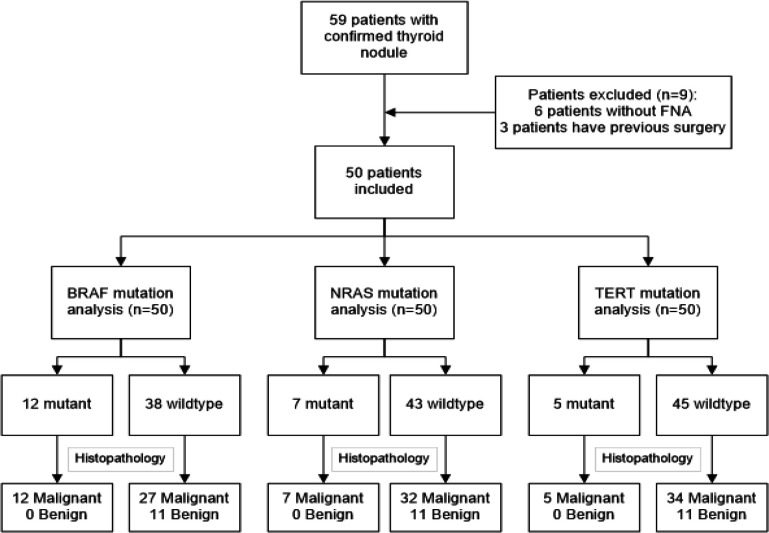
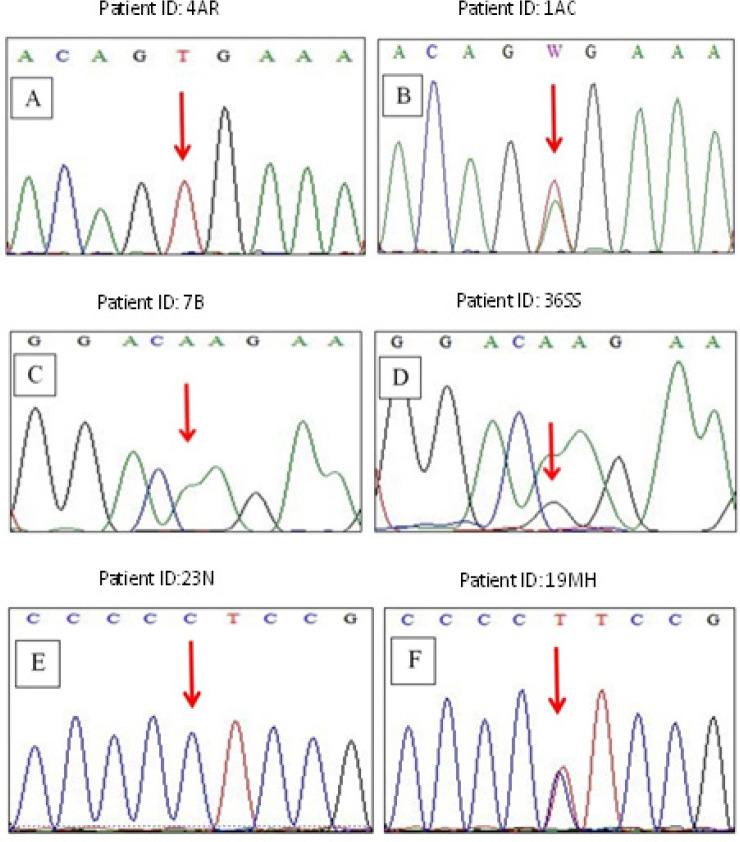
Methods: We performed a prospective diagnostic study involving 50 patients with thyroid nodules who needed surgery between September 2013 and August 2014. Mutational hotspots in BRAF exon 15, NRAS exon 3, and TERT promoter region were analyzed by Sanger sequencing from FNAB specimens. Cytology and molecular data were compared to histopathology results.
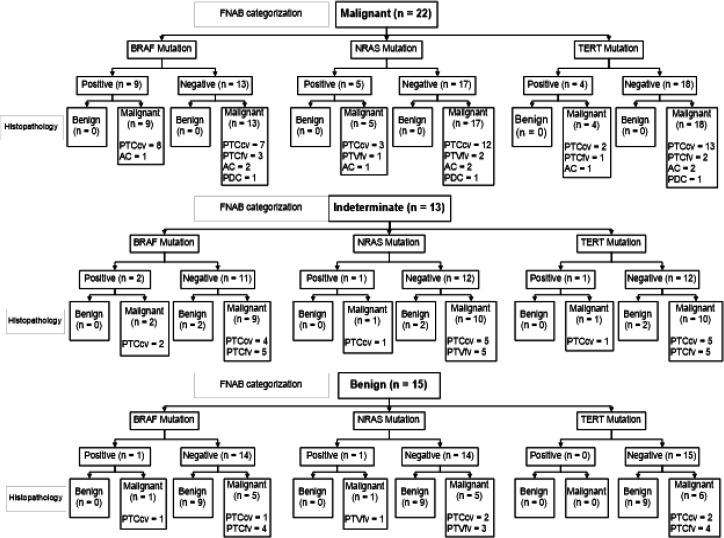
Result: Of the 50 cases included in the analysis, 39 cases (78%) were thyroid malignancies. Mutations of BRAF, NRAS, and TERT promoter were detected in 31% (12/39), 18% (7/39), and 13% (5/39) cases, respectively. BRAF and NRAS mutations were found mutually exclusive, while all of TERT promoter mutation was found coexistent either with BRAF (40%) or NRAS (60%). The combination of FNAB cytology and molecular testing resulted in 69% sensitivity, 100% specificity, 100% positive predictive value, 48% negative predictive value, and 76% accuracy.
Conclusion: Molecular testing of BRAF, NRAS, and TERT mutations improve the sensitivity of thyroid FNAB and is beneficial for more definitive treatment in selective cases. However, the NPV is relatively low to avoid the need for diagnostic surgery. Therefore, further studies to identify more sensitive methods and more comprehensive molecular markers in the diagnosis of thyroid nodules are needed.
甲状腺结节的分子检测对于提高细针穿刺活检(FNAB)的准确性变得非常重要。本研究旨在探讨 Dharmais 癌症医院甲状腺结节中 BRAF、NRAS 和 TERT 启动子突变的诊断效用。
方法:我们进行了一项前瞻性诊断研究,纳入了 2013 年 9 月至 2014 年 8 月期间需要手术的 50 例甲状腺结节患者。通过 FNAB 标本的 Sanger 测序分析 BRAF 外显子 15、NRAS 外显子 3 和 TERT 启动子区域的突变热点。比较细胞学和分子数据与组织病理学结果。
结果:在纳入分析的 50 例病例中,有 39 例(78%)为甲状腺恶性肿瘤。在 39 例病例中,分别检测到 BRAF、NRAS 和 TERT 启动子突变的比例为 31%(12/39)、18%(7/39)和 13%(5/39)。BRAF 和 NRAS 突变是互斥的,而 TERT 启动子突变均与 BRAF(40%)或 NRAS(60%)共存。FNAB 细胞学和分子检测联合应用的敏感性为 69%,特异性为 100%,阳性预测值为 100%,阴性预测值为 48%,准确性为 76%。
结论:BRAF、NRAS 和 TERT 突变的分子检测提高了甲状腺 FNAB 的敏感性,有利于在选择性病例中进行更明确的治疗。然而,为了避免诊断性手术的需要,NPV 相对较低。因此,需要进一步研究以确定更敏感的方法和更全面的分子标志物用于甲状腺结节的诊断。