Alex and Simona Shnaider Research Laboratory in Molecular Oncology, Lunenfeld-Tanenbaum Research Institute, Mount Sinai Hospital, Sinai Health, Toronto, Ontario, Canada.
Department of Pathology and Laboratory Medicine, Mount Sinai Hospital, Sinai Health and University of Toronto, Toronto, Ontario, Canada.
JAMA Netw Open. 2024 May 1;7(5):e2411919. doi: 10.1001/jamanetworkopen.2024.11919.
Interpatient variabilities in genomic variants may reflect differences in tumor statuses among individuals.
To delineate interpatient variabilities in RAS variants in thyroid tumors based on the fifth World Health Organization classification of thyroid neoplasms and assess their diagnostic significance in cancer detection among patients with thyroid nodules.
DESIGN, SETTING, AND PARTICIPANTS: This prospective diagnostic study analyzed surgically resected thyroid tumors obtained from February 2016 to April 2022 and residual thyroid fine-needle aspiration (FNA) biopsies obtained from January 2020 to March 2021, at Mount Sinai Hospital, Toronto, Ontario, Canada. Data were analyzed from June 20, 2022, to October 15, 2023.
Quantitative detection of interpatient disparities of RAS variants (ie, NRAS, HRAS, and KRAS) was performed along with assessment of BRAF V600E and TERT promoter variants (C228T and C250T) by detecting their variant allele fractions (VAFs) using digital polymerase chain reaction assays.
Interpatient differences in RAS, BRAF V600E, and TERT promoter variants were analyzed and compared with surgical histopathologic diagnoses. Malignancy rates, sensitivity, specificity, positive predictive values, and negative predictive values were calculated.
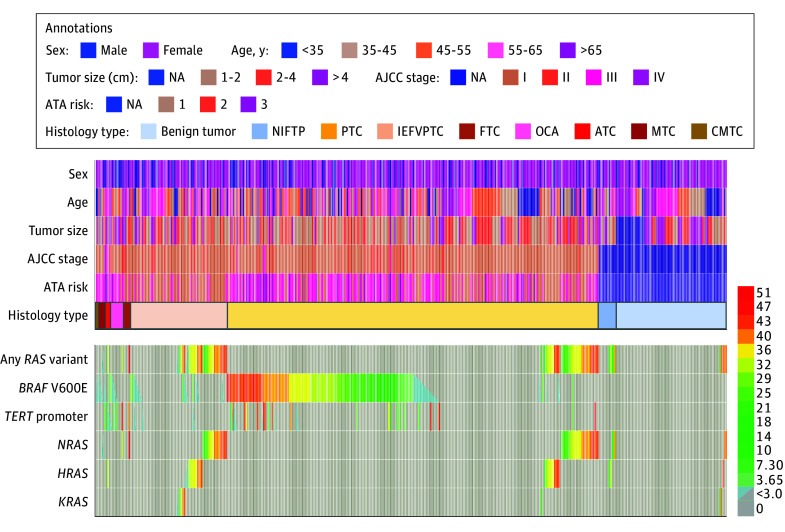
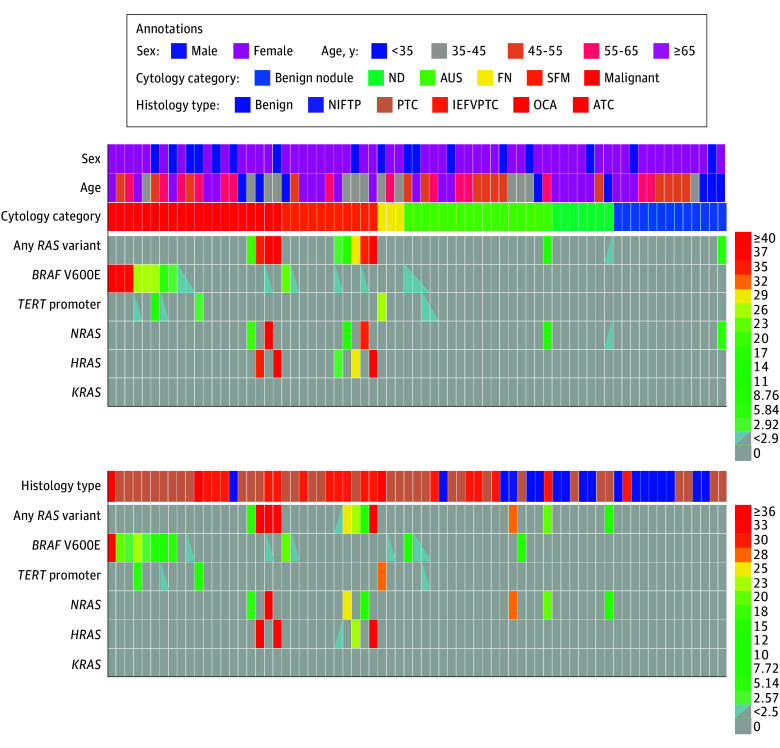
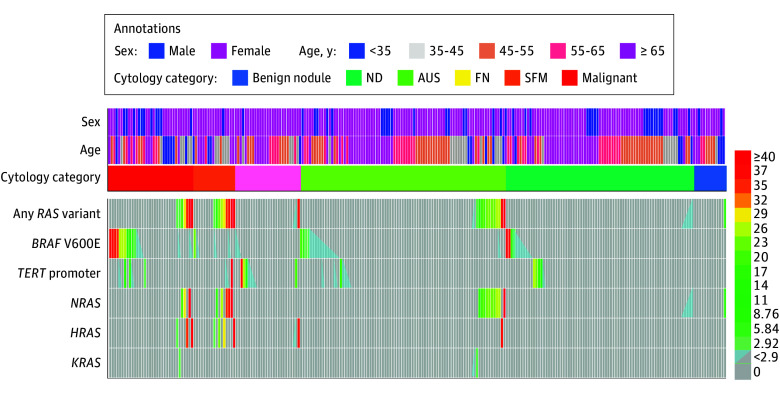
A total of 438 surgically resected thyroid tumor tissues and 249 thyroid nodule FNA biopsies were obtained from 620 patients (470 [75.8%] female; mean [SD] age, 50.7 [15.9] years). Median (IQR) follow-up for patients who underwent FNA biopsy analysis and subsequent resection was 88 (50-156) days. Of 438 tumors, 89 (20.3%) were identified with the presence of RAS variants, including 51 (11.6%) with NRAS, 29 (6.6%) with HRAS, and 9 (2.1%) with KRAS. The interpatient differences in these variants were discriminated at VAF levels ranging from 0.15% to 51.53%. The mean (SD) VAF of RAS variants exhibited no significant differences among benign nodules (39.2% [11.2%]), noninvasive follicular thyroid neoplasm with papillary-like nuclear features (NIFTPs) (25.4% [14.3%]), and malignant neoplasms (33.4% [13.8%]) (P = .28), although their distribution was found in 41.7% of NIFTPs and 50.7% of invasive encapsulated follicular variant papillary thyroid carcinomas (P < .001). RAS variants alone, regardless of a low or high VAF, were significantly associated with neoplasms at low risk of tumor recurrence (60.7% of RAS variants vs 26.9% of samples negative for RAS variants; P < .001). Compared with the sensitivity of 54.2% (95% CI, 48.8%-59.4%) and specificity of 100% (95% CI, 94.8%-100%) for BRAF V600E and TERT promoter variant assays, the inclusion of RAS variants into BRAF and TERT promoter variant assays improved sensitivity to 70.5% (95% CI, 65.4%-75.2%), albeit with a reduction in specificity to 88.8% (95% CI, 79.8%-94.1%) in distinguishing malignant neoplasms from benign and NIFTP tumors. Furthermore, interpatient differences in 5 gene variants (NRAS, HRAS, KRAS, BRAF, and TERT) were discriminated in 54 of 126 indeterminate FNAs (42.9%) and 18 of 76 nondiagnostic FNAs (23.7%), and all tumors with follow-up surgical pathology confirmed malignancy.
This diagnostic study delineated interpatient differences in RAS variants present in thyroid tumors with a variety of histopathological diagnoses. Discrimination of interpatient variabilities in RAS in combination with BRAF V600E and TERT promoter variants could facilitate cytology examinations in preoperative precision malignancy diagnosis among patients with thyroid nodules.
基因组变异的个体间差异可能反映了个体间肿瘤状态的差异。
根据第五版世界卫生组织甲状腺肿瘤分类,描绘甲状腺肿瘤中 RAS 变异的个体间差异,并评估其在甲状腺结节患者癌症检测中的诊断意义。
设计、设置和参与者:本前瞻性诊断研究分析了 2016 年 2 月至 2022 年 4 月期间切除的甲状腺肿瘤和 2020 年 1 月至 2021 年 3 月期间获得的剩余甲状腺细针抽吸 (FNA) 活检,这些标本均来自加拿大安大略省多伦多西奈山医院。数据分析于 2022 年 6 月 20 日至 2023 年 10 月 15 日进行。
通过数字聚合酶链反应检测检测其变异等位基因分数 (VAF),定量检测 RAS 变异(即 NRAS、HRAS 和 KRAS)的个体间差异,并评估 BRAF V600E 和 TERT 启动子变异(C228T 和 C250T)。
分析了 RAS、BRAF V600E 和 TERT 启动子变异的个体间差异,并与手术组织病理学诊断进行了比较。计算了恶性肿瘤率、灵敏度、特异性、阳性预测值和阴性预测值。
从 620 名患者中获得了 438 份切除的甲状腺肿瘤组织和 249 份甲状腺结节 FNA 活检(470 名 [75.8%] 为女性;平均 [标准差] 年龄为 50.7 [15.9] 岁)。接受 FNA 分析和随后切除的患者中位(IQR)随访时间为 88(50-156)天。在 438 个肿瘤中,有 89 个(20.3%)存在 RAS 变异,包括 51 个(11.6%) NRAS、29 个(6.6%) HRAS 和 9 个(2.1%) KRAS。这些变异的个体间差异在 VAF 水平为 0.15%至 51.53%之间得到区分。RAS 变异的平均(标准差)VAF 在良性结节(39.2% [11.2%])、非侵袭性滤泡性甲状腺肿瘤伴乳头状核特征(NIFTPs)(25.4% [14.3%])和恶性肿瘤(33.4% [13.8%])中无显著差异(P = .28),尽管在 41.7%的 NIFTPs 和 50.7%的侵袭性包膜滤泡状变异型乳头状甲状腺癌中发现了它们的分布(P < .001)。无论 VAF 高低,RAS 变异本身与肿瘤复发风险低的肿瘤显著相关(RAS 变异患者中 60.7%,RAS 变异阴性患者中 26.9%;P < .001)。与 BRAF V600E 和 TERT 启动子变异检测的敏感性为 54.2%(95%CI,48.8%-59.4%)和特异性为 100%(95%CI,94.8%-100%)相比,将 RAS 变异纳入 BRAF 和 TERT 启动子变异检测可将敏感性提高至 70.5%(95%CI,65.4%-75.2%),但特异性降低至 88.8%(95%CI,79.8%-94.1%),以区分恶性肿瘤与良性和 NIFTP 肿瘤。此外,在 54 例不确定的细针抽吸(126 例中有 54 例,42.9%)和 76 例非诊断性细针抽吸(76 例中有 18 例,23.7%)中,18 例(54 例中有 18 例,33.3%)的 5 个基因变异(NRAS、HRAS、KRAS、BRAF 和 TERT)中存在个体间差异,所有有随访手术病理证实为恶性肿瘤的肿瘤。
本诊断研究描绘了具有多种组织病理学诊断的甲状腺肿瘤中 RAS 变异的个体间差异。RAS 在 BRAF V600E 和 TERT 启动子变异检测中的个体间差异的鉴别可能有助于术前对甲状腺结节患者进行精确的恶性肿瘤诊断。