Widyarman Armelia Sari, Bachtiar Endang W, Theodorea Citra Fragrantia, Rizal M Ihsan, Roeslan M Orliando, Djamil Melanie S, Santosa Didi N, Bachtiar Boy M
Department of Microbiology, Faculty of Dentistry, Trisakti University, Jakarta, Indonesia.
Department of Oral Biology, Faculty of Dentistry, Universitas Indonesia, Depok, Indonesia.
Front Med (Lausanne). 2020 Nov 4;7:589759. doi: 10.3389/fmed.2020.589759. eCollection 2020.
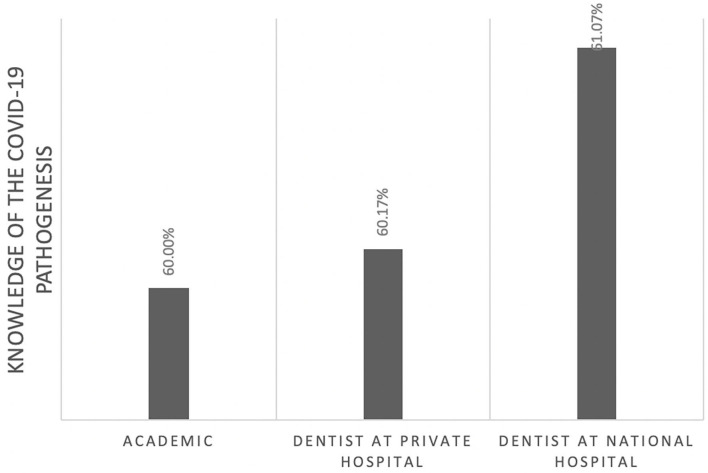
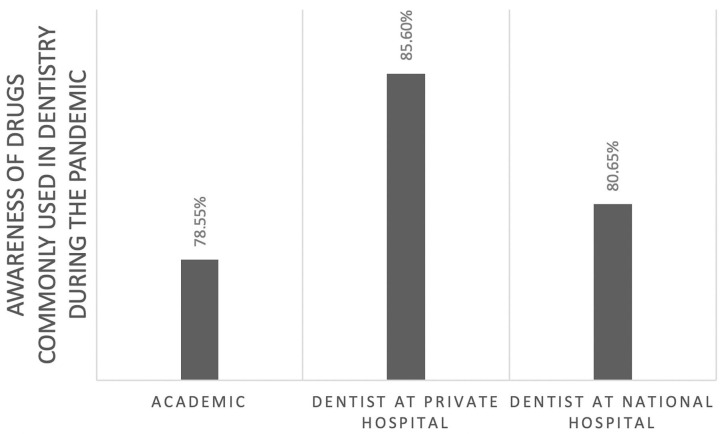
The COVID-19 pandemic caused by SARS-CoV-2 has claimed thousands of lives worldwide. To enhance knowledge and awareness of COVID-19, considerable online resources have been made available, including aspects related to the dental profession. The study aim was to examine the knowledge, perception, and attitude of dental professionals in Indonesia toward COVID-19. We conducted a survey via a questionnaire created using Google docs and distributed to 632 members of the Indonesian Dental Association in the context of a webinar hosted by the Indonesian Oral Biology Association on first June, 2020. The questionnaire consisted of 17 items pertaining to demographic data, knowledge and virus identification, awareness regarding drugs commonly used in dentistry during pandemic and research opportunities. Participants were asked to complete the questionnaire after the webinar by choosing one answer to each question. For the analysis, participants were divided into three groups according to their professional background i.e., employment at national hospital, private hospital, or academic faculty. Data were analyzed using descriptive statistics and expressed as frequencies and percentages. The chi-square test was used to investigate the association between professional activity and the level of knowledge, perceptions, and attitudes about COVID-19. Sixty percent of the participants correctly identified the pathogenesis of the disease. This knowledge was not associated with their professional affiliation ( = 0.95). Sixty-seven percentage had comprehensive knowledge about virus detection methods. This knowledge was not associated with their affiliation either ( = 0.54). Questions regarding drugs of choice, prevention, and the spread of COVID-19 were correctly answered by 89, 96, and 82% of the participants, respectively. Knowledge of these aspects were significantly associated with the professional affiliation ( < 0.05). All respondents were optimistic regarding research opportunities ( < 0.01). Respondents from academics were more interested in joining COVID-19-related research projects with governmental institutions ( < 0.01). Knowledge and awareness of COVID-19 among Indonesian dentists are reasonably good. However, further improvement would be beneficial to manage patients during this pandemic. As the number of COVID-19 cases continue to rise in Indonesia, it is important that dentists keep abreast of the updated knowledge on this moving field. Dentist knowledge on infection control should be strengthened through continuous educational programs.
由严重急性呼吸综合征冠状病毒 2(SARS-CoV-2)引起的 COVID-19 大流行已在全球夺走了数千人的生命。为了增进对 COVID-19 的了解和认识,现已提供了大量在线资源,包括与牙科专业相关的方面。本研究的目的是调查印度尼西亚牙科专业人员对 COVID-19 的知识、认知和态度。我们通过使用谷歌文档创建的问卷进行了一项调查,并在 2020 年 6 月 1 日由印度尼西亚口腔生物学协会主办的网络研讨会上分发给了 632 名印度尼西亚牙科协会成员。问卷由 17 个项目组成,涉及人口统计学数据、知识与病毒识别、大流行期间牙科常用药物的认识以及研究机会。参与者被要求在网络研讨会结束后通过为每个问题选择一个答案来完成问卷。为了进行分析,参与者根据其专业背景被分为三组,即就职于国立医院、私立医院或学术机构。数据采用描述性统计进行分析,并以频率和百分比表示。卡方检验用于调查专业活动与关于 COVID-19 的知识水平、认知和态度之间的关联。60% 的参与者正确识别了该疾病的发病机制。这一知识与他们的专业所属机构无关(P = 0.95)。67% 的参与者对病毒检测方法有全面的了解。这一知识也与他们的所属机构无关(P = 0.54)。关于首选药物、预防和 COVID-19 传播的问题,分别有 89%、96% 和 82% 的参与者回答正确。这些方面的知识与专业所属机构显著相关(P < 0.05)。所有受访者对研究机会持乐观态度(P < 0.01)。来自学术机构的受访者对与政府机构合作参与 COVID-19 相关研究项目更感兴趣(P < 0.01)。印度尼西亚牙医对 COVID-19 的知识和认识相当不错。然而,进一步改进将有助于在此次大流行期间管理患者。由于印度尼西亚的 COVID-19 病例数持续上升,牙医紧跟这一动态领域的最新知识非常重要。应通过持续教育项目加强牙医对感染控制的知识。