Barron Tara, Kim Jun Hee
The Department of Cellular and Integrative Physiology, University of Texas Health Science Center, San Antonio, TX 78229, USA.
Brain Sci. 2020 Nov 24;10(12):897. doi: 10.3390/brainsci10120897.
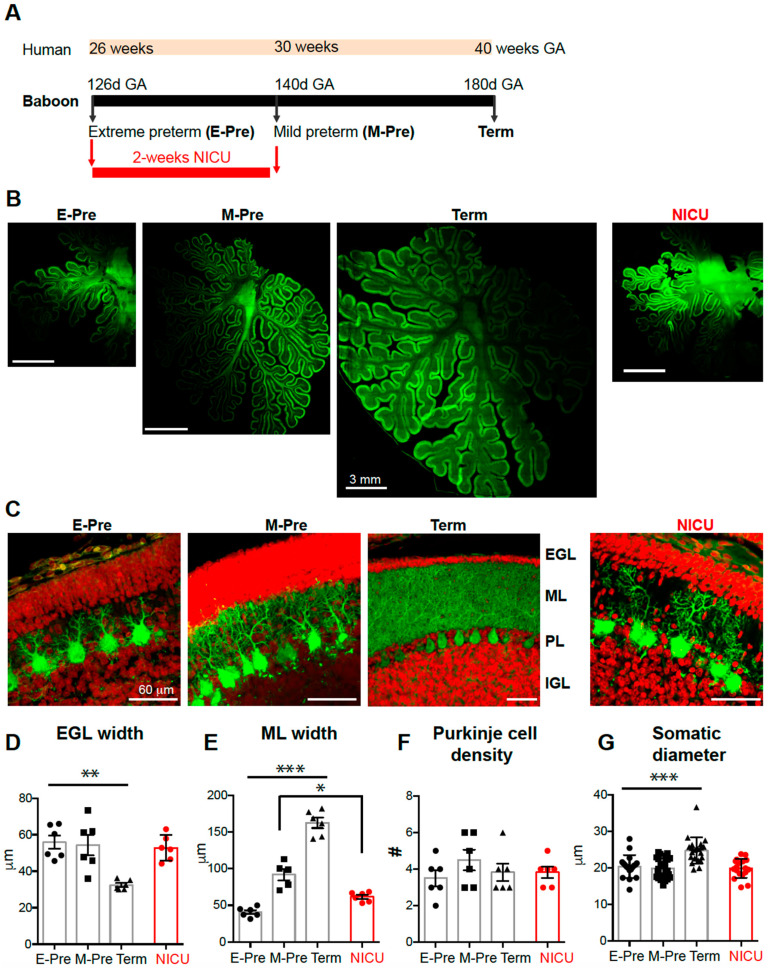
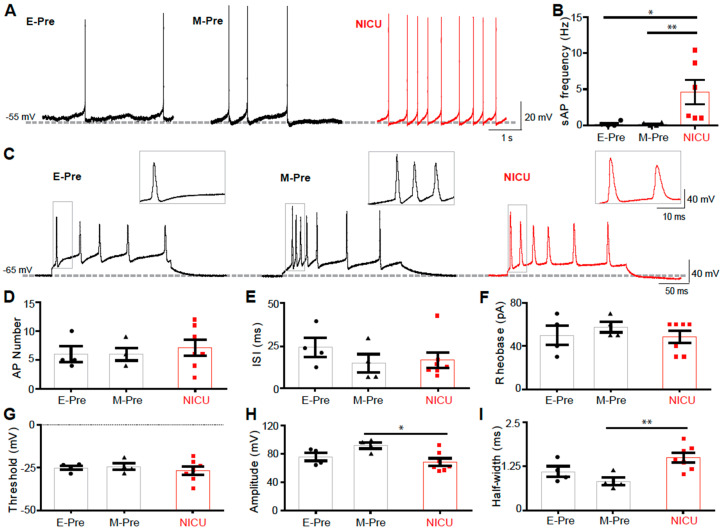
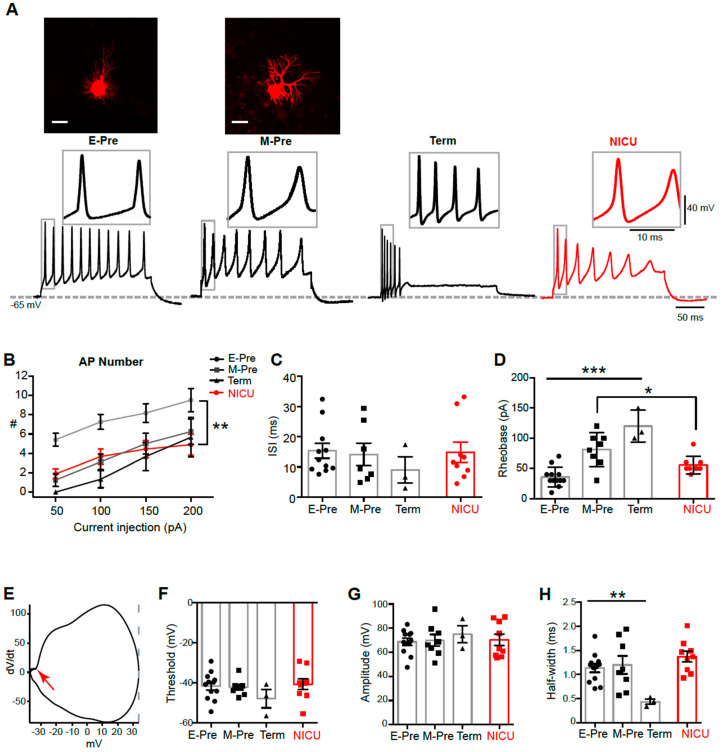
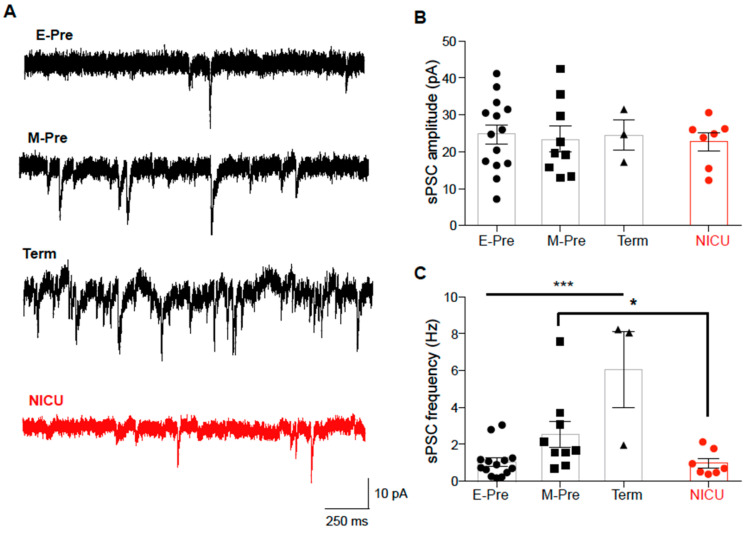
Human cerebellar development occurs late in gestation and is hindered by preterm birth. The fetal development of Purkinje cells, the primary output cells of the cerebellar cortex, is crucial for the structure and function of the cerebellum. However, morphological and electrophysiological features in Purkinje cells at different gestational ages, and the effects of neonatal intensive care unit (NICU) experience on cerebellar development are unexplored. Utilizing the non-human primate baboon cerebellum, we investigated Purkinje cell development during the last trimester of pregnancy and the effect of NICU experience following premature birth on developmental features of Purkinje cells. Immunostaining and whole-cell patch clamp recordings of Purkinje cells in the baboon cerebellum at different gestational ages revealed that molecular layer width, driven by Purkinje dendrite extension, drastically increased and refinement of action potential waveform properties occurred throughout the last trimester of pregnancy. Preterm birth followed by NICU experience for 2 weeks impeded development of Purkinje cells, including action potential waveform properties, synaptic input, and dendrite extension compared with age-matched controls. In addition, these alterations impact Purkinje cell output, reducing the spontaneous firing frequency in deep cerebellar nucleus (DCN) neurons. Taken together, the primate cerebellum undergoes developmental refinements during late gestation, and NICU experience following extreme preterm birth influences morphological and physiological features in the cerebellum that can lead to functional deficits.
人类小脑发育在妊娠后期发生,且会受到早产的阻碍。浦肯野细胞是小脑皮质的主要输出细胞,其胎儿期发育对小脑的结构和功能至关重要。然而,不同胎龄浦肯野细胞的形态和电生理特征,以及新生儿重症监护病房(NICU)经历对小脑发育的影响尚未得到探索。利用非人类灵长类动物狒狒的小脑,我们研究了妊娠最后三个月期间浦肯野细胞的发育情况,以及早产后面临NICU经历对浦肯野细胞发育特征的影响。对不同胎龄狒狒小脑浦肯野细胞进行免疫染色和全细胞膜片钳记录发现,在妊娠最后三个月期间,由浦肯野树突延伸驱动的分子层宽度急剧增加,动作电位波形特性得到优化。与年龄匹配的对照组相比,早产后面临2周NICU经历阻碍了浦肯野细胞的发育,包括动作电位波形特性、突触输入和树突延伸。此外,这些改变影响浦肯野细胞输出,降低了小脑深部核团(DCN)神经元的自发放电频率。综上所述,灵长类动物小脑在妊娠后期经历发育优化,极早早产后面临NICU经历会影响小脑的形态和生理特征,进而导致功能缺陷。