Paço Ana, da-Silva José Rodrigo, Torres Denise Pereira, Glick Bernard R, Brígido Clarisse
MED-Mediterranean Institute for Agriculture, Environment and Development, Instituto de Investigação e Formação Avançada, Universidade de Évora, Pólo da Mitra, Ap. 94, 7006-554 Évora, Portugal.
Department of Biology, University of Waterloo, Waterloo, ON N2L 3G1, Canada.
Plants (Basel). 2020 Nov 24;9(12):1630. doi: 10.3390/plants9121630.
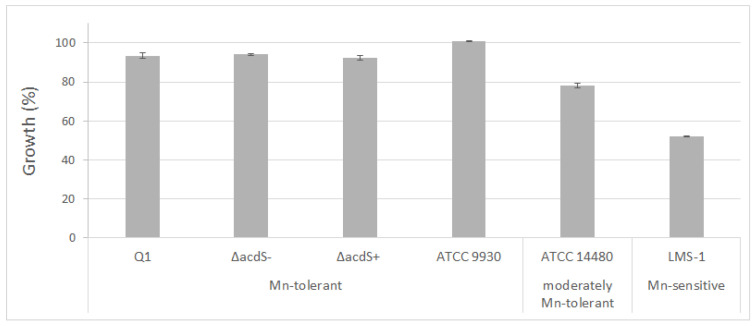
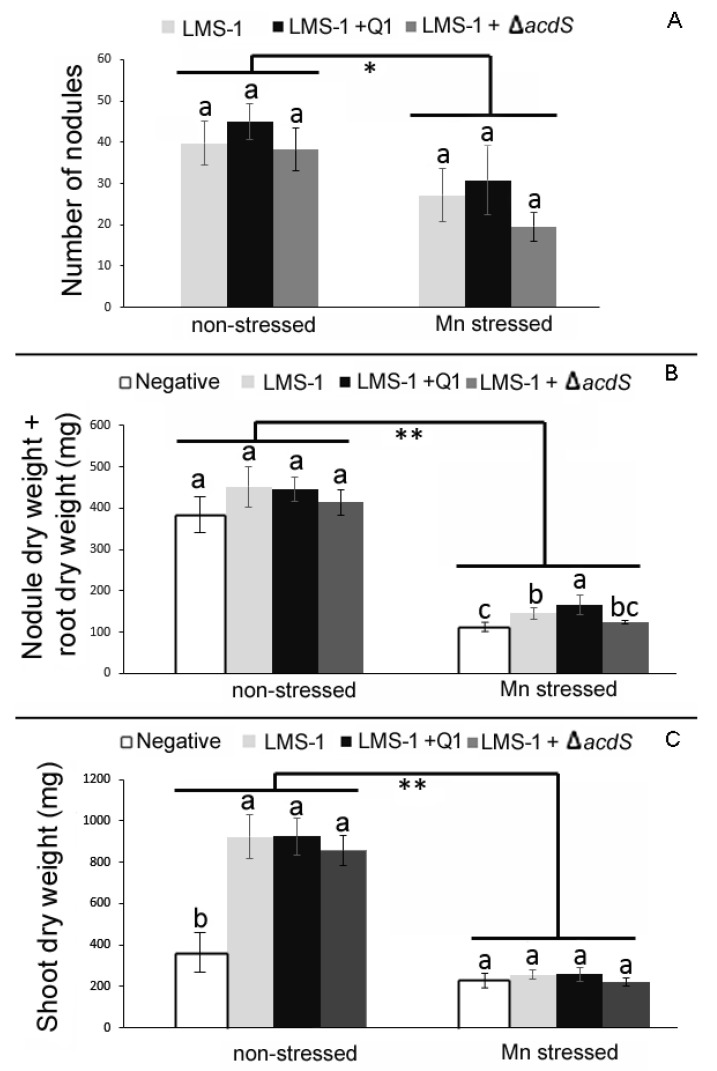
Manganese (Mn) toxicity is a very common soil stress around the world, which is responsible for low soil fertility. This manuscript evaluates the effect of the endophytic bacterium sp. Q1 on different rhizobial-legume symbioses in the absence and presence of Mn toxicity. Three legume species, (chickpea), (subterranean clover), and (burr medic) were used. To evaluate the role of 1-aminocyclopropane-1-carboxylate (ACC) deaminase produced by strain Q1 in these interactions, an ACC deaminase knockout mutant of this strain was constructed and used in those trials. The Q1 strain only promoted the symbiotic performance of bv. trifolii ATCC 14480 and ATCC 9930, leading to an increase of the growth of their hosts in both conditions. Notably, the gene disruption of strain Q1 abolished the beneficial effect of this bacterium as well as causing this mutant strain to act deleteriously in those specific symbioses. This study suggests that the addition of non-rhizobia with functional ACC deaminase may be a strategy to improve the pasture legume-rhizobial symbioses, particularly when the use of rhizobial strains alone does not yield the expected results due to their difficulty in competing with native strains or in adapting to inhibitory soil conditions.
锰(Mn)毒性是全球一种非常常见的土壤胁迫,它会导致土壤肥力低下。本手稿评估了内生细菌sp. Q1在存在和不存在锰毒性的情况下对不同根瘤菌 - 豆科植物共生关系的影响。使用了三种豆科植物,即鹰嘴豆、地下三叶草和毛刺苜蓿。为了评估菌株Q1产生的1 - 氨基环丙烷 - 1 - 羧酸(ACC)脱氨酶在这些相互作用中的作用,构建了该菌株的ACC脱氨酶基因敲除突变体并用于这些试验。Q1菌株仅促进了三叶草根瘤菌ATCC 14480和苜蓿根瘤菌ATCC 9930的共生性能,导致它们的宿主在两种条件下的生长都有所增加。值得注意的是,菌株Q1的acc基因破坏消除了该细菌的有益作用,并且导致该突变菌株在那些特定的共生关系中产生有害作用。本研究表明,添加具有功能性ACC脱氨酶的非根瘤菌可能是改善牧草豆科植物 - 根瘤菌共生关系的一种策略,特别是当单独使用根瘤菌菌株由于难以与本地菌株竞争或难以适应抑制性土壤条件而无法产生预期结果时。