Departamento de Biología Molecular, Universidad Autónoma de Madrid, Cantoblanco, 28049 Madrid, Spain.
Centro de Biología Molecular Severo Ochoa, Spanish National Research Council-Universidad Autónoma de Madrid (CSIC-UAM), Cantoblanco, 28049 Madrid, Spain.
Viruses. 2020 Nov 26;12(12):1356. doi: 10.3390/v12121356.
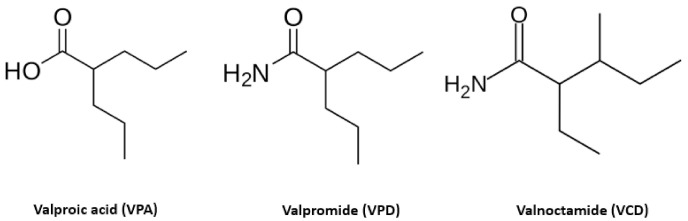
Herpes simplex viruses (HSVs) are neurotropic viruses with broad host range whose infections cause considerable health problems in both animals and humans. In fact, 67% of the global population under the age of 50 are infected with HSV-1 and 13% have clinically recurrent HSV-2 infections. The most prescribed antiherpetics are nucleoside analogues such as acyclovir, but the emergence of mutants resistant to these drugs and the lack of available vaccines against human HSVs has led to an imminent need for new antivirals. Valproic acid (VPA) is a branched short-chain fatty acid clinically used as a broad-spectrum antiepileptic drug in the treatment of neurological disorders, which has shown promising antiviral activity against some herpesviruses. Moreover, its amidic derivatives valpromide and valnoctamide also share this antiherpetic activity. This review summarizes the current research on the use of VPA and its amidic derivatives as alternatives to traditional antiherpetics in the fight against HSV infections.
单纯疱疹病毒(HSV)是一种具有广泛宿主范围的嗜神经病毒,其感染会给动物和人类带来严重的健康问题。事实上,全球 50 岁以下人群中有 67%感染了 HSV-1,13%患有临床复发性 HSV-2 感染。最常开的抗疱疹药物是核苷类似物,如阿昔洛韦,但这些药物的耐药突变体的出现以及缺乏针对人类 HSV 的可用疫苗,导致对新型抗病毒药物的迫切需求。丙戊酸(VPA)是一种支链短链脂肪酸,临床上用作治疗神经障碍的广谱抗癫痫药物,它对一些疱疹病毒显示出有前景的抗病毒活性。此外,其酰胺衍生物丙戊酰胺和戊诺酰胺也具有这种抗疱疹活性。本文综述了 VPA 及其酰胺衍生物作为传统抗疱疹药物替代品,用于治疗 HSV 感染的研究现状。