Centre of Innovative Care and Technology (EIZT), Zuyd University of Applied Sciences, Heerlen, Netherlands.
Care and Public Health Research Institute, Faculty of Health, Medicine and Life Sciences, Maastricht University, Maastricht, Netherlands.
J Med Internet Res. 2020 Dec 1;22(12):e20304. doi: 10.2196/20304.
In a changing ageing society wherein older adults are increasingly expected to take care of themselves instead of relying on health care services, online community care platforms can help older adults to meet these expectations. A considerable number of these online community care platforms have been introduced in several European countries based on their potential. However, their actual impact is unclear.
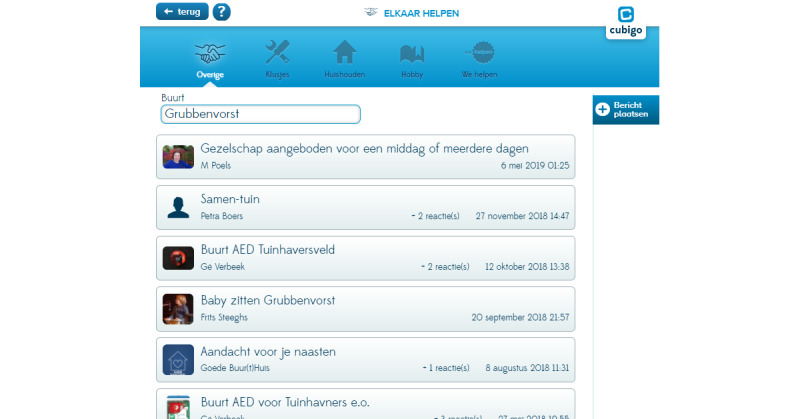
The aim of this study was to investigate the self-reported use, expectations, and perceived impact of a Dutch online community care platform called Grubbenvorst-Online among Dutch older adults. The following 2 questions were studied: (1) What is the self-reported use of Grubbenvorst-Online among older adults? (2) What are their expectations and perceived impact of Grubbenvorst-Online regarding local participation, their social network, mutual informal caregiving, and feelings of connectedness?
An observational pretest-posttest study was conducted. Participants were recruited via a web-based message on the Grubbenvorst-Online platform and data were collected via postal questionnaires among older users at the start of the study and 4 months later. Data regarding the expectations and the perceived impact of Grubbenvorst-Online were compared and tested.
Forty-seven Grubbenvorst-Online users with an average age of 74 years participated in this study. They were healthy, predominantly "internet-skilled," and they found the internet important for maintaining social contacts. In general, the use of the online community care platform decreased during the 4-month follow-up period. The perceived impact of Grubbenvorst-Online was significantly lower than that expected regarding information provision (P=.003), seeking help from fellow villagers (P<.001), giving help to fellow villagers (P<.001), and consulting care or welfare services (P<.001).
The findings of this study indicate that online community care platforms perhaps do not provide enough "added value" in their current form. We suggest a new direction in which online community care platforms primarily support existing offline initiatives aimed at stimulating local participation, informal caregiving, and feelings of connectedness.
在不断变化的老龄化社会中,老年人越来越需要照顾自己,而不是依赖医疗保健服务,在线社区护理平台可以帮助老年人满足这些期望。基于其潜力,一些欧洲国家已经引入了相当数量的在线社区护理平台。然而,它们的实际影响尚不清楚。
本研究旨在调查荷兰老年人对荷兰在线社区护理平台 Grubbenvorst-Online 的自我报告使用情况、期望和感知影响。研究了以下 2 个问题:(1)老年人对 Grubbenvorst-Online 的自我报告使用情况如何?(2)他们对 Grubbenvorst-Online 在本地参与、社交网络、相互非正式护理以及联系感方面的期望和感知影响是什么?
采用观察性预试验-后试验研究。通过 Grubbenvorst-Online 平台上的网络消息招募参与者,并在研究开始时和 4 个月后通过邮寄问卷收集老年人的使用数据。比较并测试了 Grubbenvorst-Online 的期望和感知影响的数据。
47 名平均年龄为 74 岁的 Grubbenvorst-Online 用户参加了这项研究。他们身体健康,主要是“互联网熟练者”,并认为互联网对维持社交联系很重要。一般来说,在 4 个月的随访期间,在线社区护理平台的使用量有所下降。Grubbenvorst-Online 的感知影响明显低于预期,在信息提供(P=.003)、向村民寻求帮助(P<.001)、向村民提供帮助(P<.001)和咨询护理或福利服务(P<.001)方面。
本研究结果表明,在线社区护理平台在当前形式下可能没有提供足够的“附加值”。我们建议一个新的方向,即在线社区护理平台主要支持旨在刺激本地参与、非正式护理和联系感的现有线下举措。