Richter Maike Frederike, Storck Michael, Blitz Rogério, Goltermann Janik, Seipp Juliana, Dannlowski Udo, Baune Bernhard T, Dugas Martin, Opel Nils
Department of Psychiatry, University of Münster, Münster, Germany.
Institute of Medical Informatics, University of Münster, Münster, Germany.
JMIR Ment Health. 2020 Dec 1;7(12):e24066. doi: 10.2196/24066.
Predictive models have revealed promising results for the individual prognosis of treatment response and relapse risk as well as for differential diagnosis in affective disorders. Yet, in order to translate personalized predictive modeling from research contexts to psychiatric clinical routine, standardized collection of information of sufficient detail and temporal resolution in day-to-day clinical care is needed. Digital collection of self-report measures by patients is a time- and cost-efficient approach to gain such data throughout treatment.
The objective of this study was to investigate whether patients with severe affective disorders were willing and able to participate in such efforts, whether the feasibility of such systems might vary depending on individual patient characteristics, and if digitally acquired assessments were of sufficient diagnostic validity.
We implemented a system for longitudinal digital collection of risk and symptom profiles based on repeated self-reports via tablet computers throughout inpatient treatment of affective disorders at the Department of Psychiatry at the University of Münster. Tablet-handling competency and the speed of data entry were assessed. Depression severity was additionally assessed by a clinical interviewer at baseline and before discharge.
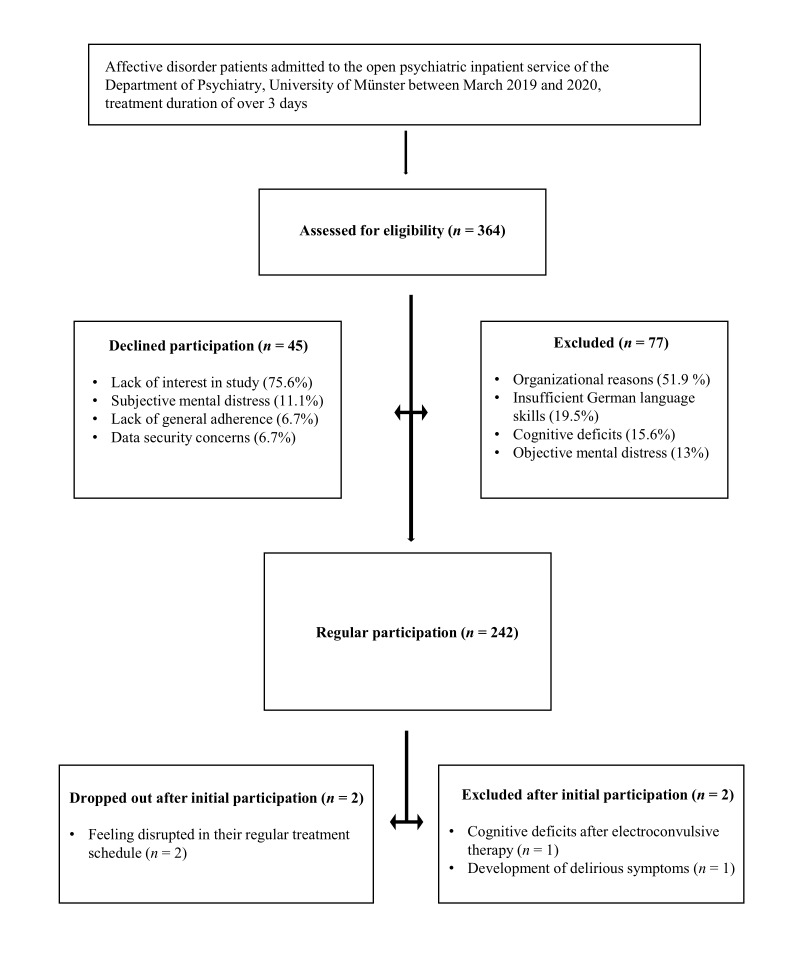
Of 364 affective disorder patients who were approached, 242 (66.5%) participated in the study; 88.8% of participants (215/242) were diagnosed with major depressive disorder, and 27 (11.2%) had bipolar disorder. During the duration of inpatient treatment, 79% of expected assessments were completed, with an average of 4 completed assessments per participant; 4 participants (4/242, 1.6%) dropped out of the study prematurely. During data entry, 89.3% of participants (216/242) did not require additional support. Needing support with tablet handling and slower data entry pace were predicted by older age, whereas depression severity at baseline did not influence these measures. Patient self-reporting of depression severity showed high agreement with standardized external assessments by a clinical interviewer.
Our results indicate that digital collection of self-report measures is a feasible, accessible, and valid method for longitudinal data collection in psychiatric routine, which will eventually facilitate the identification of individual risk and resilience factors for affective disorders and pave the way toward personalized psychiatric care.
预测模型在情感障碍的治疗反应个体预后、复发风险以及鉴别诊断方面已显示出有前景的结果。然而,为了将个性化预测模型从研究背景转化为精神科临床常规应用,在日常临床护理中需要标准化收集足够详细且具有时间分辨率的信息。患者通过数字方式收集自我报告测量数据是一种在整个治疗过程中获取此类数据的省时且经济高效的方法。
本研究的目的是调查重度情感障碍患者是否愿意且能够参与此类工作,此类系统的可行性是否可能因患者个体特征而异,以及数字获取的评估是否具有足够的诊断效度。
我们在明斯特大学精神病学系对情感障碍患者进行住院治疗期间,基于通过平板电脑重复进行的自我报告,实施了一个用于纵向数字收集风险和症状概况的系统。评估了平板电脑操作能力和数据录入速度。此外,在基线和出院前由临床访谈者评估抑郁严重程度。
在接触的364名情感障碍患者中,242名(66.5%)参与了研究;88.8%的参与者(215/242)被诊断为重度抑郁症,27名(11.2%)患有双相情感障碍。在住院治疗期间,完成了79%的预期评估,每位参与者平均完成4次评估;4名参与者(4/242,1.6%)提前退出研究。在数据录入过程中,89.3%的参与者(216/242)不需要额外支持。年龄较大预测了在平板电脑操作方面需要支持以及数据录入速度较慢,而基线时的抑郁严重程度并未影响这些指标。患者对抑郁严重程度的自我报告与临床访谈者的标准化外部评估高度一致。
我们的结果表明,自我报告测量数据的数字收集是精神科常规纵向数据收集的一种可行、可及且有效的方法,这最终将有助于识别情感障碍的个体风险和恢复力因素,并为个性化精神科护理铺平道路。