Zaiser Erica, Sehnert Amy J, Duenas Ashley, Saberi Sara, Brookes Ella, Reaney Matthew
Evidera, London, UK.
MyoKardia, Inc, Brisbane, California, USA.
J Patient Rep Outcomes. 2020 Dec 1;4(1):102. doi: 10.1186/s41687-020-00269-8.
Hypertrophic cardiomyopathy (HCM) is a primary myocardial disorder defined by left ventricular hypertrophy that cannot be explained by another cardiac or systemic disease. There is a general lack of knowledge about patients' perspectives on the symptoms and day-to-day limitations they experience as a result of HCM. We therefore sought an in-depth understanding of patients' experiences of obstructive (oHCM) and nonobstructive (nHCM) forms of the disease, including symptoms and their quality of life impacts, and to develop a conceptual model to capture them.
Development of the HCM conceptual model involved a web-based survey to capture patients' insights, a targeted literature review (which included relevant guidelines and patient advocacy websites), one-to-one interviews with clinical experts, and one-to-one qualitative concept elicitation interviews with patients. Key symptoms and their impacts most important to patients' experiences were identified and used to develop a conceptual model of the patient experience with HCM.
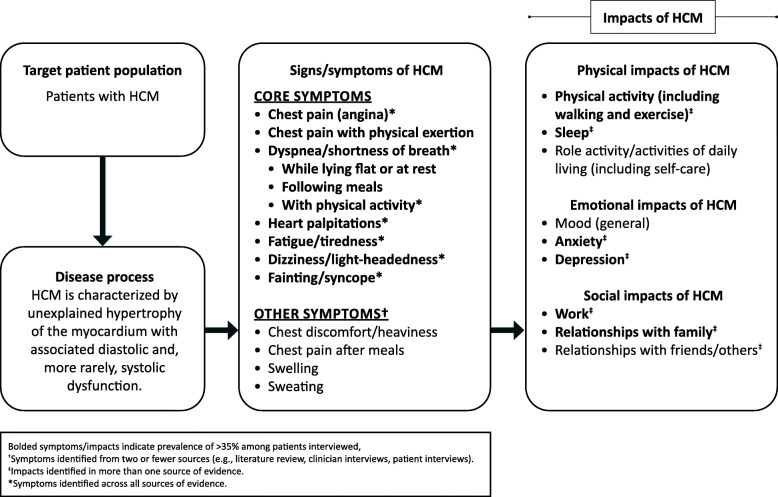
The HCM symptoms reported by patient interviewees (n = 27) were largely consistent with findings from the patient web survey (n = 444), literature review, and interviews with three expert clinicians. The symptoms most commonly reported in patient interviews included tiredness (89%), shortness of breath (89%), shortness of breath with physical activity (89%), and dizziness/light-headedness (89%). Other symptoms commonly reported included chest pain (angina) (70%), chest pain (angina) with physical exertion (70%), and palpitations (fluttering or rapid heartbeat) (81%). The most commonly reported impacts of HCM symptoms on patients' lives included limitations to physical activities (78%), emotional impacts, including feeling anxious or depressed (78%), and impacts on work (63%). Symptoms and impacts were similar for both oHCM and nHCM.
A conceptual model was developed, which identifies the core symptoms that patients with oHCM and nHCM reported as most frequent and most important: shortness of breath, palpitations, fatigue/tiredness, dizziness/light-headedness, and chest pain, as well as the impacts those symptoms have on patients' lives. This HCM conceptual model reflecting patients' experiences and perspectives was used in the development of a patient-reported outcomes instrument for use in clinical trials and it may also help inform the clinical management of HCM.
肥厚型心肌病(HCM)是一种原发性心肌疾病,其定义为左心室肥厚,且无法用其他心脏或全身性疾病来解释。对于肥厚型心肌病患者对其所经历症状及日常活动受限情况的看法,人们普遍了解不足。因此,我们试图深入了解患者对于梗阻性(oHCM)和非梗阻性(nHCM)肥厚型心肌病的体验,包括症状及其对生活质量的影响,并构建一个概念模型来加以描述。
肥厚型心肌病概念模型的构建涉及一项基于网络的调查以获取患者的见解、一次针对性的文献综述(包括相关指南和患者权益倡导网站)、与临床专家的一对一访谈以及与患者的一对一质性概念引出访谈。确定了对患者体验最为重要的关键症状及其影响,并用于构建肥厚型心肌病患者体验的概念模型。
患者访谈对象(n = 27)报告的肥厚型心肌病症状在很大程度上与患者网络调查(n = 444)、文献综述以及对三位专家临床医生的访谈结果一致。患者访谈中最常报告的症状包括疲倦(89%)、呼吸急促(89%)、体力活动时呼吸急促(89%)以及头晕/眩晕(89%)。其他常报告的症状包括胸痛(心绞痛)(70%)、体力活动时胸痛(心绞痛)(70%)以及心悸(心跳扑动或快速跳动)(81%)。肥厚型心肌病症状对患者生活最常报告的影响包括身体活动受限(78%)、情绪影响,包括感到焦虑或抑郁(78%)以及对工作的影响(63%)。梗阻性和非梗阻性肥厚型心肌病的症状及影响相似。
构建了一个概念模型,该模型确定了梗阻性和非梗阻性肥厚型心肌病患者报告为最常见且最重要的核心症状:呼吸急促、心悸、疲劳/疲倦、头晕/眩晕以及胸痛,以及这些症状对患者生活的影响。这个反映患者体验和观点的肥厚型心肌病概念模型被用于开发一种用于临床试验的患者报告结局工具,它也可能有助于为肥厚型心肌病的临床管理提供信息。