From the Section of Biostatistics, Department of Public Health, Faculty of Health Sciences, University of Copenhagen. Copenhagen K, Denmark.
Department of Sexual and Reproductive Health and Research (SRH), World Health Organization, Geneva, Switzerland.
Epidemiology. 2021 Jan;32(1):27-35. doi: 10.1097/EDE.0000000000001296.
Available studies on the prevalence of infertility have proved to have certain limitations, with a scarcity of population-based studies and inconsistent reporting from surveys in countries at all income levels. We wanted to test the applicability of the current duration approach to data from the important Demographic and Health Surveys (DHS) program, funded by USAID since its inception in 1985, https://dhsprogram.com/.
The current duration approach assumes that there is a well-defined time of initiation of attempts to get pregnant and defines the current duration of a still ongoing pregnancy attempt as the time interval from initiation to interview. The DHS interviews do not have an explicit question about initiation. We focused on nullipari and substituted date of "establishment of relationship with current partner" for initiation. Our study used the current duration approach on 15 datasets from DHS during 2002-2016 in eight different countries from sub-Saharan Africa, Asia, and Latin America.
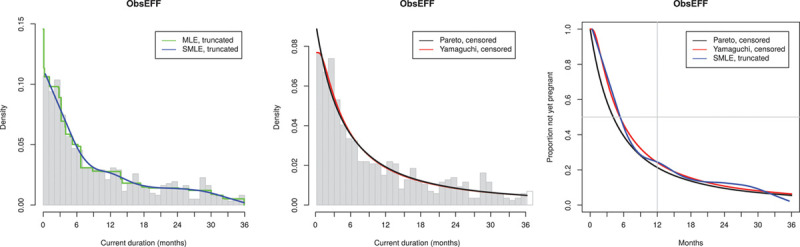
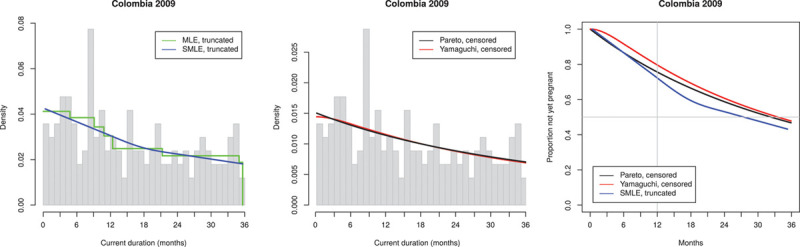
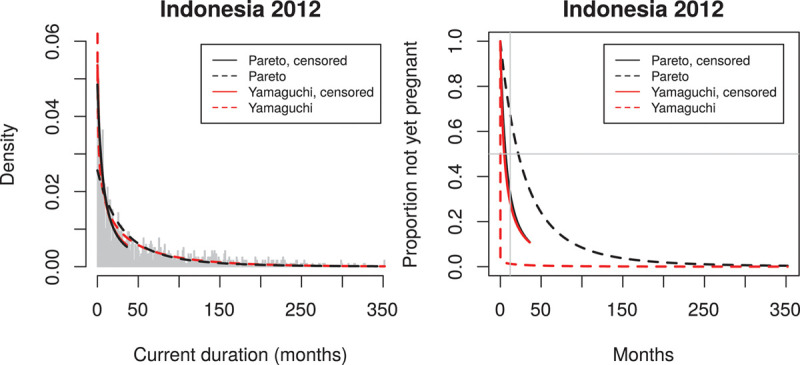
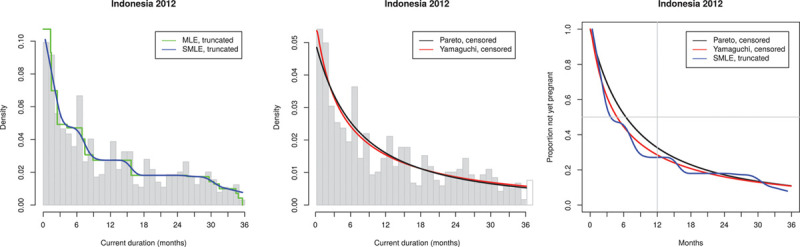
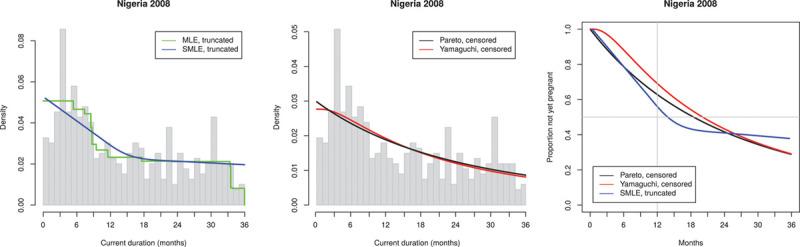
Well-established statistical techniques for current duration data yielded results that for some countries postulated surprisingly long median times to pregnancy and surprisingly high estimates of infertility prevalence. Further study of the data structures revealed serious deviations from expected patterns, in contrast to our earlier experience from surveys in France and the United States where participants were asked explicitly about time of initiation of attempts to become pregnant.
Using cohabitation as a proxy for the initiation of attempts to get pregnant is too crude. Using the current duration approach with DHS data will require more explicit questions during the DHS interviews about initiation of pregnancy attempt.
现有的不孕不育患病率研究证明存在一定的局限性,这些研究大多基于特定人群且调查结果在不同收入水平的国家之间也不一致。我们希望检验当前持续时间方法在由美国国际开发署自 1985 年成立以来资助的重要人口与健康调查(DHS)项目数据中的适用性,https://dhsprogram.com/。
当前持续时间方法假设存在明确的受孕尝试起始时间,并将当前持续妊娠尝试的时间定义为从起始到访谈的时间间隔。DHS 访谈中没有关于起始的明确问题。我们专注于初产妇,并将“与当前伴侣建立关系的日期”代替起始日期。我们的研究在 2002 年至 2016 年期间使用了来自 8 个不同国家的 15 个 DHS 数据集,这些国家分布在撒哈拉以南非洲、亚洲和拉丁美洲。
针对当前持续时间数据的成熟统计技术得出的结果表明,对于某些国家,假定的妊娠中位数时间非常长,不孕不育患病率的估计值也非常高。进一步研究数据结构发现,与我们之前在法国和美国进行的调查经验形成鲜明对比,这些调查明确询问了参与者开始尝试怀孕的时间,这些国家的数据存在严重偏离预期模式的情况。
将同居作为受孕尝试起始的代理过于粗糙。使用 DHS 数据的当前持续时间方法将需要在 DHS 访谈中更明确地询问关于妊娠尝试起始的问题。