Suzuki Shigeki, Goto Taichiro
General Thoracic Surgery, Sagamihara Kyodo Hospital, Kanagawa 252-5188, Japan.
Lung Cancer and Respiratory Disease Center, Yamanashi Central Hospital, Kofu 400-8506, Japan.
J Clin Med. 2020 Nov 29;9(12):3881. doi: 10.3390/jcm9123881.
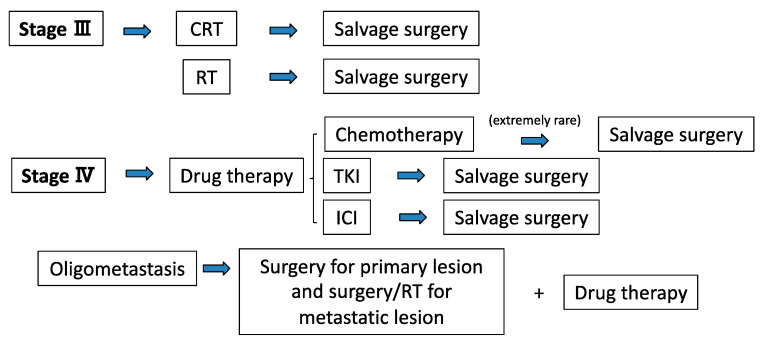
With the development of systemic treatments with high response rates, including tyrosine kinase inhibitors and immune checkpoint inhibitors, some patients with unresectable lung cancer now have a chance to undergo radical resection after primary treatment. Although there is no general consensus regarding the definition of "unresectable" in lung cancer, the term "resectable" refers to technically resectable and indicates that resection can provide a favorable prognosis to some extent. Unresectable lung cancer is typically represented by stage III and IV disease. Stage III lung cancer is a heterogeneous disease, and in some patients with technically resectable non-small cell lung cancer (NSCLC), multimodality treatments, including induction chemoradiotherapy followed by surgery, are the treatments of choice. The representative surgical intervention for unresectable stage III/IV NSCLC is salvage surgery, which refers to surgical treatment for local residual/recurrent lesions after definitive non-surgical treatment. Surgical intervention is also used for an oligometastatic stage IV NSCLC. In this review, we highlight the role of surgical intervention in patients with unresectable NSCLC, for whom an initial complete resection is technically difficult. We further describe the history of and new findings on salvage surgery for unresectable NSCLC and surgery for oligometastatic NSCLC.
随着包括酪氨酸激酶抑制剂和免疫检查点抑制剂在内的高缓解率全身治疗方法的发展,一些无法切除的肺癌患者现在有机会在初始治疗后接受根治性切除。尽管对于肺癌中“无法切除”的定义尚无普遍共识,但“可切除”一词在技术上指可切除,并表明切除在一定程度上可提供良好的预后。无法切除的肺癌通常表现为Ⅲ期和Ⅳ期疾病。Ⅲ期肺癌是一种异质性疾病,对于一些技术上可切除的非小细胞肺癌(NSCLC)患者,多模式治疗,包括诱导放化疗后手术,是首选治疗方法。无法切除的Ⅲ/Ⅳ期NSCLC的代表性手术干预是挽救性手术,指在确定性非手术治疗后对局部残留/复发病变进行的手术治疗。手术干预也用于寡转移的Ⅳ期NSCLC。在本综述中,我们重点介绍了手术干预在初始完全切除技术上困难的无法切除NSCLC患者中的作用。我们进一步描述了无法切除NSCLC的挽救性手术以及寡转移NSCLC手术的历史和新发现。